
In recent months, artificial intelligence has evolved from a hype topic to a concrete expectation. Many companies are no longer asking whether they should use AI, but where and how. Especially in CRM, the potential is obvious: less manual work, better data, and faster processes.
In practice, however, the picture looks different. Many companies want to use AI but are not structurally prepared for it. The real bottleneck is rarely the technology – but almost always the CRM itself.
Why AI in CRM is becoming a topic right now
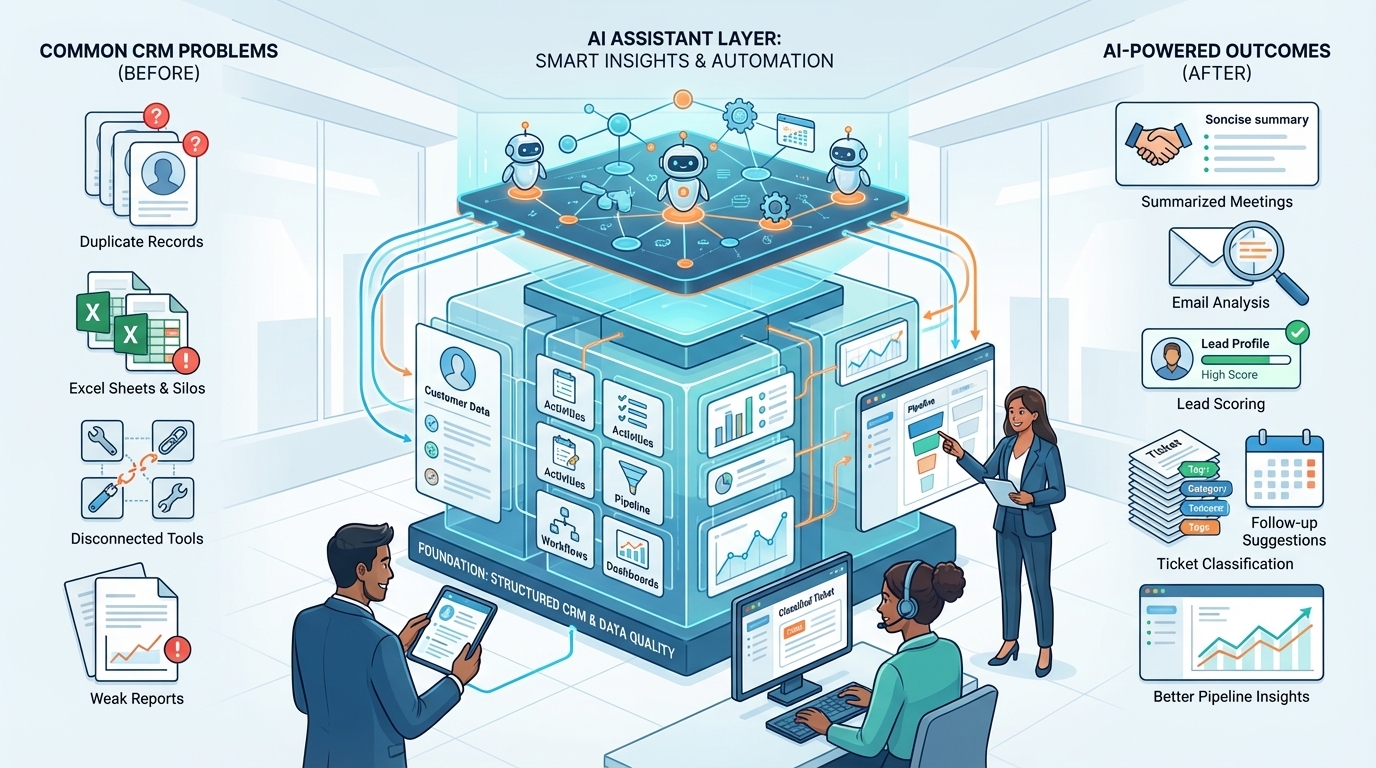
The real bottleneck: CRM structure and data quality
| No. | Problem | Description |
|---|---|---|
| 1 | Duplicates | Multiple records per customer distort analyses |
| 2 | Incomplete data | Important fields are missing or empty |
| 3 | Unclear processes | Everyone works differently in the CRM |
| 4 | Missing activities | History is not traceable |
| 5 | Unclear responsibilities | Nobody feels responsible |
| 6 | Excel parallel worlds | Data is maintained outside the CRM |
| 7 | Unclear pipeline | Opportunity phases are used inconsistently |
| 8 | Missing integration | Systems are not connected |
| 9 | Weak reports | Dashboards do not deliver reliable insights |
| 10 | Low usage | Employees work around the CRM |
Statistics: Where companies stand today
| Topic | Share of companies | Problem |
|---|---|---|
| Insufficient data quality | 60–70 % | Lacking structure |
| CRM is not fully used | 50–60 % | Low adoption |
| AI projects without a clear use case | 40–50 % | Lacking strategy |
What AI can really deliver in CRM
Many discussions about AI are very abstract. In practice, however, it is about concrete improvements in daily operations. Especially in CRM, these are often not major transformations but many small automations.
These use cases are so relevant because they are directly measurable and can be implemented quickly. In flexible CRM platforms (Salesforce, SpiceCRM, Sugar …), many of them can be mapped through workflows, integrations, and structured data models. It is important that each function is linked to a clear process. Only then does real added value emerge in daily operations.
| No. | Use Case | Description |
|---|---|---|
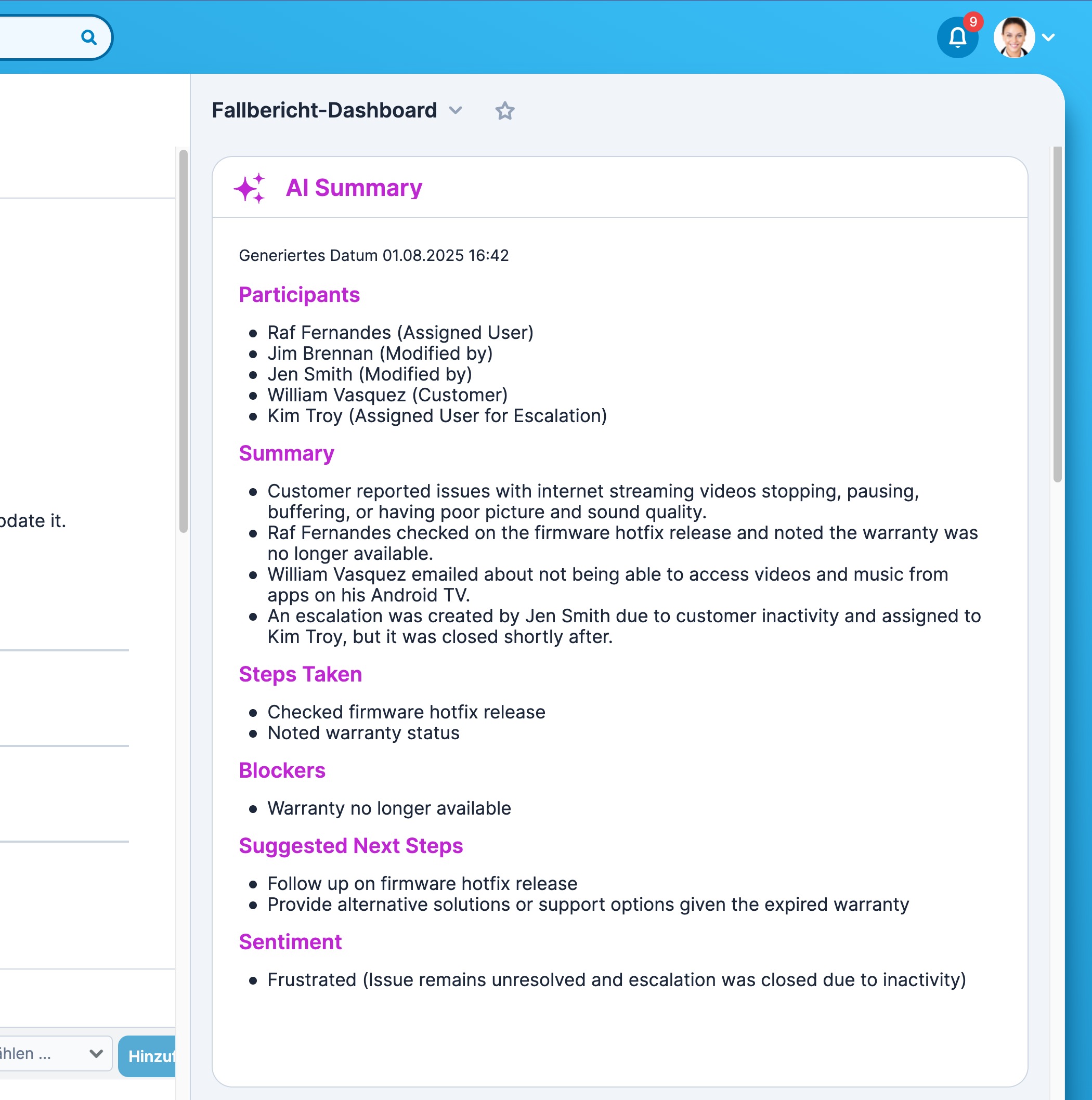
| 1 | Conversation summary | Automatic documentation of meetings |
| 2 | Email analysis | Summarization of email threads |
| 3 | Lead qualification | Automatic evaluation of leads |
| 4 | Follow-up suggestions | Automatically generate next steps |
| 5 | Ticket classification | Structure support requests |
| 6 | Data enrichment | Supplement company data |
| 7 | Document analysis | Extract information from PDFs |
| 8 | Activity detection | Automatically capture interactions |
| 9 | Pipeline analysis | Identify risks early |
| 10 | Knowledge search | Quick access to information |
Practical example from a CRM project
A mid-sized B2B sales company wanted to use AI in CRM to reduce sales effort. Starting situation: A CRM tool was in use but was being used inconsistently. Data was partially maintained but not consistent. Reports were additionally created in Excel.
Instead of introducing AI directly, the project was divided into phases. First, data structure, mandatory fields, and pipeline were standardized. Then simple workflows for activities and follow-ups were implemented. Only in the third step was AI deployed for conversation summaries.
The result was measurable:
- 30% less time spent on documentation
- significantly better data quality
- higher close rate through structured pipeline
Checklist: Is your CRM ready for AI?
- Data is complete and up to date
- Duplicates are cleaned up
- Processes are defined
- Pipeline is standardized
- Reports are reliable
- Users work within the system
- Integrations are in place
- Responsibilities are clear
- Use cases are defined
- Pilot project is planned
Conclusion
This article is the introduction to our series on the use of artificial intelligence in CRM.
We deliberately look not only at the possibilities, but above all at the prerequisites that determine success or frustration in practice.
In the next article, we will show why many AI projects in CRM do not fail due to technology – but due to lacking data quality and unclear processes.
Note on the article series
AI in CRM is not a sure-fire success. It only works when data, processes, and systems are properly set up.
Companies that rethink now have a clear advantage. Not because they deploy the best technology – but because they improve their CRM structure.
👉 Our tip: Don’t start with AI – start with a thorough review of your existing CRM system.