The CRM landscape is experiencing its biggest transformation since the introduction of the cloud. While established vendors continue to inflate their pricing models and feature sets, there is a counter-movement challenging the “Software as a Service” (SaaS) business model: Vibe Coding.
The premise: Until now, companies had the choice between renting tools from the “big blue SaaS giants” with overloaded platforms, or using a variety of lean tools from small SaaS providers where they had to adapt to the software’s workflow. Vibe Coding is a game changer in this equation.
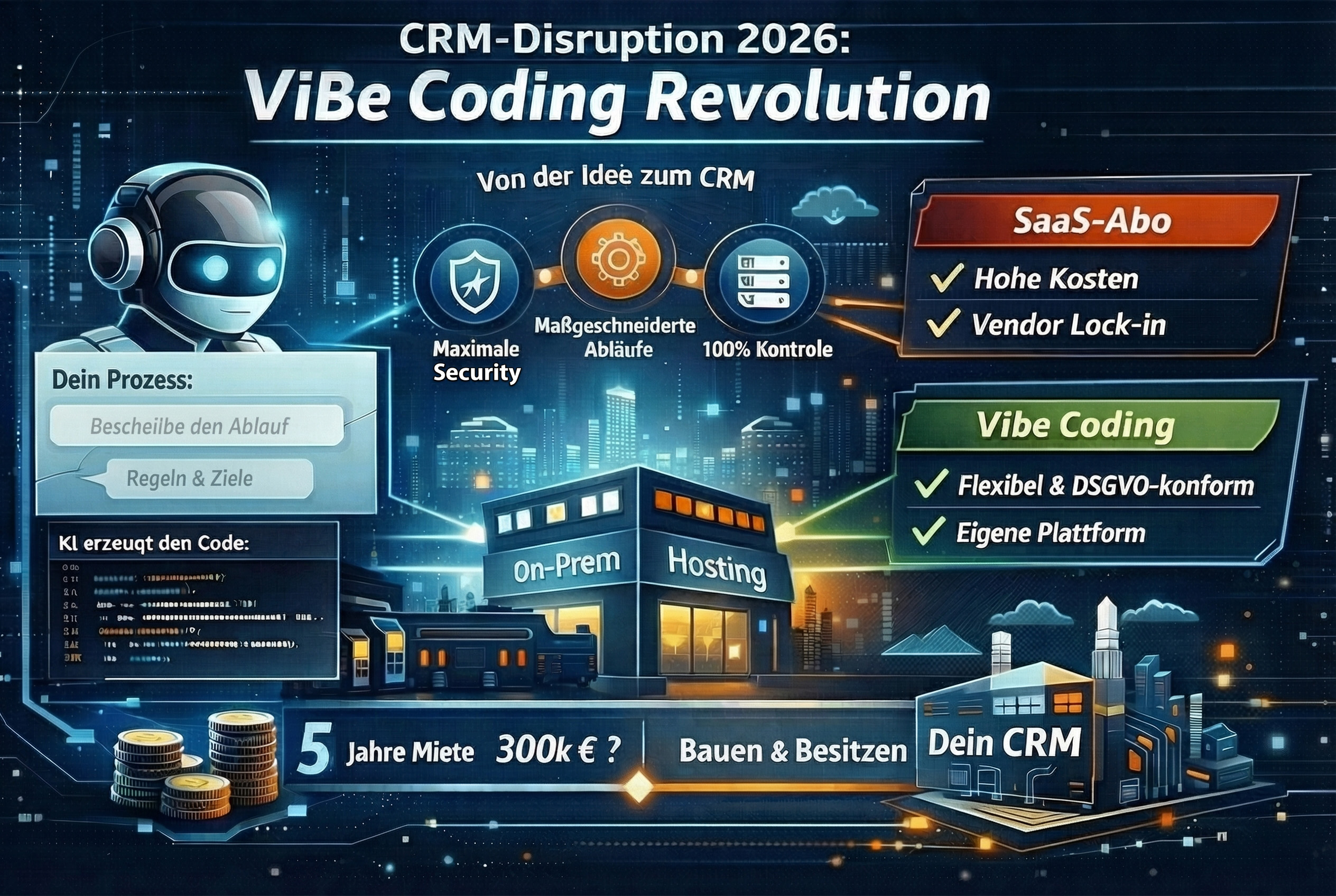
What is Vibe Coding?
The target audiences of the revolution: sovereignty & vertical focus
Looking ahead: Organizations with highly specific processes and extreme security requirements in particular will cancel their CRM subscriptions.
- Government agencies, public administration & military: The US Cloud Act represents a legal and strategic minefield here. Vibe Coding enables the construction of highly specialized systems (such as citizen services or supply chains) that are fully GDPR-compliant and operated on government servers.
- Specialized industries with high vertical alignment: Whether manufacturing companies or IT service providers – companies with processes that are not “standard” often see only 20% of their reality reflected in traditional CRMs. With Vibe Coding, organizations use AI to build the software around the process – not the other way around.
Open source software and Vibe Coding
A common objection is that open-source solutions already exist. The dilemma: These systems are fundamentally “process-neutral” just like other CRM tools. They are powerful platforms that initially also require significant effort and cost to adapt to a vertical reality.
The potential solution: Vibe Coding can use stable open-source libraries as a foundation to immediately tailor the system to the company’s specific vertical “vibe.” Incidentally, activity in many open-source projects is increasing significantly again thanks to Vibe Coding, presumably simply because contributions can now come from many more people than just developers.
Digital sovereignty: Hosting at a location of your choice
A major advantage is that code and infrastructure are decoupled from each other. While development costs are significantly reduced by AI, hosting fees remain – but you have control over them.
- Geopatriation: Bring your data back. By hosting your data with professional service providers in Germany, Canada, or Australia, you can escape access under the US Cloud Act.
- No vendor lock-in: The intelligence (the code) is your property. Does your host raise prices? Then simply move your CRM.
Security & audit: AI code in government and military
In areas with the highest security requirements, the integrity of the code is particularly important. In any case, appropriate security measures are naturally required, just as with traditional software development.
- Code audits through automation: Code created by AI is checked for vulnerabilities in real time using tools like Snyk or GitHub Advanced Security.
- Human-in-the-loop: Senior developers take over validation of the architecture and critical logic paths, instead of writing every line themselves.
- Sandboxing: The CRM is hosted in isolated containers (Docker/Kubernetes), minimizing risk to the rest of the infrastructure.
The 5-year calculation: Ownership vs. rental
- SaaS model: 50 users at €100/month = €300,000 over 5 years.
- Vibe Coding: One-time investment in AI-supported architecture, consumed tokens, labor time, and hosting costs.
Even when factoring in expenses, the result is a digital asset owned by the company, instead of leaving behind a “5-year rental debt.”
Checklist: Is Vibe Coding ready for internal use?
The caveats: What you need to watch out for
Despite all the enthusiasm, there are critical points that require strategic planning:
- Process clarity: Are our sales workflows documented precisely enough for an AI to translate them?
- Data location: Have we chosen a certified host outside US legal jurisdiction?
- Interfaces: Which third-party systems (ERP, accounting) need to be connected?
- Security audit: Is a process for automated code reviews established?
- Open source foundation: Are we using proven libraries as the basis for our custom code?
- In areas with high security, the integrity of the code is particularly important. The capabilities AI offers can naturally also be used in reverse, for example to simulate or defend against attacks by developing the corresponding tools with AI. In any case, this includes
- Open source foundation: Are we using proven libraries as the basis for our custom code?
- Maintenance & updates: A SaaS provider delivers updates automatically. With custom-built solutions, AI agents must be trained to keep APIs and security patches up to date.
- Hosting management: Coding costs drop dramatically, but hosting costs (managed cloud, GPU instances for AI features) remain and must be actively managed.
- Documentation: Without a clean “prompt history,” no one will know in two years why the AI built the process the way it did.
Conclusion: More freedom
It seems we are witnessing that the possibilities for software to follow the process are becoming many times easier and cheaper to implement.
Furthermore, for organizations that want digital sovereignty, Vibe Coding can no longer be a technical gimmick; it is becoming a strategic necessity for accelerating processes. Exactly how things will unfold, we do not know for sure. Those who start learning today can gain the necessary experience to make the right decisions.