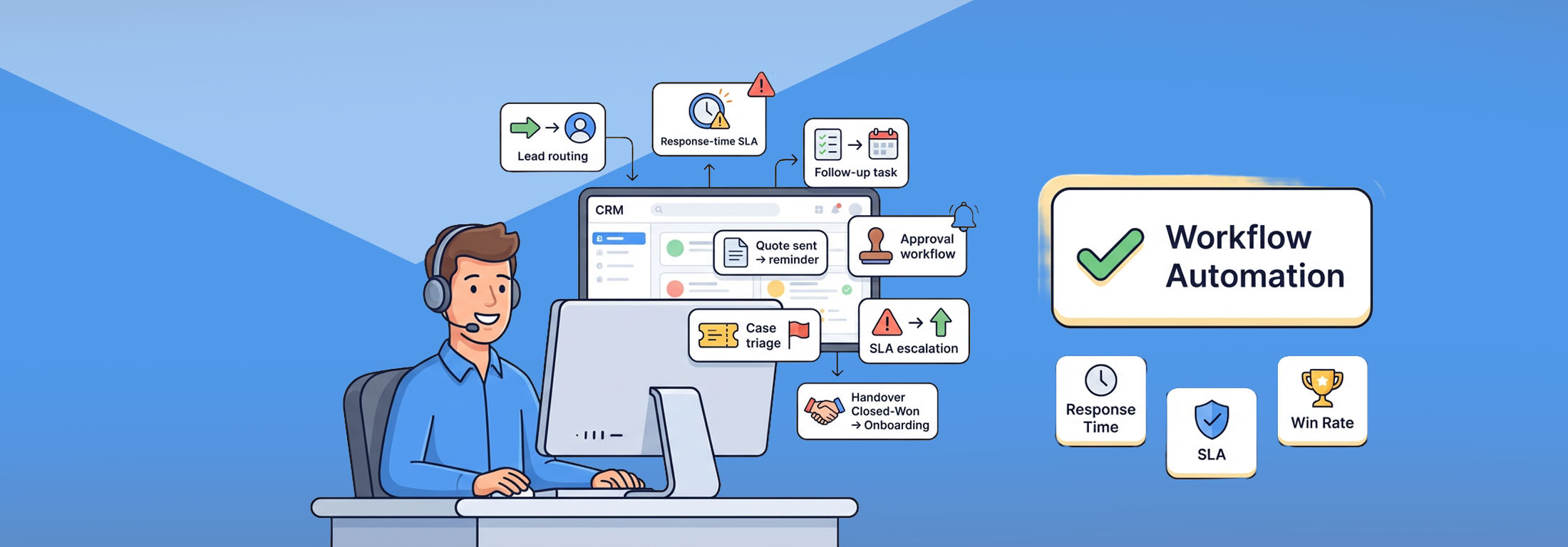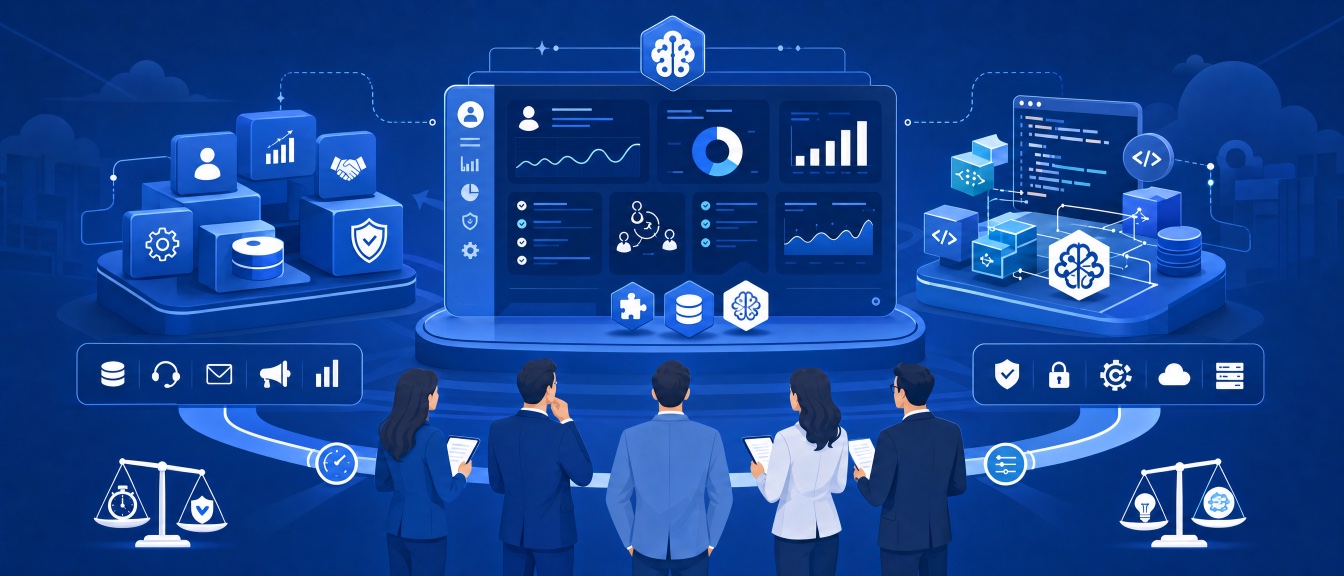
When the CEO of Klarna declared just over a year ago that artificial intelligence would enable his company to operate with significantly fewer employees, this statement was widely discussed. Many considered it exaggerated or a future scenario still years away. Today, it seems more like a sober description of reality.
Because by now it is not consultants or analysts, but the developers themselves who say: with AI they work many times more productively. Factors of ten or more are not a vision, but operational reality. When productivity changes at this scale, it is no longer optimization – it is a structural shift.
For executive management, this means an uncomfortable truth:
This development will not remain limited to IT or software. It changes the foundations of value creation – especially in sales and customer relationships.

CRM is no longer an IT question, but a leadership question
For many years, CRM was a classic cross-cutting topic: important, but delegable.
A system for documentation, transparency, and supporting sales and service. This view falls short today.
With AI, CRM is evolving from a data repository into a decision-making platform. Not because it suddenly looks “intelligent,” but because it begins to prepare decisions, make priorities visible, and actively steer processes.
For executive management, this is crucial: CRM is becoming the nervous system of sales and customer management. And nervous systems do not belong at the second level of leadership.
Sales: From personal excellence to organizational excellence
Many companies owe their success to individual strong salespeople. This is an advantage – and at the same time a risk. Because personal excellence is not scalable.
AI changes this pattern. It makes good sales work reproducible without standardizing it. It ensures that priorities become clearer, risks become visible earlier, and conversations are better prepared.
For executive management, this means:
- reduced dependency on individuals
- more stable results
- greater predictability
Customer relationships as a strategic differentiator
The perspective is also shifting in customer management. Customers today no longer expect just reaction, but orientation. They want to be understood before they have to escalate problems.
AI enables exactly that. It recognizes patterns, tensions, and risks long before they become visible. It makes proactive communication possible – not as a marketing measure, but as an expression of competence.
For executive management and investors, this is central: Stable customer relationships are not a “soft” topic. They are a significant value driver.
AI agents: Operational intelligence under strategic control
At the core of this development are AI agents – not as a gimmick, but as a new operational layer. They take on clearly defined tasks: analysis, prioritization, preparation, and in some cases execution.
The crucial point: Control remains with humans. Goals, rules, escalations, and boundaries are defined by leadership. AI works within this framework – consistently and without fatigue.
For executive management, this is not a loss of control, but the opposite:
Decisions become more traceable, more consistent, and possible earlier.
Architecture determines impact
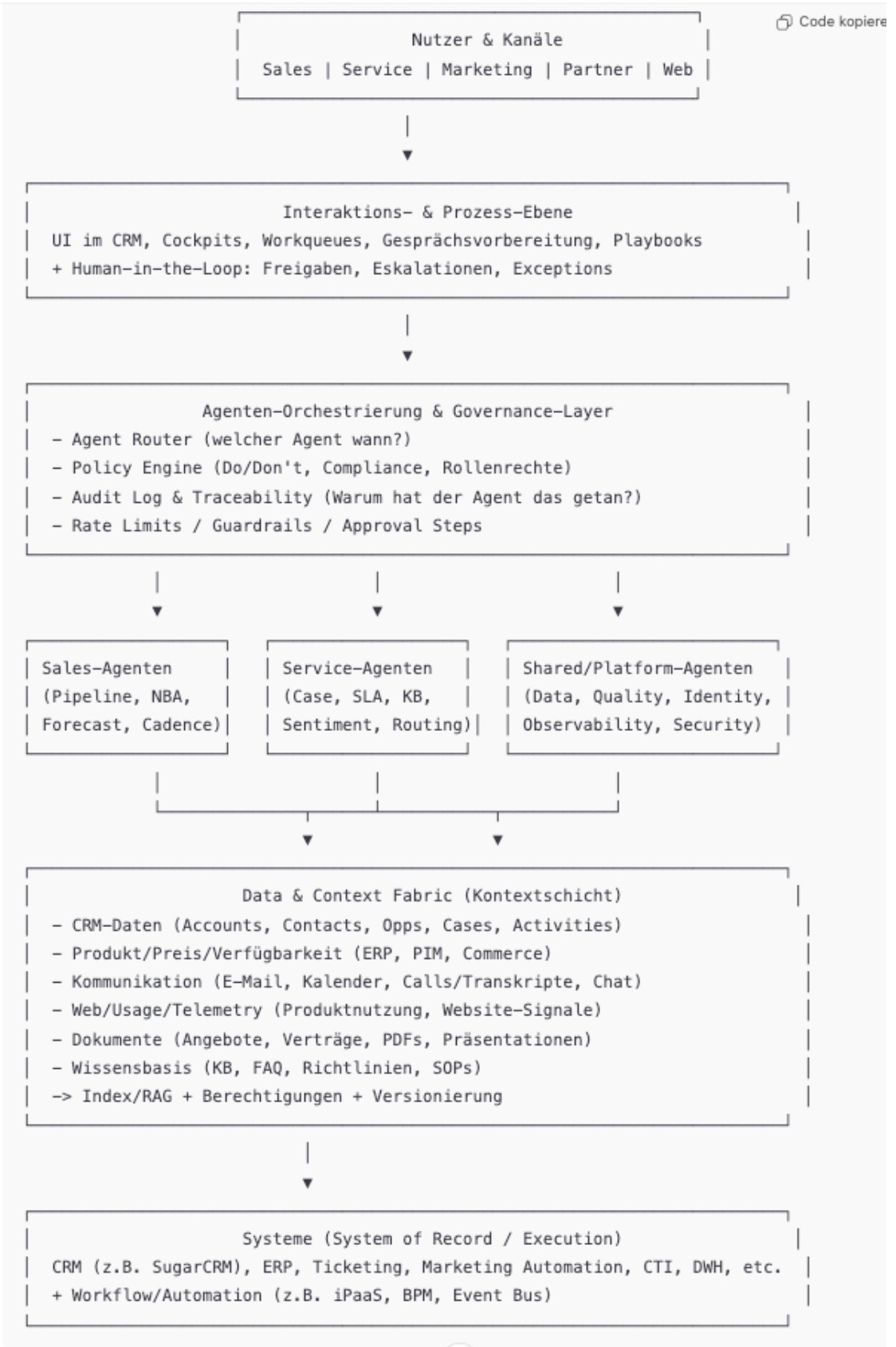
Whether AI creates real added value in CRM is not a tool question, but an architecture question.
CRM remains the stable backbone. AI is layered on top – as an intelligence layer, not as a replacement.
Companies that design this separation cleanly gain speed and scalability. Companies that try to “fit AI in somewhere” remain stuck in experimentation.
These architecture decisions are strategic. They determine how adaptable the company will be in the years to come.
What this means for employees and investors
- less operational burden
- clearer priorities
- better work quality
- more impact instead of more activity
- scaling without linear headcount growth
- reduced key person risks
- more stable forecasts
- greater business resilience
AI is therefore not a cost issue, but a value creation issue.
The real decision: Now or later – and what that really means
The greatest danger in dealing with AI is not the technology. It is the hesitation.
“We’re still observing” or “we’ll start in a few months” sounds reasonable, but is often a deferred decision. And those who defer do not learn.
AI is not a traditional project that can be fully planned. Its value comes from usage, iteration, and experience. Those who wait lose not only time – but insight.
Therefore, the decisive question for executive management is not whether AI will be introduced.
But whether you sit down tomorrow and begin – or have to explain in two years why others were faster, more focused, and closer to the customer.
Do not start with a major project, but with a clear use case, a team, and the willingness to learn from it.
The technology is here.