A new CRM system can be set up technically excellently and still have hardly any effect. This often happens when employees experience the system primarily as a control instrument. More mandatory fields, additional reminders, and regular admonitions do increase activity in the short term, but do not yet create sustainable usage.
Another possibility is to make progress visible, create shared goals, and immediately recognize good collaboration. This is exactly where gamification comes in. It is not about turning sales into a computer game or keeping employees busy with colorful badges. It is about sensibly transferring proven motivation mechanisms to everyday CRM work.
Used correctly, gamification can contribute to sales and customer success maintaining the CRM not only because they have to. Rather, employees recognize what contribution they themselves make, where the team stands, and how they can support colleagues.
However, gamification is not automatically engaging. Constant notifications about which task is still open, which score could be improved, or what the team should achieve next can quickly become disruptive. Especially with simple and self-evident activities, the impression otherwise arises that the system comments on every action and artificially turns normal work into a game.
Voluntary support must therefore not become a new mandatory event. An approach along the lines of “from now on everyone must use gamification” would create exactly the pressure that is actually meant to be avoided. Employees should experience functions such as progress displays, shared goals, or recognitions as helpful and not as an additional layer of control.
The company culture and the type of processes also play an important role. In companies with clear, simple, and highly standardized workflows, additional points, hints, and team challenges can seem unnecessary or even silly. There, a well-built dashboard with a few relevant metrics may be entirely sufficient.
It is different in organizations that live strongly on building knowledge, passing on experience, and collaboration between different teams. When sales, customer success, service, and consulting must exchange information regularly, social mechanisms can offer real added value. Recognition for good documentation, shared learning goals, or visible contributions to a successful customer handover then support not only CRM usage, but also collaboration.
Gamification must therefore fit the company, the process, and the employees. It should be used specifically where it improves orientation, motivation, or collaboration. Where it merely produces additional notifications and artificial competitions, less is often more.
Why more pressure rarely improves CRM usage permanently
When a CRM is not used sufficiently, companies often react with control. Reports about missing entries are sent to managers. Further mandatory fields are added. Employees are reminded in meetings to update their opportunities, activities, and customer data.
This can be necessary in individual cases, but often does not solve the actual problem. Employees initially experience additional data maintenance as administrative effort. The benefit, by contrast, often arises only later or at another point in the company.
Sales, for example, documents the expectations of a new customer so that customer success can work with the right information a few weeks later. The effort arises in sales. The immediate benefit initially arises for another team.
Between effort and benefit, a temporal and organizational gap thus arises. Exactly this gap a good CRM concept must close.
The decisive question is therefore not:
How do we force the employees to maintain the CRM?
But rather:
How do we make progress, benefit, and collaboration so visible that CRM usage is perceived as a meaningful part of the work?
What CRM systems can learn from Duolingo
Duolingo vividly shows how small feedback and social mechanisms can influence behavior. Users do not only see which lessons they have completed. They receive progress displays, streaks, milestones, and immediate feedback.
Particularly interesting are the social functions. Users can build shared streaks, cheer each other on, and complete tasks together. In so-called friend quests, they can send short messages and even transfer a virtual bonus to a fellow player. In this way, Duolingo connects personal progress with mutual responsibility and support.
The decisive point is not the collecting of virtual points. What is decisive is that one’s own progress becomes visible at all times. At the same time, a social commitment arises without a supervisor having to constantly monitor.
For a CRM, this means: employees should not only see which data is still missing. They should also recognize what they have already achieved, how their work helps others, and on which shared goals the team is working.
A complete opportunity record is then no longer merely a fulfilled documentation obligation. It is a visible contribution to a better forecast, a faster decision, or a smoother customer handover.
Statistics: What social motivation and recognition can achieve
Gamification is no guarantee of better CRM usage. The following figures also do not come from classic CRM projects and therefore cannot be transferred one to one. But they show that visible progress, social commitment, and recognition can measurably influence behavior.
Duolingo reports that users with at least one shared streak complete their daily lesson with a 22 percent higher probability. At the time of the published evaluation, 57 percent of users had at least one contact within the application. Users who followed friends completed their course, according to Duolingo, 5.6 times more often, whereby this last figure represents a correlation and not a certain proof of causality.
A randomized field experiment with 4,007 new Wikipedia authors additionally examined the effect of purely symbolic recognition. The recognized participants were 20 percent more likely to remain active in the following month. The share of authors who continued to work directly on articles rose by 13 percent.
| Study or mechanic | Result | Interpretation for CRM projects |
|---|---|---|
| Duolingo friend streak | 22% higher probability of completing the daily lesson | Shared routines can be more effective than individual reminders. |
| Social contacts on Duolingo | 5.6 times higher probability of completing a language course | Social integration can support long-term usage. The figure describes a correlation. |
| Spread of social functions | 57% of users had at least one contact in the application | Gamification becomes more relevant when it is embedded in existing relationships. |
| Wikipedia field experiment | 20% higher activity in the following month and 13% more direct article work | Even symbolic recognition can have a measurable and lasting effect. |
For CRM projects, the direction is especially interesting. Employees do not necessarily have to be rewarded materially. Often, immediate feedback, recognition, and the feeling of pursuing a relevant goal together are effective.
Gamification is more than a leaderboard
Many companies first think of points, badges, and leaderboards when it comes to gamification. This is exactly where one of the greatest dangers lies.
A public leaderboard of the highest revenues usually motivates those who are already at the top. Other employees, by contrast, quickly lose interest or consider the comparison unfair due to different territories, customer structures, and starting situations.
Gamification should therefore not primarily create competition. It should promote orientation, progress, and collaboration.
| Principle | Meaning in the CRM |
|---|---|
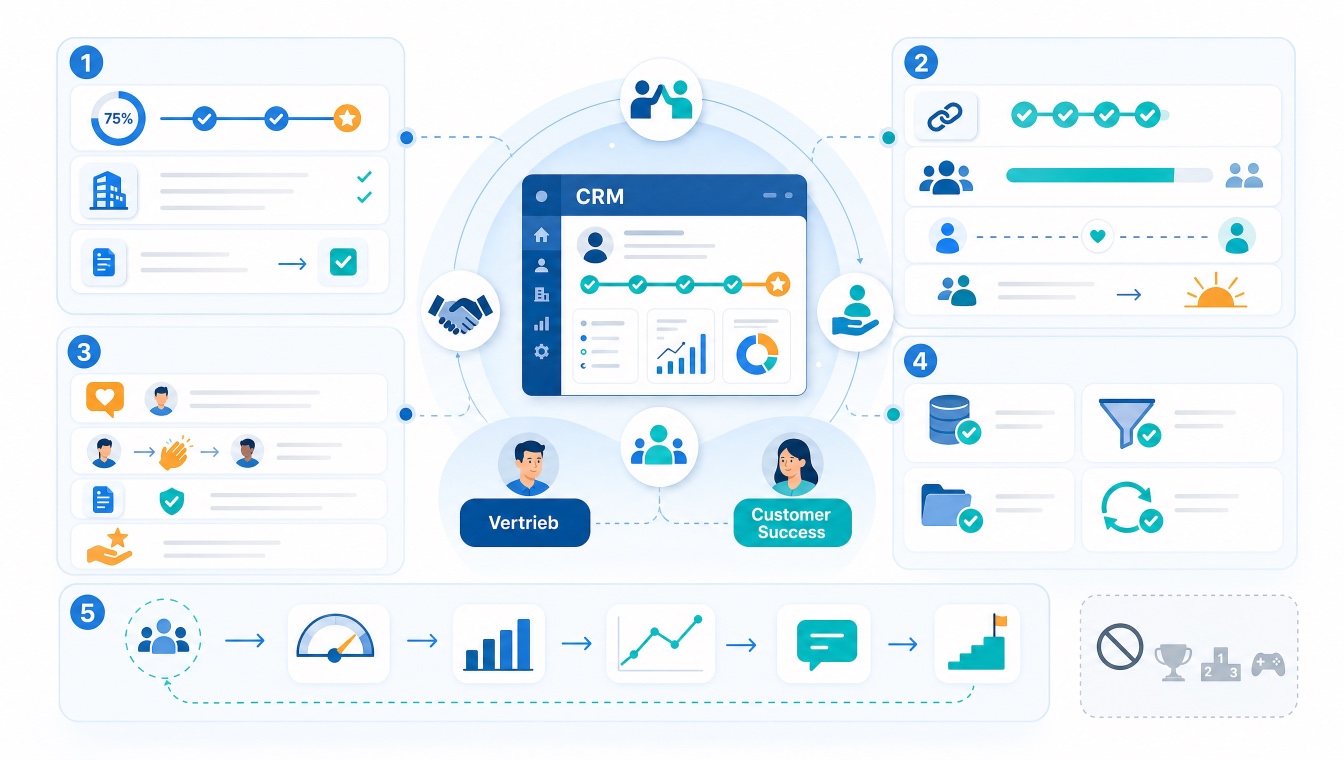
| Visible progress | Employees recognize how complete their opportunities, customer handovers, or account plans are. |
| Immediate feedback | Good data maintenance or a reached milestone is confirmed directly and not only mentioned in the monthly report. |
| Shared goals | Sales and customer success work together on complete and punctual customer handovers. |
| Mutual recognition | Colleagues can visibly acknowledge helpful support, good documentation, or a particularly clean handover. |
| Self-determination | Employees understand the rules and can trace how evaluations and progress displays come about. |
| Comparability | Goals take into account different roles, territories, customer groups, and starting conditions. |
A meaningful CRM gamification answers not only the question of who has done the most. It shows whether a team has improved a process together.
Ten simple gamification ideas for sales and customer success
For a first approach, no elaborate game platform is necessary. Many functions can already be implemented with existing CRM reports, dashboards, workflows, notifications, and calculated fields.
It is important to select only one or two behaviors at first. The mechanic should then be tested in a small team. At the beginning, it must also be clarified which metric is to be improved. Only when the approach is perceived as helpful by the employees should it be rolled out to further areas.
The following suggestions range from simple progress displays to cross-team tasks. They can, in principle, be mapped in SugarCRM, Salesforce, SpiceCRM, and comparable CRM platforms with standard functions or manageable extensions.
| No. | Suggestion | Description | Simple implementation in the CRM | Suitable metric |
|---|---|---|---|---|
| 1 | Opportunity progress display | A visual display shows whether all information relevant to the current sales phase is present. | Calculated field, traffic light, or percentage value in the record | Share of fully qualified opportunities |
| 2 | Personal improvement history | Employees compare themselves not with colleagues, but with their own status from the previous weeks. | Personal dashboard with time comparison | Improvement of one’s own data quality |
| 3 | Shared handover streak | Sales and customer success together build a streak of complete and timely customer handovers. | Workflow checks defined handover criteria and counts successful handovers | Share of complete handovers |
| 4 | Team quest for pipeline cleanup | The team receives a shared weekly goal, for example to review 50 outdated opportunities. | Filtered report, progress counter, and completion notification | Number of cleaned records |
| 5 | Digital thank-you | Employees can thank colleagues for support, good documentation, or quick responses. | Activity, feed entry, or recognition field | Number and distribution of recognitions |
| 6 | Colleague boost | An employee can visibly offer or request support for a complex account. | Internal task, status field, or team feed | Processing time of shared tasks |
| 7 | Customer rescue mission | Sales, service, and customer success work together on at-risk customer relationships. | Health score, risk list, and shared action planning | Number of stabilized customer relationships |
| 8 | Milestone feed | Successes such as a completed onboarding, a contract renewal, or positive customer feedback are made visible. | Automated feed entry or notification | Reached customer milestones |
| 9 | Learning and knowledge badges | Employees receive recognition for completed training or documented knowledge. | Link with learning content or knowledge base | Use and creation of knowledge articles |
| 10 | Shared customer success goal | The team pursues a shared value, such as the timely handling of all critical customer actions. | Team dashboard with target value and progress display | Overdue actions and response times |
Reward quality instead of as many activities as possible
What is measured in the CRM is usually also optimized. If only the number of phone calls is evaluated, the number of documented calls may increase. Whether this results in better customer conversations, qualified opportunities, or successful closes remains open.
This is exactly where poorly designed gamification models can set false incentives. A critical study of gamification in enterprise software concluded that many solutions mainly reward quantitative activities, while the quality of the work is neglected.
Employees may then begin to optimize the point system instead of improving the customer process. Ten trivial activities become more attractive than a well-prepared customer conversation. A quickly closed task counts more than a sustainable problem solution.
A good CRM gamification therefore connects an activity with a traceable result.
| Less meaningful | More meaningful |
|---|---|
| Number of created leads | Share of qualified leads with a documented next step |
| Number of documented calls | Customer conversations with an outcome and an agreed follow-up activity |
| Number of changed opportunities | Updated opportunities with a realistic close probability |
| Number of customer handovers | Complete handovers without avoidable follow-up questions |
| Number of closed tickets | Sustainably resolved issues without reopening |
| Personal revenue comparison | Improvement over one’s own baseline and contribution to the team goal |
The better metric is often not the absolute quantity. More interesting is whether the quality, speed, or reliability of a process has improved.
Connect sales and customer success through shared goals
In many companies, gamification ends at contract closing. Sales is rewarded for won deals. Afterward, customer success begins the actual implementation – often on the basis of incomplete information.
This sets exactly the wrong signal. The individual close counts more than the quality of the subsequent customer relationship.
A better approach is a shared goal for sales and customer success. A handover, for example, is only considered successful when all agreed information is present, the first customer success conversation has taken place, and the customer knows the next step.
Sales thereby receives recognition for good preparation. Customer success benefits from fewer follow-up questions and faster ability to act. At the same time, a shared success arises instead of optimizing two separate departmental metrics.
This can be mapped relatively easily in the CRM. A handover dashboard shows the current status, missing information, and the previous streak of successful handovers. When a milestone is reached, both parties involved receive feedback.
For missing information, no public negative rating appears. Instead, the system shows concretely what still needs to be added. The gamification thus supports collaboration instead of creating an additional control mechanism.
Gamification must not become mandated cheerfulness
Gamification can also achieve the opposite. An elaborately designed sales game does not automatically improve overall performance. This is especially true when employees do not accept the game or perceive the rules as unfair.
Positive effects tend to arise with participants who understand the mechanics and perceive them as meaningful. If, on the other hand, the game is experienced as imposed, childish, or implausible, it can even worsen motivation. That is exactly why a gamification function must not simply be mandated from above.
The employees should be involved as early as the selection of goals and mechanisms. Particularly critical are public loser lists, non-comparable revenue targets, and point systems whose calculation no one understands. Equally problematic is a mechanic that creates additional manual effort.
The frequency of feedback must also fit the task. A notification at an important shared milestone can be sensible. A notification after every small data change, by contrast, is quickly ignored or perceived as disruptive.
The most important test is therefore:
Does the mechanic help the employees with their work – or does it merely help management with control?
Native CRM functions or an additional gamification app?
Besides the functional design, the question of implementation effort quickly arises. On the market, there are ready-made gamification solutions that already offer points, badges, competitions, leaderboards, and rewards as a standardized application.
Such products can be sensible when a company needs very extensive game mechanics or wants to operate gamification across multiple systems. The supposedly fast rollout, however, brings an additional technology component into the system landscape.
Besides the actual license costs, further efforts often arise. The application must be connected to the CRM. User data, roles, events, points, and results must be transferred between the systems. In addition, data protection, permissions, maintenance, interface monitoring, and the behavior during CRM updates must be taken into account.
A ready-made gamification app is therefore not automatically the simplest or most economical solution.
| Question | Native CRM implementation | Additional gamification app |
|---|---|---|
| License costs | Often covered by the existing platform license | Additional ongoing app costs |
| Integration | Data remains in the CRM | Interface and data synchronization required |
| Customization | Configurable closely to your own process | Depends on the vendor’s functional model |
| Rollout | Suitable for step-by-step piloting | Often a separate rollout project |
| Operations | Existing roles, permissions, and administration usable | Additional user, permission, and operating logic |
| Feature scope | Often sufficient for simple and medium use cases | Advantageous for complex game and reward worlds |
For many companies, an additional application is initially not necessary. Modern CRM platforms already have a large part of the required functions. These include reports, dashboards, formula fields, scoring models, workflows, notifications, role and permission concepts, as well as internal activities or feeds.
With SugarCRM, Salesforce, SpiceCRM, and comparable platforms, many basic gamification approaches can be mapped directly in the CRM.
An opportunity score, for example, can be calculated automatically from data quality, sales phase, next step, and recency. A shared handover goal can be represented via defined information, status fields, and a team dashboard. Personal progress displays, milestones, or automatic recognitions are also often possible without an additional application.
The advantage lies not only in the lower license costs. The data remains in the leading CRM system. Existing roles and permissions can continue to be used. Moreover, no further interface arises that has to be permanently operated and monitored.
However, the native implementation does not work entirely without effort either. Goals, rules, evaluations, and success criteria must be defined functionally. Afterward, fields, calculations, reports, and workflows are set up and tested with a pilot group.
This effort, however, is usually well controllable. At the same time, a foundation arises that can be expanded step by step.
Templates reduce the rollout effort
Implementation becomes especially efficient when a company does not have to start from scratch. Many gamification use cases follow recurring patterns.
An opportunity score, for example, requires criteria for recency, completeness, qualification, and next steps. A customer handover requires a defined status, minimum information, and a clear transfer of responsibility. A team dashboard requires shared goals, a baseline, and an understandable progress display.
For such use cases, prepared templates can considerably reduce the effort. These include pre-configured scoring logics, field structures, dashboard concepts, workflow patterns, and metric models.
However, the template does not replace the functional alignment. A mechanical engineering company needs different qualification criteria than a software provider. A customer success team with contract renewals works with different milestones than a project business.
Therefore, a template should be understood as a proven starting point. It is adapted to the roles, processes, data, and goals of the respective company.
Exactly such templates we can provide and configure together with the customer. The benefit does not lie in the most spectacular game world possible. What matters is building, with manageable effort, a mechanic that works in the existing CRM platform and supports measurably better processes.
Start with simple CRM means
For getting started, neither a dedicated gamification module nor extensive custom development is needed. In many projects, a combination of reports, dashboards, calculated fields, and automated notifications is sufficient at first.
A phased implementation reduces the risk. At the same time, the mechanisms can be developed further based on real feedback.
| Phase | Content | Technical means |
|---|---|---|
| Phase 0: Define goals | Define two or three desired behavior changes and matching success metrics | Workshop, process analysis, and KPI definition |
| Phase 1: Make progress visible | Introduce personal progress displays and a shared team dashboard | Reports, dashboards, and calculated fields |
| Phase 2: Promote collaboration | Add shared handover goals, recognition, and team tasks | Workflows, notifications, and feed |
| Phase 3: Evaluate the pilot | Compare usage, data quality, and process impact with the baseline | CRM reports and qualitative user survey |
| Phase 4: Expand in a targeted way | Transfer only successful mechanisms to further teams and processes | Configuration, templates, or targeted extensions |
The advantage of this approach is that a large solution does not have to be designed immediately. The company starts with a concrete problem and a measurable goal.
After a few weeks, it becomes apparent whether the mechanic is actually accepted. It can then be changed, expanded, or, if necessary, switched off again.
Practical example: From mandatory fields to shared handover goals
The following example is condensed from typical experiences of several CRM projects. The values are deliberately rounded. They show how a phased and agile rollout can be assessed measurably.
A mid-sized B2B service provider used its CRM with around 120 users in sales and customer success. Opportunities were generally maintained. When handing over won customers, however, information about contacts, promised services, expectations, and next appointments was regularly missing.
Management initially considered introducing further mandatory fields. Instead, a shared handover score was developed with a pilot group of twelve employees. The score showed whether all information necessary for customer success was present.
In addition, a shared streak for fully and punctually handed-over new customers was set up. Sales and customer success thus saw not only individual errors, but their shared progress.
In the first phase, only the handover status was made visible. In the second phase, customer success employees could mark especially helpful handovers with a digital thank-you. Only in the third phase was the solution transferred to further teams.
| Metric | Before the pilot | After twelve weeks | Change |
|---|---|---|---|
| Complete customer handovers | 54 % | 83 % | +29 percentage points |
| Average time to first customer success contact | 3.1 days | 1.8 days | −42 % |
| Handovers with internal follow-up questions | 38 % | 19 % | −50 % |
| Weekly active CRM users in the pilot group | 69 % | 87 % | +18 percentage points |
| Overdue tasks in the first 30 customer days | 27 % | 15 % | −44 % |
Success did not come from points for as many activities as possible. What was decisive was a clear shared process, immediate feedback, and the visible connection between good data maintenance and a faster customer start.
Equally important was the agile rollout. After the first four weeks, it became clear that some criteria of the handover score were not relevant for certain contract types. These criteria were adjusted before further teams were added.
This prevented the gamification from becoming a rigid and unfair evaluation system. At the same time, the implementation effort remained manageable, because existing CRM functions and a prepared score template were used at first.
Measuring success: benefit instead of activity
With gamification too, it must be established before the start how success is measured. The number of points or badges awarded is not a relevant business metric. Nor is it sufficient to look only at the number of logins.
The company should first determine the baseline. Afterward, it is checked whether the actual customer or sales process has improved.
Suitable metrics are, for example, the completeness of qualified opportunities, the time between contract closing and customer handover, the number of internal follow-up questions, overdue customer actions, the quality of forecasts, or the development of at-risk customer relationships.
Gamification is successful when it positively influences such metrics. It is not successful merely because employees look at a dashboard more often.
Checklist for meaningful CRM gamification
Before implementation, the company should first examine which concrete problem is to be solved. After that, it must be clear which behavior actually contributes to an improvement of the process. The rules must be understandable for all involved, fair, and implementable with reasonable effort. Equally important is a limited pilot before the mechanic is rolled out company-wide. Only after a comparison with the previously defined baselines can it be judged whether the gamification creates real benefit.
- The CRM or process problem to be solved is clearly described.
- The baseline of the relevant metrics was captured before the start.
- Results and quality are evaluated instead of mere activity.
- Sales and customer success were involved in the design.
- The rules and calculations are understandable for all participants.
- Different territories, roles, and customer structures are taken into account.
- Shared goals take precedence over public loser lists.
- Progress is displayed immediately and understandably.
- Recognition can also occur between colleagues.
- The number and frequency of notifications are sensibly limited.
- Employees can disable or reduce unnecessary notifications.
- The gamification is not introduced as a mandatory additional task.
- The mechanics fit the company culture and the complexity of the processes.
- The mechanics use existing CRM data as much as possible.
- It has been checked whether existing standard CRM functions are sufficient.
- Additional license costs of external gamification solutions have been taken into account.
- Integration, data protection, maintenance, and operating efforts have been assessed.
- Templates for scores, dashboards, and workflows are used as a starting point.
- Templates are adapted to your own processes and roles.
- The pilot starts with few teams, metrics, and functions.
- User feedback is evaluated during the pilot.
- Mechanisms that do not work are changed or switched off.
- The benefit is measured again after six and twelve weeks.
- A company-wide rollout only takes place after a demonstrable improvement.
Conclusion: CRM usage arises through visible benefit
CRM gamification can be a sensible alternative to constant pressure and additional control. The prerequisite is that it does not stop at points, badges, and leaderboards.
Visible progress, shared tasks, mutual recognition, and immediate feedback can support employees in developing better work habits. This approach becomes especially valuable when sales and customer success are not evaluated separately but pursue shared customer outcomes.
However, gamification is not suitable for every company and every process. In simple, clearly structured workflows, additional notifications, badges, and team challenges can disrupt more than they help. In knowledge-intensive organizations with many handovers and strong collaboration between teams, by contrast, the approach can create considerable added value.
This does not necessarily require an additional gamification app. Powerful CRM platforms already bring many of the necessary standard functions. With scoring, dashboards, reports, workflows, and notifications, a great deal can often already be achieved.
Prepared templates shorten the path further. What remains decisive, however, is adapting them to the actual processes, roles, and goals of the company.
Technology is rarely the biggest challenge. More important is to promote the right behaviors, avoid unnecessary notifications, measure the benefit from the start, and develop the solution further in phases together with the users.