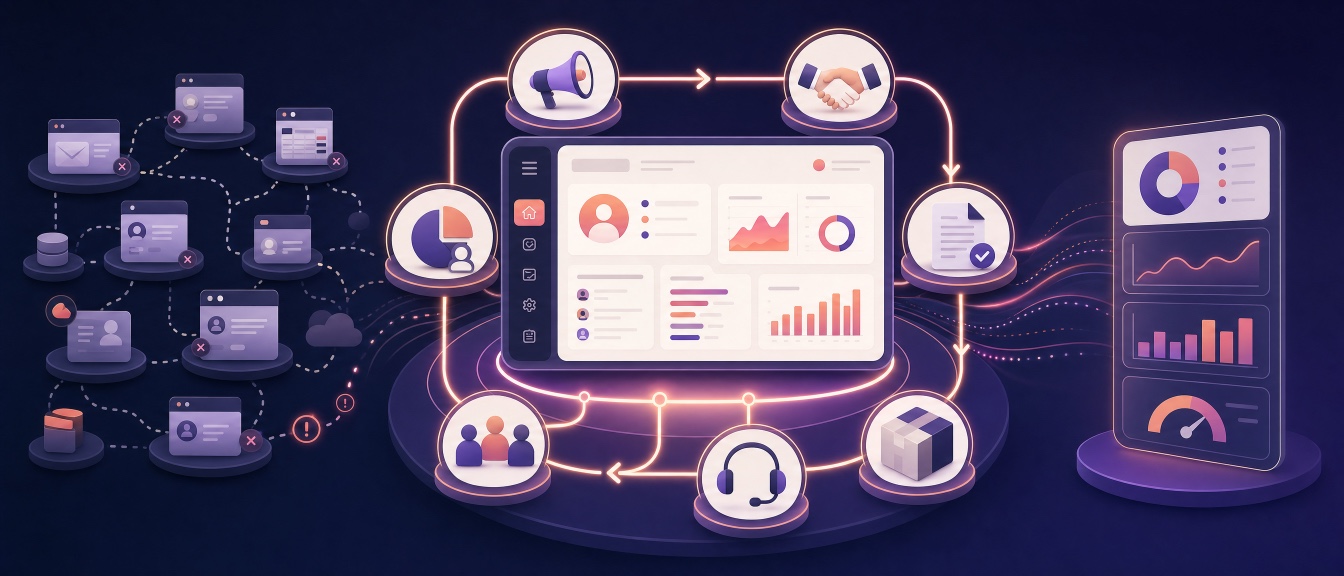
Many CRM systems begin with a prospect and end with a won opportunity. What happens afterward is often distributed across emails, Excel lists, ERP systems, project management tools, ticketing systems, and individual specialist applications.
As long as only a few people are involved, this can work quite well. The employees know each other, information is exchanged directly, and missing details can be supplemented by a direct inquiry.
As the organization grows, the situation changes. More departments, locations, products, roles, and handovers make it increasingly difficult to keep the entire customer process in view. Each individual isolated solution can fulfill its task well, while the overarching process nevertheless remains slow, error-prone, and non-transparent.
Then a strategic question arises: Should the CRM only manage contacts and opportunities, or should it support the customer process end to end from first interest to long-term care?
The answer is not automatically that everything must take place in a single system. Rather, the goal should be a sustainable platform strategy: a central CRM or ERP platform leads the process, while specialized applications are connected where their functional added value justifies the additional integration and operating effort.
Which companies is this approach intended for?
This article is primarily aimed at companies with more than 50 active CRM users. The number of CRM users does not correspond to the total number of employees.
In a manufacturing company, 50 active CRM users can quickly represent an organization with 200, 300, or even 500 employees. Many employees in production, assembly, logistics, or warehousing do not work in the CRM daily. But they are indirectly part of the customer, order, and delivery process.
In service companies, the share of CRM users in the total workforce is often higher. Even there, however, an organization with 50 CRM users can easily employ more than 100 people. What is decisive is not the exact number of employees, but the number of people who work with customer information, opportunities, projects, contracts, service cases, or renewals.
By smaller companies, we understand in this context organizations with up to about 50 potential CRM users. Within this group, there are of course considerable differences. A company with eight users faces an economically different situation than an organization with 40 or 50 users.
Especially with very small companies, the available budget often does not allow an extensively customized CRM solution. This is not only about the initial rollout. Administration, support, data maintenance, training, adjustments, interfaces, and later further development must also be financed permanently.
Our recommendation is therefore not that small companies urgently need to introduce a comprehensive and custom-developed end-to-end CRM. There, a standardized CRM or ERP solution is often the more economical choice.
The greater strategic pressure to act arises above all in organizations with more than 50 active CRM users. At this scale, the number of roles, handovers, data sources, approvals, and different requirements usually increases significantly. Personal coordination and local isolated solutions then reach their limits faster.
What an end-to-end process in CRM means
An end-to-end process considers not only the work of a single department. It begins with a concrete trigger and only ends when the intended business result has been achieved.
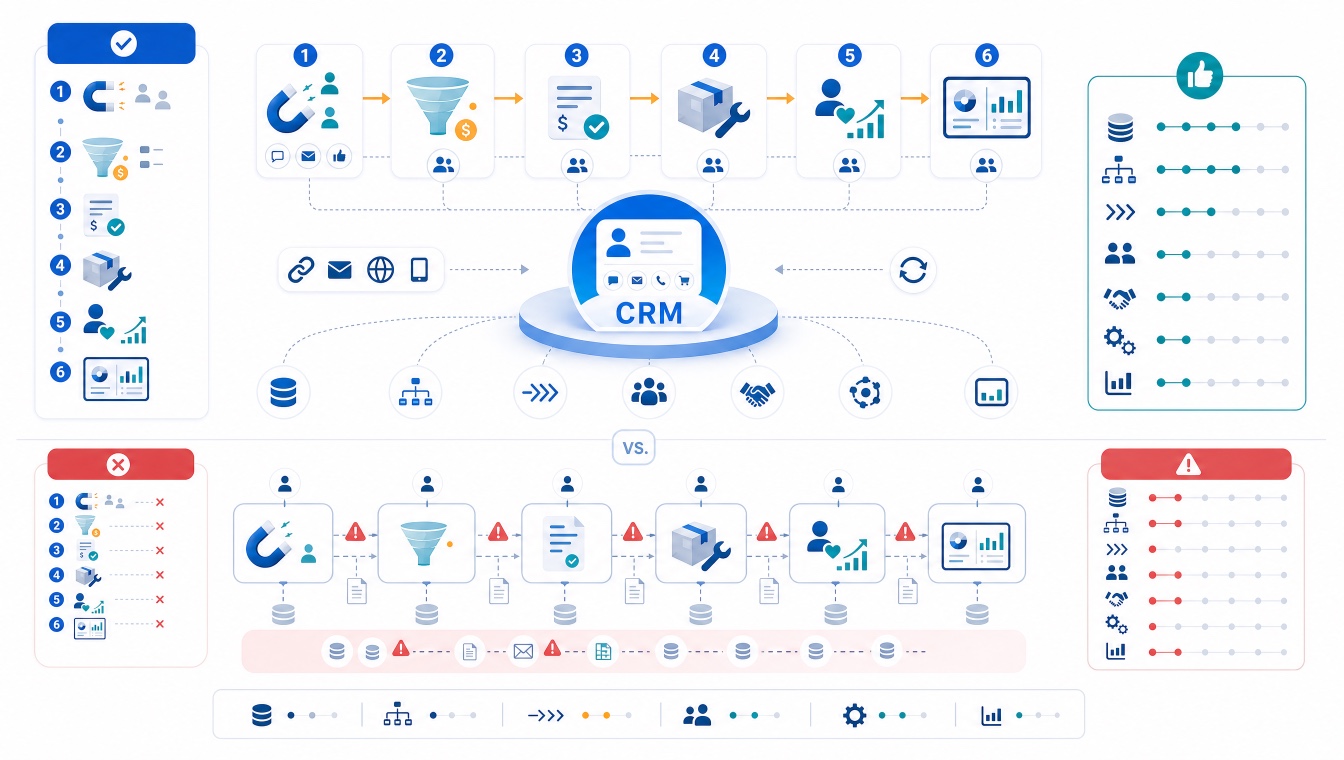
In the CRM environment, the process can begin with the first interest of a potential customer. After that follow, for example, qualification, consulting, quote, approval, contract closing, order, handover to implementation, commissioning, customer support, renewal, and the later expansion of the customer relationship.
The following process chain shows a typical flow:
Marketing contact → Inquiry → Lead → Opportunity → Quote → Contract → Order → Implementation → Service → Renewal → Expansion
What is decisive is not that every single activity is technically executed within the CRM. What is decisive is that the overall status, the responsibilities, the next steps, and the relevant customer information remain continuously visible.
The ERP can continue to manage articles, prices, orders, invoices, inventory, and payment information. A document management system can store contracts in an audit-proof way. A project management system can control tasks, resources, and deadlines in detail.
The CRM, however, holds the customer-related context together. It shows what was agreed with the customer, how far the process has progressed, which problems exist, and who has to act next.
Why CRM processes often end too early
Many CRM rollouts initially focus on marketing and sales. Contacts, companies, activities, and opportunities are recorded in a structured way. Dashboards show the pipeline and workflows remind of open tasks.
With the won order, however, systematic process management often ends. The opportunity is set to “won,” the handover takes place via email, and the further information is distributed across other systems.
Exactly at this point, many problems arise in practice. Order processing does not receive all information from sales. The project team is unaware of important commitments from the sales phase. Service learns too late which special requirements were agreed.
Information is also missing in the reverse direction. Sales may not recognize that a project is delayed, a service problem is escalating, or an invoice has been outstanding for weeks. Nevertheless, the customer is already approached about a renewal or additional business.
A CRM should therefore not only document what happened up to the order. It should make visible the connection between sales, service delivery, service, and further customer development.
Statistics: Why integration is becoming a strategic topic
The following figures are not universally valid statements about every mid-sized company. But they show what orders of magnitude modern application landscapes can now reach.
The more applications are used, the greater the probability that data is maintained multiple times, information is interpreted differently, and processes are interrupted at system boundaries. At the same time, decentralized software procurement makes the development of a unified platform strategy more difficult.
| Metric | Result | Significance for End-to-End Processes |
|---|---|---|
| Average number of applications used in the Connectivity Benchmark 2025 | 897 | Business processes can be spread across a very large number of applications. |
| Respondents using more than 1,000 applications | 45% | Especially large organizations must manage considerable integration complexity. |
| Companies without an integrated user experience across their channels | 66% | Customers and employees experience inconsistent information levels and process breaks. |
| IT leaders who see integration as a hurdle to effective AI use | 95% | Without connected data and processes, AI also remains limited to individual tasks. |
| Share of SaaS spending that, according to Zylo 2025, is owned by business departments | 70% | Software is increasingly purchased in a decentralized way and outside an overarching architecture. |
| IT leaders who see cross-system integration as a prerequisite for successful AI agents | 96% | New automation increases the need for a connected process and data architecture. |
| Potential impact of an end-to-end redesign compared with isolated improvements | Three to four times | The greater benefit often comes from redesigning the entire workflow. |
The MuleSoft Connectivity Benchmark 2025 is based on a survey of 1,050 IT decision-makers. The study cites an average of 897 applications in use, 66 percent of respondents without an integrated user experience, and 95 percent who see integration as a hurdle for effective AI use.
The SaaS Management Index 2025 by Zylo additionally shows that business units now account for 70 percent of SaaS spending. Decentralized decisions can be functionally sensible, but they make transparency, governance, and the development of a coherent platform strategy more difficult.
In the Connectivity Report 2026, 96 percent of the surveyed IT decision-makers regard integration across different systems as a prerequisite for the success of AI agents. When examining thoroughly redesigned processes, BCG concludes that their impact can be three to four times higher than with isolated individual improvements.
The figures should not serve as an argument to migrate as many systems as possible onto a single platform. Rather, they show that every additional application and every further interface should be part of a deliberate architecture decision.
Company size alone does not decide
The number of employees or CRM users is an important indicator, but not a sufficient decision criterion.
A manufacturing company with 500 employees may have a comparatively simple sales process. A service company with 120 employees, by contrast, may work through partners, platforms, subcontractors, different contract models, and numerous approval levels.
Several factors are decisive:
| Criterion | Lower complexity | Higher complexity |
|---|---|---|
| People involved | Few people with direct coordination | Many roles and organizational units |
| Locations and entities | One location and one entity | Multiple locations, countries, or entities |
| Sales model | Direct and uniform sales | Direct sales, partners, platforms, and tenders |
| Products and services | Few standard offerings | Many variants and individual services |
| Quote creation | Simple calculation | Multi-stage calculation and approvals |
| Handover after closing | Direct personal handover | Handover to project, production, logistics, and service |
| Contract models | One-time engagement | Terms, subscriptions, consumption models, and renewals |
| Transaction volume | Few transactions per week | Many recurring transactions |
| Permissions | Few simple roles | Complex view and editing rights |
| Reporting | Simple sales metrics | Cross-departmental steering and compliance |
A high transaction volume is not automatically problematic if all transactions follow a clear standard. Conversely, even a few transactions can create considerable coordination effort if each case has to be handled individually.
Regulatory requirements, international entities, or different permissions also increase the complexity. Therefore, a platform decision should always be aligned with the actual business model.
What is often more sensible for smaller companies
Smaller companies fundamentally have the chance to map a large part of their workflows with a single central solution. However, this does not mean that they should introduce an extensively customized CRM platform.
With few users and a manageable process volume, the costs for design, customization, and continuous further development are often not in a sensible proportion to the expected benefit. An elaborately integrated system landscape can then hardly be operated economically either.
A standardized CRM or ERP solution can nevertheless support a largely end-to-end process. Contacts, inquiries, opportunities, quotes, orders, tasks, and simple service processes can, depending on the system, be managed within a central application.
Some ERP systems already come with basic CRM functions. Conversely, CRM platforms can support simple approvals, contract information, service workflows, and recurring tasks.
Specialized tools often remain in place for marketing. Website, social media, search engine marketing, and email marketing usually require their own applications. What is decisive is that concrete responses reach the central customer process in a controlled way.
A website form should generate an inquiry or a lead. A concrete newsletter response should be assignable to the right contact. A qualified response from a campaign should trigger a sales process.
With a low volume, a custom-developed integration is not necessarily required for this. Standard connectors, simple imports, or clearly defined manual handovers can suffice.
The central question for smaller companies is therefore not how as many workflows as possible can be individually automated. Rather, it is to be examined which functions are economically usable in the standard and which process steps do not justify technical automation due to their low volume.
Large companies can also work with a central platform
The possibility of mapping many workflows within one platform exists not only for smaller companies.
Larger organizations too can work successfully with a largely central solution if their processes are uniform and no highly specialized functional requirements exist. The sheer size of a company does not automatically force a large number of different specialist systems.
What is decisive is the expandability of the platform in use. Some CRM or ERP solutions are suited above all for clearly limited standard processes. Others can be extended with additional modules, data structures, workflows, portals, and automations.
Flexible CRM platforms such as SugarCRM or SpiceCRM can, alongside classic sales processes, also support custom data objects, approvals, service workflows, and customer-specific processes. Extensive enterprise platforms such as SAP or Salesforce offer, depending on product selection and expansion stage, the possibility of mapping further business areas on a shared technological foundation.
Under suitable conditions, individual specialized applications can thereby be dispensed with. Simple partner management, contract processes, internal requests, service workflows, or selected HR processes can possibly be implemented within the existing platform.
Whether this is sensible must be weighed on a case-by-case basis. A central platform does not reach the same functional depth in every domain as a specialized provider.
A specialized applicant management system, for example, can offer better functions for job portals, applicant communication, and talent pools. A specialized field service system can map deployment planning, spare parts, and technical maintenance contracts more deeply.
The question is therefore not whether an existing platform can theoretically be extended. What is decisive is whether the desired process can be mapped sufficiently well, economically, and maintainably over the long term.
Not every specialized solution is automatically the better solution
Business departments understandably prefer applications that are tailored precisely to their tasks. From the perspective of the respective area, the specialized solution can therefore seem convincing.
However, the decision must not be made solely based on the functions within the application. The effort for integration, user administration, data protection, support, and operation is also part of the overall consideration.
An additional application usually creates a further system boundary. Customer data, status information, documents, and responsibilities must be exchanged between the systems involved.
This creates new dependencies. A process only functions reliably when the source system, interface, and target system work correctly at the same time.
The right question is therefore:
Is the functional added value of the specialized solution large enough to permanently justify the additional technical and organizational complexity?
| Review Question | Rather Supports Expanding the Platform | Rather Supports a Specialized Solution |
|---|---|---|
| How specific is the process? | Largely standardized | Highly domain- or industry-specific |
| How high is the transaction volume? | Manageable or clearly standardized | Very high and with special requirements |
| What functional depth is required? | Basic functions are sufficient | Specialized functions are business-critical |
| How high would the integration effort be? | A new interface would be disproportionate | A proven standard integration is available |
| How important is a shared data view? | A central view has high priority | Functional separation is necessary |
| How often does the process change? | Changes can be configured internally | The specialized provider delivers important functional updates |
| How critical is vendor dependency? | The existing platform is used more extensively | An additional vendor is strategically acceptable |
| What do the total costs look like? | Platform expansion is cheaper in the long term | The specialized solution saves more effort than it creates |
Where the existing platform can map a process sufficiently well, a further application is not automatically the better choice.
Every additional interface needs a business case
An interface causes not only one-time implementation effort. It must be documented, monitored, tested, and adjusted when the systems involved change.
Added to this are error analyses, coordination between different vendors, and possible outages after updates. Changes to fields, permissions, APIs, or data formats can trigger additional work.
For business-critical integrations, monitoring, logging, retry mechanisms, and clearly regulated responsibilities are also needed. The more interfaces exist, the greater the number of possible error combinations.
If only a few transactions per week are transferred between two applications, this technical and organizational effort can exceed the actual benefit of a specialized application.
A further application therefore has to justify its added value not only against its license costs. The economic assessment also includes implementation, ongoing operation, update capability, error analysis, user administration, and coordination between the vendors.
These costs are often underestimated during an early product selection. The license of a specialized application can initially seem inexpensive. The greater effort may only arise during operation over several years.
It becomes especially critical when no one is clearly responsible for the interface. Errors may then only be noticed when data is missing or subsequent processes are already affected.
Fewer interfaces can increase robustness
The advantage of a consolidated platform lies above all in the smaller number of technical transitions.
Every avoided interface reduces potential sources of error, maintenance effort, and dependencies between different vendors. Data more often remains within a unified model and does not have to be continuously translated or reconciled.
Roles and permissions can also be managed more centrally. Automations access the same data objects, responsibilities, and status values.
Another advantage shows in error analysis. When a process runs within one platform, it is often faster to recognize at which step a problem arose.
With several connected applications, it must first be checked whether the cause lies in the source system, in the interface, in the target system, or in an incorrect mapping. Fewer system transitions can therefore increase the robustness of the entire process landscape.
However, this does not mean that every centralization automatically leads to a better architecture. If a platform is customized so heavily that updates are only possible with considerable effort, merely another form of technical dependency arises.
License costs, vendor lock-in, and the availability of qualified administrators must also be taken into account. A central platform must not become a hard-to-maintain monolith.
The CRM does not have to do everything itself
An end-to-end process does not mean that every specialist function must be executed directly in the CRM.
The CRM should lead where the customer, the customer relationship, the communication, and the next process step are central. This includes, for example, leads, contacts, opportunities, quotes, approvals, contract status, handovers, service information, and renewals.
The ERP usually remains the leading system for articles, prices, orders, deliveries, invoices, inventory, and financial information. A project management system can continue to handle detailed task and resource planning.
Not all ERP or project data has to be duplicated in the CRM. What should be visible is the information needed to manage the customer relationship and the next process step.
In SugarCRM or SpiceCRM, for example, it can be displayed that an order has been created, a delivery is pending, a project is delayed, or open service cases exist. The salesperson does not necessarily have to switch to every source system for this.
The platform idea thus does not consist of abolishing all applications. It creates a binding framework within which the entire customer process can be managed.
Why larger companies need staying power
An end-to-end process does not arise from the installation of a new CRM system alone. It changes responsibilities, decision paths, data structures, and in part also established power relations.
Many business units have optimized their own workflows over years. These workflows can function well locally without being compatible with the overarching customer process.
In an end-to-end perspective, contradictions become visible that were previously hidden between departments. Typical discussions concern the question of when a lead may be handed over, who approves a quote, when a contract is complete, or who takes over responsibility after the order.
The question of the leading system also frequently creates conflicts. Sales may regard the CRM as leading, while order processing relies solely on the ERP.
Such questions cannot be answered by technical configuration alone. They require binding functional decisions and clear process ownership.
Management must therefore be willing to enforce cross-departmental standards. Without governance, a new platform quickly becomes just another application within the existing isolated landscape.
Ten sensible expansion stages for an end-to-end process
A comprehensive customer process should not be implemented as a big-bang project. More sensible is a clearly defined target vision that is broken down into functionally usable and measurable phases.
Each phase should deliver a standalone benefit. The project must not create technical foundations exclusively for years without improving the daily work of the users.
The sequence depends on the business model and the biggest current process problems. In many companies, however, the following expansion stages suggest themselves:
| Proposal or Idea | Benefit | Description |
|---|---|---|
| Unified customer and contact view | Less searching and duplicate maintenance | Relevant customer information is consolidated or made visible across the systems involved. |
| Standardized lead qualification | Comparable decisions | Marketing and sales receive binding criteria for evaluation and handover. |
| Consistent sales phases | More realistic pipeline | Clear entry and exit criteria are defined for each sales phase. |
| Quotation and approval process | Faster decisions | Discounts, special conditions, and legal reviews are controlled based on roles. |
| Structured contract handover | Less loss of information | Services, deadlines, commitments, and prerequisites are handed over completely after closing. |
| Integration of order processing | Transparency after closing | Order number, processing status, delivery, and selected billing information become visible. |
| Onboarding or project handover | Faster implementation | Won deals trigger defined follow-up processes for project, production, or customer success. |
| Service integration | More complete customer view | Open tickets, escalations, and service quality are available to sales and customer support. |
| Renewal and expansion process | Fewer missed revenue opportunities | Contract terms, notice periods, usage signals, and expansion potential are monitored. |
| End-to-end reporting | Management of the overall process | Dashboards show lead times, handover quality, bottlenecks, and results across departmental boundaries. |
The sequence does not have to be identical in every company. A manufacturer may first prioritize the handover from sales to order processing and production. A service provider may begin with the quote, contract approval, and project start.
What is decisive is that each stage contributes to the overarching target vision.
Roles, permissions, and data quality become more important
The more parts of the customer process are managed via a central platform, the more important a robust role and permission concept becomes.
Not every employee may see and edit all price, contract, service, or financial information. At the same time, the permission concept must not hinder the process so strongly that information is again exchanged via email and Excel.
Roles and permissions should therefore be considered as early as the process design. This is not only about data protection, but also about clear responsibilities.
Data quality is equally important. An end-to-end process can only function if central information such as customer numbers, entities, contacts, products, contract terms, and responsibilities is unambiguous.
Automated checks, duplicate rules, and mandatory fields can help. But they do not replace functional data responsibility.
It must be clarified which area maintains which information, which system is leading, and how faulty data is corrected.
Workflows must also allow exceptions
A common mistake in digitalization is to map only the ideal process.
In practice, special prices, subsequent contract changes, split deliveries, changing contacts, paused projects, and deviating payment terms arise.
An overly rigid CRM is circumvented by the users. Information then ends up again in emails, personal notes, or local Excel lists.
Good end-to-end processes therefore distinguish between binding core steps and controlled exceptions. An exception may be possible but must remain traceable.
The system should record who approved a deviation, why it was necessary, and what effects it has on the subsequent process steps.
Workflows, role models, dashboards, and configurable data structures should support the process. They must not lead to every conceivable exception being prevented through further mandatory fields and complicated screens.
Introduce in phases instead of rebuilding everything at once
An end-to-end target vision is necessary. It describes which stations a customer passes through, which systems are involved, and which information is needed between the areas.
This target vision, however, must not be confused with a single large rollout project. The implementation should be broken down into functionally sensible phases.
Phase 0: Define process and benefit
First, the existing workflow from first customer contact to the desired endpoint is recorded. In doing so, waiting times, media breaks, duplicate entries, and unclear responsibilities are made visible.
At the same time, measurable goals are defined. Examples are shorter quoting times, fewer incomplete handovers, lower coordination effort, or a higher renewal rate.
In this phase, it should also be checked which functions can be mapped within the existing platform. For every additional specialist application, an economic and functional benefit must be recognizable.
Phase 1: Create a resilient core process
In the first productive phase, only the most important steps are implemented. Often these are lead qualification, opportunity, quote, approval, and a structured handover after closing.
This phase must already deliver a recognizable benefit. A project that promises improvement only after several years quickly loses the support of the business units.
Phase 2: Expand the existing platform in a targeted way
Before further applications are introduced, it should be checked which additional processes can be implemented within the existing CRM or ERP platform.
This can include contract information, approvals, service handovers, task management, or simple portal functions. Not every new requirement automatically needs a new system.
Phase 3: Connect necessary specialist systems
Specialized applications are integrated where their functional depth is actually needed.
In doing so, not all available data should be synchronized. Only the information necessary for decisions, automation, or transparency is transferred.
An interface without a clear functional purpose merely creates additional dependency.
Phase 4: Add further lifecycle phases
Afterward, onboarding, service, complaints, renewals, and expansion potential can be added.
The experiences from the first phases flow directly into the extensions. This way, the platform grows in a controlled manner and orients itself to actual usage.
Practical example: From order to structured customer handover
The following anonymized example condenses typical experiences from comparable mid-sized B2B projects.
A manufacturing company with several hundred employees already used a CRM in sales. After the contract was closed, however, the handover to order processing, project management, and service took place mainly via email and Excel.
Those involved invested a lot of time in status inquiries. At the same time, information about contacts, scope of services, delivery dates, and special commitments from the sales phase was regularly missing.
Originally, the idea was considered to introduce another specialized application for the handover and customer onboarding. In the analysis, however, it turned out that the required functions could be mapped within the existing CRM platform.
This eliminated an additional user administration, a further license group, and a new interface.
In the first phase, binding sales phases, quote approvals, and a structured handover record were introduced. When an opportunity was won, the CRM automatically checked whether contacts, services, dates, commercial approvals, and technical prerequisites were complete.
In the second phase, the ERP was connected. Order number, processing status, and selected invoice information were made visible in the CRM.
In the third phase, service information and contract terms were added. Sales and customer support could thereby recognize in good time whether open problems existed or a contract renewal had to be prepared.
| Metric | Before the rollout | After the first three phases |
|---|---|---|
| Time from order receipt to confirmed handover | 4.5 working days | 1.8 working days |
| Handovers with missing mandatory information | 31 % | 9 % |
| Effort for manual status inquiries | Around 12 hours per week | Around 5 hours per week |
| Contract renewals started on time | 68 % | 91 % |
| Cross-departmental coordination meetings | Two meetings per week | One focused meeting per week |
The greatest benefit did not come from a single automation. What was decisive was the shared definition of the handover point between sales, order processing, and implementation.
The CRM thereby evolved from a pure documentation system into a platform that actively supported the next process step.
The phased and agile rollout was essential here. After each stage, the company could check whether the desired improvement had actually occurred.
Requirements were adjusted based on real usage. At the same time, it was deliberately avoided to introduce another isolated solution for a manageable sub-process.
Measure benefit instead of counting functions
An end-to-end project is not successful because a particularly large number of modules, fields, or interfaces were implemented.
What is decisive is whether the entire workflow has become faster, more reliable, and more transparent. Suitable metrics are, for example, the cycle time, waiting times between departments, the number of incomplete handovers, and the effort for rework.
Escalations, renewal rates, and the time between contract closing and productive use of a service can also be relevant measures.
User acceptance should likewise not be measured solely by the number of logins. More meaningful is whether employees voluntarily use the CRM for their daily management.
An important signal is also whether parallel Excel lists and manual status inquiries actually decline.
When consolidating the system landscape, interface costs should additionally be considered. Fewer transmission errors, lower administration effort, and fewer coordination rounds between different vendors can represent essential project results.
Checklist for a sensible end-to-end process
Before a decision, the existing customer process should be considered in full. This is not about collecting as many technical weaknesses as possible. The focus is on the handovers where information is missing, responsibilities are unclear, or transactions regularly stall. For every additional specialist application, the benefit should be weighed against the full integration and operating costs. At the same time, it must be realistically assessed which processes can be implemented within the existing platform economically and maintainably over the long term.
- Is the customer process documented from first interest through service and renewal?
- Are the most important organizational and technical handovers known?
- Is there a functionally responsible area for each process step?
- Are clear criteria defined for handovers between marketing, sales, implementation, and service?
- Is it defined which system is the leading one for which data?
- Can employees see the current customer, order, and project status without manual inquiries?
- Has it been checked which processes can be mapped within the existing platform?
- Does every additional specialist application justify its integration and operating effort?
- Are the ongoing costs and responsibilities of the existing interfaces known?
- Are errors in interfaces automatically detected and logged traceably?
- Are roles, permissions, and data protection already considered in the process design?
- Can exceptions be handled in a controlled and traceable way?
- Have measurable goals such as cycle time, handover quality, or renewal rate been defined?
- Is the rollout divided into independently usable and measurable phases?
- Is there an end-to-end process owner with sufficient decision-making authority?
- Can the chosen platform grow with the organization and the transaction volume?
- Is it regularly checked whether existing isolated solutions still deliver sufficient added value?
- Are users and business units continuously involved in the further development?
Conclusion: The process decides, not the number of systems
An end-to-end process can in principle be sensible in companies of any size. However, the scope of the technical implementation must fit the number of users, the process volume, the complexity, and the available budget.
Very small companies should not automatically try to build an extensively customized CRM platform. Rollout, operation, and continuous further development can cause an effort that is not justified by the small number of transactions.
A CRM or ERP solution that is as standardized as possible is often the more economical choice there. It can nevertheless support a large part of the communication and the customer process end to end.
This article is aimed above all at organizations with more than 50 active CRM users. In the manufacturing environment, this often corresponds to companies with 200, 300, or 500 employees. In service companies, the total workforce can also be significantly larger than the number of CRM users.
At this scale, the number of roles, handovers, data sources, and process variants usually increases. Personal coordination and many small isolated solutions thereby increasingly become a risk.
An end-to-end CRM or enterprise platform does not mean abolishing every specialist application. It creates a binding customer and process view and integrates specialized systems where their added value justifies the additional complexity.
At the same time, it should be checked which processes can be economically expanded within an existing platform. Every avoided interface can reduce maintenance effort, sources of error, and vendor dependencies.
The technical platform, however, is only one part of the task. Equally important are process ownership, governance, and the willingness to question historically grown workflows.
The right path is rarely the big bang. More successful is a clear target vision that is implemented step by step, agile, and based on measurable results.