Artificial intelligence has arrived in many companies. Nevertheless, the practical benefit often falls short of expectations. Individual employees create texts faster, summarize documents, or research with AI. But an end-to-end improvement of customer processes does not yet arise from this.
The decisive step is not to view AI as a collection of individual tools. It must be thought of along the entire customer-related organization: from marketing through sales to customer success and service. The goal is not only to complete tasks faster. It is at the same time about better decisions, higher quality, and a customer experience that makes the customer themselves more successful.
A viable AI strategy therefore needs different time horizons. Some use cases can become productive within a few weeks. Others only unfold their benefit when data, processes, and systems are connected with one another. In the long term, the greatest strategic advantage arises where AI intelligently supports entire workflows and does not merely speed up individual work steps.
The market is further ahead than many company processes
The adoption of AI is now high. According to McKinsey, 88 percent of the surveyed organizations regularly use AI in at least one business function. At the same time, only about a third have begun to scale AI company-wide.
The bottleneck is therefore often no longer access to the technology. The actual challenge lies in converting individual applications into robust and measurable business processes.
Studies also show that concrete productivity gains are possible. In a study with more than 5,000 service employees, AI support increased the number of customer issues resolved per hour by an average of 15 percent. Less experienced employees benefited particularly strongly.
Statistics: Where companies currently stand on AI
The following figures come from different studies and are therefore not directly comparable with one another. But they show a consistent pattern. The use of AI is growing quickly, while systematic scaling progresses significantly more slowly. Personal productivity gains often already arise for individual employees. Company-wide benefit, by contrast, requires integrated data, clear responsibilities, and redesigned workflows.
| Metric | Result | Classification |
|---|---|---|
| Companies regularly using AI in at least one function | 88% | AI has arrived in everyday work but is often not yet deeply integrated into processes. |
| Companies already scaling their AI programs | approx. 33% | The majority is still in pilot or experimentation phases. |
| Employees who work faster or with higher quality thanks to AI | 75% | Users often report noticeable time gains in everyday work. |
| Productivity increase in a studied customer service | 15% | What was measured was the number of successfully resolved issues per hour. |
| Companies formally measuring the ROI of generative AI | 72% | Productivity and additional profit are among the most important metrics. |
| Prioritized AI use cases that had reached productive operation | 31% | Many companies continue to struggle with data, integration, and scaling. |
Before the first use case: clarify governance and data protection
Before AI is used productively in marketing, sales, customer success, or service, the company needs a binding framework for governance, data protection, and data security. It must be clarified in advance which systems may be used, which data can be processed, and who is responsible for results, approvals, and possible errors.
It is especially important that existing role and permission concepts are not circumvented by AI. Via an AI assistant, employees may only access information that is also available to them in the CRM or in the respective source system. It must likewise be defined when a human review or approval is required.
Such a concept should be implemented in its essential parts before productive use. It creates the basis for later safely extending successful use cases to further teams and processes.
How a practical AI governance model can be built, which data protection questions are relevant, and how companies avoid shadow IT, we cover in a separate follow-up article.
Three time horizons instead of an endless AI wish list
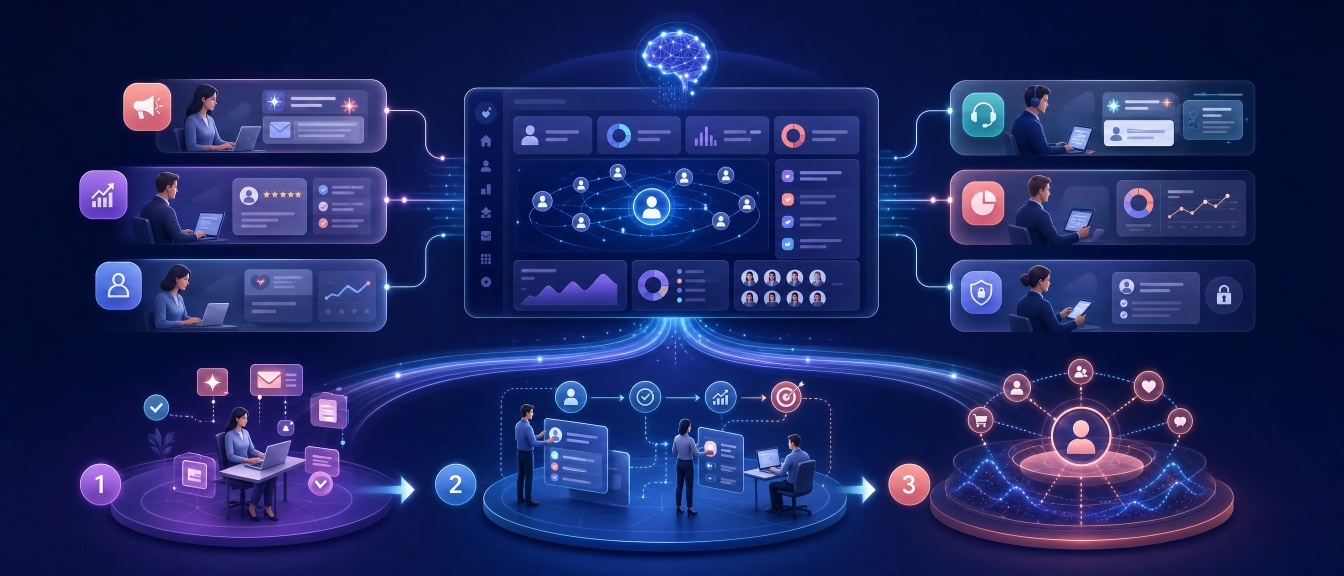
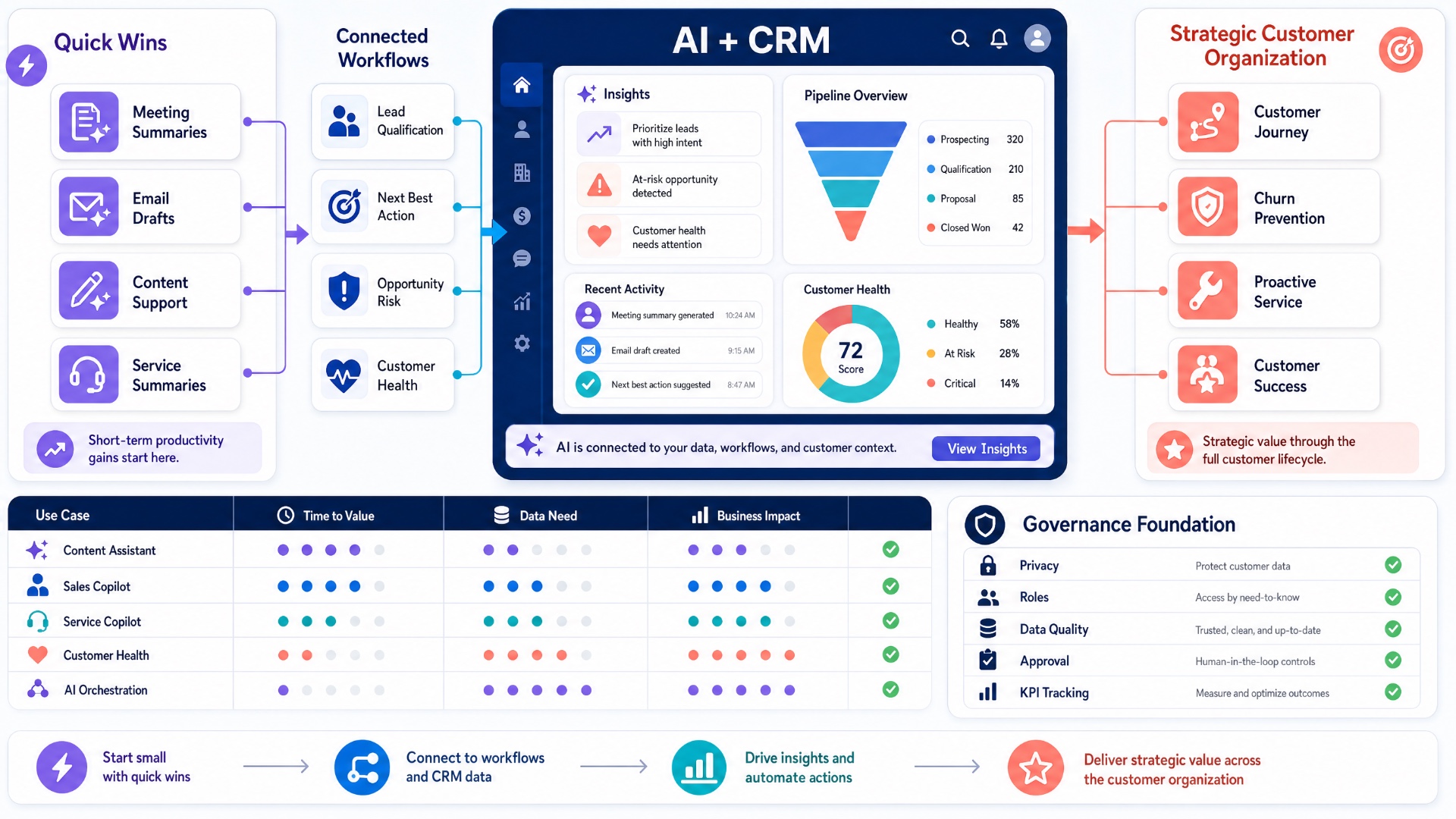
A sensible AI roadmap combines quick results with a long-term target vision. Companies do not have to wait until all data is perfectly prepared and all systems are fully integrated. But they should clearly distinguish which use cases already work reliably today and which need a more stable technical and organizational foundation.
Horizon 1: Immediate relief in everyday work
In the first horizon, AI supports individual employees or teams. It summarizes information, prepares conversations, creates drafts, or structures existing content. The human remains responsible for review, approval, and decision.
Typical areas of use are conversation summaries, email drafts, the preparation of customer appointments, variants for campaign texts, or the summarization of longer service histories. Such use cases can often be implemented within a few weeks, because they change existing processes only to a limited extent.
The benefit arises through frequency. If, for 60 sales employees, four customer conversations per week are each documented automatically, saving ten minutes each, this already results in relief of 40 hours per week.
What is decisive, however, is that the results flow directly into the work process. A summary that then has to be manually copied from a separate tool into the CRM and restructured reduces the actual advantage considerably.
Horizon 2: Better decisions and end-to-end workflows
In the second horizon, AI is connected with CRM data, process rules, and further company systems. It no longer merely creates content, but recognizes patterns, prioritizes cases, and suggests next steps.
This includes intelligent lead qualification, opportunity risk analyses, forecasts, customer health scores, and the automatic classification of service requests. The benefit does not arise from time savings alone. Decisions are made faster and prepared more consistently.
This step demands more organizational work. Data fields must be maintained understandably and reliably. Roles and permissions must also apply to the AI. In addition, the company needs a clear way of handling recommendations that are uncertain, incomplete, or contradictory.
Horizon 3: Strategic orchestration of the customer journey
In the long term, AI can support and partly coordinate complete customer-related workflows. A system recognizes, for example, that an important customer shows declining product usage, several open service requests, and an upcoming contract renewal.
It then creates a summary, suggests an action plan, informs the responsible customer success manager, and prepares a suitable customer conversation. Standardized tasks can be triggered automatically within defined limits.
In this model, the AI does not act fully autonomously. It works within defined decision spaces, escalation rules, and approval processes. Economically relevant, sensitive, or unusual decisions remain with the human.
This is where the strategic advantage arises. The company not only reacts faster to customer inquiries. It can recognize developments earlier, use existing knowledge systematically, and support customers proactively.
Ten AI use cases along the customer organization
The selection of a use case must not be based solely on technical attractiveness. A sensible starting point connects a clear business bottleneck with available data and a measurable impact.
The frequency of use is also important. A small improvement in a process executed a hundred times a day can be economically more valuable than a spectacular application needed only a few times a year.
The following overview classifies ten possible applications along marketing, sales, customer success, and service. The time estimates are to be understood as a realistic orientation. The technical starting position, data quality, and degree of integration can significantly influence the duration.
| No. | Area | AI use case | Time horizon | Description | Suitable metric |
|---|---|---|---|---|---|
| 1 | Marketing | Campaign and content assistant | Immediate | Creates different texts, subject lines, landing page variants, and briefings from the target group, product information, and campaign goal. The functional approval remains with marketing. | Production time, correction loops, campaign frequency |
| 2 | Marketing | Target customer and account research | Immediate to medium-term | Prepares information about companies, market, contacts, and possible demand signals. The results are stored in a structured way in the CRM. | Research time, data completeness, qualified target customers |
| 3 | Marketing and sales | Intelligent lead qualification | Medium-term | Evaluates leads based on company data, interactions, campaign responses, and defined target customer characteristics. The evaluation should provide traceable reasons. | Response time, MQL-to-SQL rate, misqualifications |
| 4 | Sales | Meeting preparation and follow-up | Immediate | Summarizes CRM history, open cases, emails, and recent conversation results. After the appointment, the AI creates documentation, tasks, and a follow-up draft. | Documentation time, follow-up speed, CRM completeness |
| 5 | Sales | Opportunity risk and next best action | Medium-term | Detects missing contacts, absent activities, unusually long sales phases, or unrealistic close dates. The AI then suggests concrete next steps. | Win rate, sales duration, opportunities without a next step |
| 6 | Sales | Quote and tender assistant | Immediate to medium-term | Creates initial quote structures and responses to tenders from approved text modules, service descriptions, and comparable projects. | Processing time, reuse rate, rework effort |
| 7 | Customer Success | Intelligent customer onboarding | Medium-term | Plans tasks by customer type, detects delays, and creates target-group-appropriate information. Deviations are automatically escalated to the responsible employee. | Time-to-value, overdue tasks, onboarding drop-offs |
| 8 | Customer Success | Customer health and early churn detection | Medium-term | Connects CRM activities, service cases, contract information, usage signals, and feedback. Instead of an opaque score, the system delivers concrete risk factors. | Renewal rate, churn rate, early-detected risks |
| 9 | Service | Service copilot and knowledge access | Immediate | Summarizes customer history and request, searches for suitable solution information, and creates answer suggestions. The employee reviews and supplements the answer. | Resolution time, first contact resolution, onboarding duration |
| 10 | Service and customer success | Proactive, agentic case handling | Long-term | Detects problems, gathers information from several systems, triggers defined actions, and monitors their completion. Critical steps require approval. | Case duration, escalations, repeat requests, customer satisfaction |
Marketing: More quality instead of just more content
In marketing, the most obvious entry point lies in content creation. But this is exactly where a typical undesirable development arises. If AI merely increases the quantity of texts produced, their relevance does not automatically rise.
More value arises when AI makes existing customer knowledge usable. It can analyze successful campaigns, evaluate target group characteristics, prepare different messages, and incorporate feedback from sales and service. This aligns marketing more closely with the customers’ actual questions.
A sensible connection with the CRM ensures that campaigns are not evaluated only by open or click rates. What is decisive is which target groups subsequently generate qualified conversations, opportunities, or closes.
AI can help with this attribution. But it does not replace a clean definition of campaigns, target groups, and conversion stages.
In the long term, marketing thereby becomes less of an isolated production department. It develops into a learning part of the entire customer organization.
Sales: Less administration and better prioritization
In sales, the administrative relief is especially tangible. Employees spend a lot of time on conversation preparation, documentation, research, and internal coordination. AI can significantly speed up these tasks.
The greater leverage, however, lies in the quality of sales management. A CRM often contains numerous opportunities whose close probability is largely based on subjective assessments.
AI can additionally check whether activities, contacts, response times, and sales phase match the stated assessment. The goal is not an automated judgment about the salesperson. The AI provides an additional view of the case.
It makes visible risks that are overlooked in day-to-day business and creates a better basis for pipeline reviews. For this to work, the recommendations must remain traceable.
A mere risk value of 67 percent helps sales little. More useful is a concrete explanation: there has been no contact with the economic decision-maker for 24 days, two appointments were postponed, and a confirmed next step is missing.
Customer Success: From reacting to active customer success
Customer success has particularly great strategic potential. The relevant signals, however, are often spread across CRM, support, contract management, product usage, and billing.
AI can bring this information together and point out risks or opportunities early. A customer with few support cases is not automatically satisfied. They may hardly use the product or have already reduced contact with the provider.
A robust customer health approach therefore needs more than a summarized score. The system should explain which developments led to the assessment.
It must also be clear who reacts to which signal and within what time an action is expected. Without a downstream process, even a good warning signal remains ineffective.
The end customer benefits directly from this approach. They receive support before a problem escalates. At the same time, the provider can show in a more targeted way which benefit the customer has already achieved and which next development steps make sense.
Service: Translating knowledge into solutions faster
In service, AI can make the experiential knowledge of the best employees more widely available. It supports classification, suggests relevant knowledge articles, and prepares answers. New or less experienced employees in particular benefit from this.
A good service solution, however, does not simply output a finished answer. It shows sources, previous solution paths, and possible uncertainties. The employee retains control and can adapt the answer to the specific customer.
The quality of the underlying knowledge base is decisive here. Outdated, contradictory, or poorly structured content does not automatically become correct through AI. In the worst case, faulty information is merely output faster and more convincingly.
In the long term, the system can handle standardized cases independently. The prerequisites are clearly defined limits, complete logging, and a safe handover to a human as soon as the case becomes unusual, sensitive, or economically relevant.
The CRM becomes the context system for AI
AI needs context. Without information about the customer, contract, recent conversations, open tasks, permissions, and previous decisions, the results remain generic.
The CRM therefore plays a central role. It connects customer information, activities, processes, responsibilities, and results. This allows the AI to relate its suggestions to the specific customer situation.
Not every piece of information has to physically reside in a single database. What is decisive is that the AI can access relevant data from CRM, ERP, email, calendar, support, and, if applicable, product usage in a controlled way.
Roles and permissions must also apply to AI access. A sales employee must not suddenly see, through an AI query, content to which they would have no access in the CRM or in another source system.
Companies should also avoid building an all-knowing assistant for all departments right at the start. A clearly delimited use case with defined data sources and a measurable result is much easier to test, secure, and develop further.
Measure benefit instead of counting AI activity
The number of summaries created or texts generated is not sufficient proof of success. Such figures merely show that a function was used.
For quick use cases, time savings, processing time, rework effort, and data completeness are suitable. For medium-term applications, process metrics such as response time, sales duration, forecast accuracy, first contact resolution, or time-to-value are added.
Long-term initiatives must additionally be measured against customer retention, win rate, margin, churn, and customer satisfaction. The respective use case should only be measured against metrics on which it actually has a traceable influence.
A baseline measurement before the rollout is important. Without a baseline, it later remains unclear whether the process has actually improved.
It should likewise be checked whether the time savings are lost elsewhere through additional controls or error corrections. The economic benefit only arises when faster work and higher quality are translated into better results.
Practical example: Agile rollout across three phases
The following example depicts a recurring pattern from comparable B2B projects. The figures are rounded and serve as a realistic reference frame.
A company with a grown customer organization did not want to fully automate marketing, sales, and service at the same time. The first phase focused on 70 users and three clearly limited tasks: preparing customer appointments, automatic conversation documentation, and summarizing longer service histories.
After six weeks, the average documentation effort after customer conversations fell from around 14 to six minutes. The share of follow-ups sent on the day of the appointment rose from 54 to 82 percent. In service, the time for reviewing and initially classifying more complex requests shortened from an average of nine to five minutes.
In the second phase, the data was embedded directly into CRM workflows. Opportunities without a confirmed next step were detected automatically. Leads received traceable prioritization suggestions. During customer onboarding, the system pointed out missing tasks and looming delays.
Four months after the start, the share of active opportunities without a next step fell from 31 to 15 percent. Overdue tasks in onboarding decreased by 26 percent. At the same time, internal data completeness improved, because information no longer had to be transferred subsequently from notes and emails.
Only in the third phase was a cross-departmental customer picture built. Service history, sales activities, contract data, and onboarding status were brought together for customer success. This allowed at-risk customers to be recognized earlier and addressed specifically.
Success did not come from a big technological leap. What was decisive was the phased rollout with short feedback loops. Each phase had to deliver a measurable benefit before additional complexity was built up.
Checklist for a resilient AI roadmap
An AI roadmap does not become resilient through the number of available tools. It needs a clear business starting point and a measurable target state. Quick wins are important but must not create new isolated solutions. Governance, data protection, data access, roles, and human responsibility must be taken into account from the start. Each use case should also be regularly checked as to whether it actually achieves the expected benefit.
- Is the concrete customer or process problem clearly described?
- Is there a measurable baseline before the rollout?
- Is it clarified which employees are actually relieved?
- Is there an implemented concept for AI governance, data protection, and data security?
- Is it clearly regulated which data may be transferred to which AI systems?
- Are the required CRM and process data available and sufficiently reliable?
- Are existing role and permission concepts technically enforced?
- Is it defined when a human must review or approve results?
- Are recommendations, sources used, and actions taken logged traceably?
- Are there clear metrics for speed, quality, and customer benefit?
- Can the solution be integrated directly into CRM workflows and existing tasks?
- Is an agile rollout with limited scope and short learning cycles planned?
- Is user feedback systematically evaluated?
- Is there a target vision for how successful use cases are later connected across areas?
Conclusion: AI must show impact with the customer
The first AI use cases can start very pragmatically. Conversation preparation, documentation, service summaries, and content drafts quickly deliver visible relief.
The sustainable benefit, however, only arises at the next stage. AI must be connected with CRM data, responsibilities, and end-to-end processes. Then it improves not only the speed, but also the quality of decisions and customer interactions.
The prerequisite is a clear framework for governance, data protection, and data security. Only through this can companies extend successful applications in a controlled way to further teams, processes, and data sources.
In the long term, it is not the most powerful individual AI model that decides the competitive advantage. What is decisive is a company’s ability to connect knowledge, data, and workflows in such a way that customers are supported earlier, more precisely, and more successfully.
A good AI strategy therefore begins focused, measures consistently, and at the same time pursues a clear target vision for the entire customer organization.