AI has now arrived in many areas of the CRM. Conversation notes can be summarized automatically, emails prepared, information researched, and opportunities analyzed. These functions support users above all in working faster and spending less time on recurring tasks.
With agentic AI, however, a new stage of development begins. An agent no longer merely reacts to a specific request, but can handle tasks independently within defined limits. It accesses information, assesses a situation, uses different tools, and can then carry out actions. For CRM, this is especially relevant, because customer processes almost always consist of several connected work steps. A sales employee, for example, checks an account, analyzes open opportunities, takes service cases into account, reads the latest communication, prepares an appointment, and then documents the result. Exactly such workflows can increasingly be partly handed over to agents.
This changes the role of AI in the CRM. A pure assistance function gradually becomes an active part of the business process. The central question is therefore no longer only what AI can prepare, but which tasks a company can already hand over to an agent today in a controlled way.
From workflow to agent
The terms copilot, assistant, and agent are currently used very differently. For companies, therefore, the label is less important than the actual function.
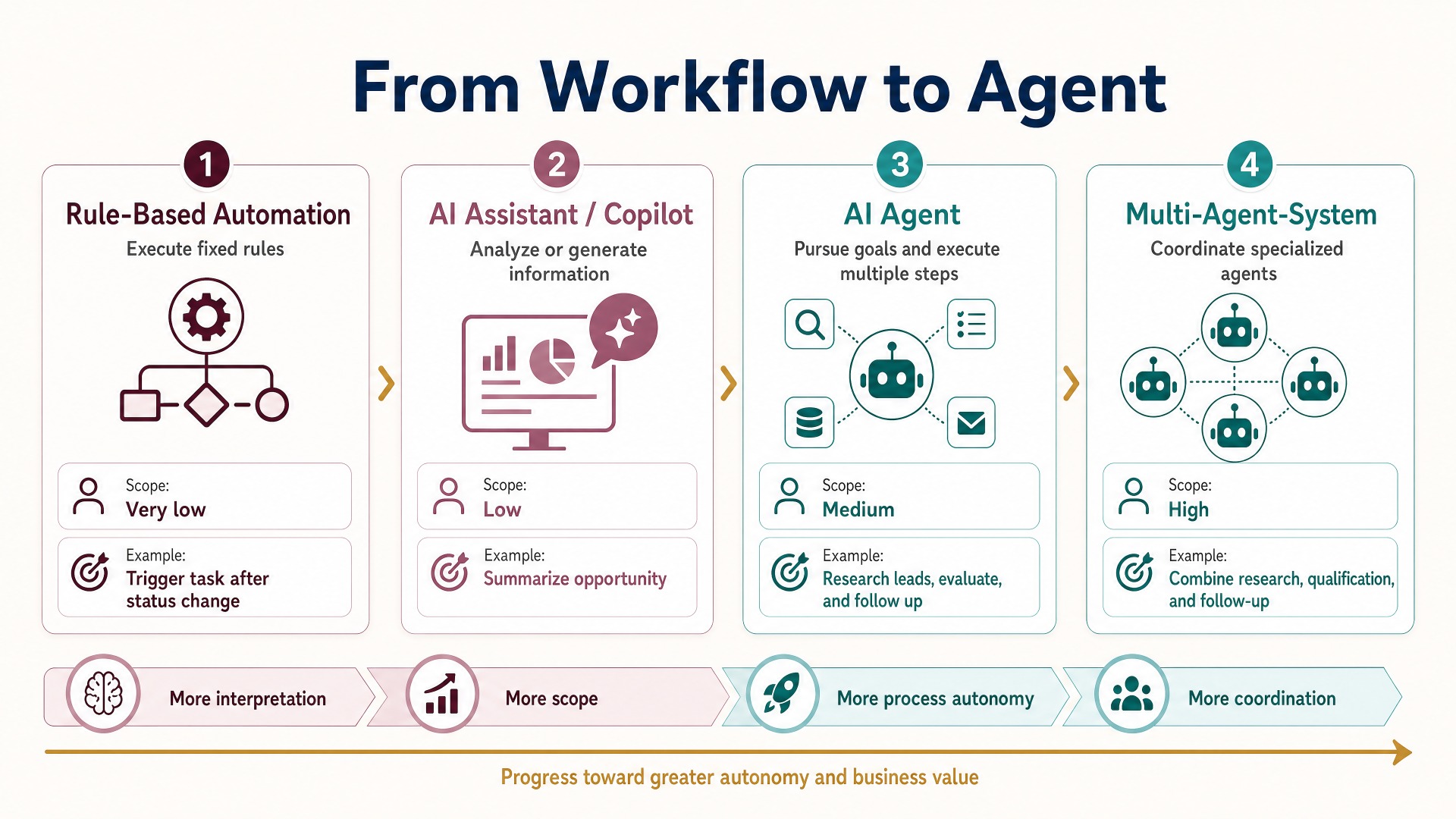
A classic workflow follows a predetermined logic. When an opportunity is won, a task can be created automatically or a certain process can be started. An AI assistant already goes further and can interpret information, create texts, or summarize a record. An agent additionally has a certain scope of action. It can decide for itself which information it needs and which steps are sensible within its permissions.
| Technology | Typical task | Scope of action | Example in the CRM |
|---|---|---|---|
| Classic automation | Execute fixed rules | Very low | Create task after status change |
| AI assistant / copilot | Analyze or generate information | Low | Summarize opportunity |
| AI agent | Pursue a goal and carry out several steps | Medium | Research, evaluate, and process a lead |
| Multi-agent system | Coordinate specialized agents | Higher | Combine research, qualification, and follow-up |
An automatically drafted email is therefore not yet an agentic application. Agentic AI begins where software can decide independently, within defined limits, which data, information, and tools are needed to handle a task.
Where agentic AI actually stands in 2026
Technical development is already further along than its spread in everyday business would suggest. Many platforms today enable agents that can process data from several sources, research external information, call APIs, or trigger actions in company systems. At the same time, productive use is still at the beginning in many organizations.
McKinsey reports that 23 percent of the surveyed companies already scale at least one agentic system somewhere in the organization. A further 39 percent are experimenting with AI agents. Looking at individual business functions, however, the share of companies with scaled agent use is still at most ten percent in each case.
These figures show a realistic picture. Agentic AI is no longer a future technology, but not yet a widespread standard either. Many companies are currently in a phase in which first concrete processes are being tested while experience with governance, data quality, permissions, and costs is still being gathered.
Statistics: Agentic AI between pilot project and productive use
| Metric | Value | Classification |
|---|---|---|
| Companies already scaling agentic AI | 23 % | First productive use exists |
| Companies additionally experimenting with AI agents | 39 % | The market is strongly in the trial phase |
| Scaling within a single business function | at most 10% | Broad productive use is still rare |
| Enterprise applications with agentic AI according to Gartner by 2028 | 33 % | In 2024 it was less than 1% |
| Daily work decisions that agentic AI could make autonomously by 2028 according to Gartner | at least 15% | Autonomy is likely to increase significantly |
| Agentic AI projects that could be discontinued by the end of 2027 according to Gartner | over 40% | Benefit, costs, and governance remain critical |
At the same time, Gartner expects a rapid expansion of agentic functions in enterprise software. By 2028, 33 percent of enterprise applications are expected to contain such functions. At the same time, more than 40 percent of today’s agentic AI projects could be discontinued by the end of 2027 because costs, business case, or governance were not sufficiently clarified.
This combination in particular is important. The technology is developing quickly, but not every conceivable agent is automatically sensible. What remains decisive is whether a concrete business process becomes better, faster, or more economical.
Which applications in the CRM already make sense today
For getting started, tasks are especially suitable where employees today regularly spend time searching, checking, consolidating, and documenting. There, the benefit can be measured comparatively quickly and the risk remains manageable.
Processes with sufficient volume and clear quality criteria are particularly interesting. At the same time, customer-critical actions should initially continue to be approved by an employee. An agent can, for example, consolidate information, detect risks, or prepare an activity without immediately communicating autonomously to the outside.
| No. | Suggestion | Description | Realistic use |
|---|---|---|---|
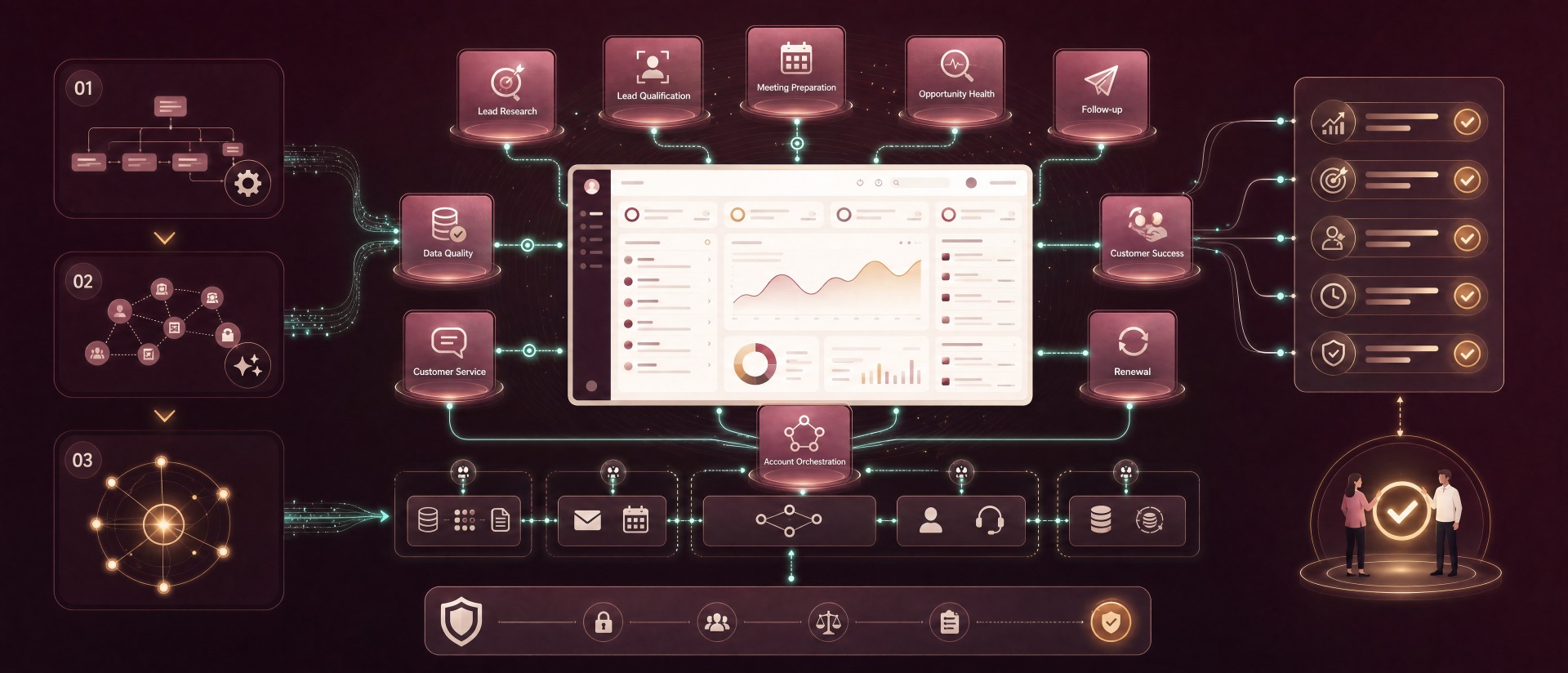
| 1 | Lead Research Agent | Researches company, industry, contacts, and current developments | today |
| 2 | Lead Qualification Agent | Evaluates leads based on defined criteria and existing CRM data | today |
| 3 | Meeting Preparation Agent | Creates briefings from CRM, communication, service, and external information | today |
| 4 | Follow-up Agent | Detects open next steps and prepares suitable follow-ups | today |
| 5 | Opportunity Health Agent | Analyzes activity, stakeholders, duration, risks, and missing information | today |
| 6 | Customer Service Agent | Handles standardizable requests and carries out defined actions | today / short-term |
| 7 | Data Quality Agent | Detects missing data, inconsistencies, and possible duplicates | today |
| 8 | Customer Success Agent | Detects usage, contract, or service risks and suggests measures | short-term |
| 9 | Renewal Agent | Monitors contract terms, usage, open problems, and renewal risks | short-term |
| 10 | Account Orchestration Agent | Coordinates several agents around a complex customer process | medium-term |
At first glance, many of these applications seem less spectacular than an autonomous sales agent. In practice, this is precisely where their advantage lies. They relieve employees where a lot of time is lost today, without immediately intervening deeply in customer-critical decisions.
The sensible entry: first read, then act
For many companies, a step-by-step rollout is more sensible than the attempt to immediately build an agent that is as autonomous as possible. In a first phase, the agent can access information only in read mode. A meeting preparation agent, for example, receives access to relevant CRM data, activities, opportunities, emails, and service information and creates a structured briefing from them.
This already makes it possible to assess very well whether the approach works. What can be measured, for example, is how much preparation time is saved, which information is regularly missing, and in which situations the agent establishes wrong connections. The actual use by employees is also an important indicator. An agent whose results no one uses voluntarily has not achieved its goal, regardless of the technical quality.
Only when the results are reliable should the scope of action be expanded. In a second phase, the agent can, for example, create tasks, add notes, update data, or prepare a follow-up. Critical actions remain subject to approval.
Especially in more complex situations, the difference from classic workflows becomes visible. A workflow can determine that an opportunity has shown no activity for 30 days. An agent can additionally check whether relevant decision-makers are known, whether an open service case exists, whether a meeting has taken place, whether the close date is still plausible, and which next steps would be sensible. A simple reminder thus becomes an assessment of the business situation.
From reactive to situation-oriented CRM
Many of today’s AI functions are still actively started by a user. The user requests a summary, has an opportunity analyzed, or an answer formulated. In the long term, this form of use is likely to be only one part of the overall picture.
An agentic CRM can increasingly detect changes independently and connect different signals with one another. If, for example, product usage declines at an important customer while at the same time critical service cases arise, the contract expires in a few months, and no contact with the decision-maker has been documented for weeks, a clear risk arises from the combination of this information.
Today, such signals are often located in different systems or views. A future customer success agent can bring them together and derive a business situation from them. It then does not report four individual warnings, but recognizes an increased churn risk and suggests a suitable measure.
CRM thereby changes from a reactive information system into a system that recognizes situations and can react to changes.
What CRM vendors are currently developing
Nearly all major CRM and enterprise platforms are now investing in agentic functions. However, no uniform model is emerging. Rather, different architectural approaches can be identified.
With Agentforce, Salesforce pursues an approach in which agents are directly part of the platform. They access data, use rules and reasoning, and can carry out concrete actions via workflows, automations, or APIs.
Within Dynamics 365, Microsoft is also moving in this direction. The Sales Qualification Agent can research and evaluate leads. In more advanced scenarios, agents can prepare follow-ups, analyze opportunities, or bring together information from CRM, email, meetings, and web research.
HubSpot in particular is currently developing clearly toward an agent platform. With Agent Hub, a central layer for managing different agents is emerging. At the same time, companies can configure their own agents with the Agent Builder and provide them with goals, CRM data, rules, and tools. This is complemented by specialized agents for prospecting, customer service, and data analysis.
The pricing logic at HubSpot is also interesting. Certain agent services are no longer billed only indirectly via user licenses, but increasingly via credits or work performed. In the long term, this creates a new model for enterprise software. Besides the question of how many users need a license, it becomes increasingly relevant how much operational work the system actually takes over.
The CRM as a tool for external agents
Pipedrive currently shows a second development that could become at least equally important in the long term. There, the agent is not necessarily located within the CRM platform.
With its own MCP connector, Pipedrive opens its CRM to external AI systems. Via the Model Context Protocol, compatible agents can access CRM data in a controlled way and carry out defined actions.
The first published usage data is remarkable in this respect. Already shortly after introduction, more than six percent of paying customers had activated the MCP connection. Around 65 percent of the interactions were read operations, about 35 percent already write or update operations.
This makes visible how quickly usage can shift from pure information queries toward actual actions. Agents not only analyze deals or activities, but update contacts, create notes, or change leads.
This approach detaches the agent logic from the individual CRM vendor. The CRM thereby becomes a controlled data and action platform that different agents can access.
SugarAI, SpiceCRM, and customer-specific MCP architectures
SugarCRM has operated under the name SugarAI since 2026. The platform currently pursues an intelligence-first approach strongly. CRM, ERP, and transaction data are brought together in order to detect risks, opportunities, and sensible next activities.
This approach is not identical to a freely acting autonomous agent, but forms an important basis for it. An agent can only act sensibly if the system beforehand has sufficient context about the business situation.
At the same time, the use of agentic functions is not limited to the options provided by the vendor by default. SugarAI and SpiceCRM can be opened to external agents via open APIs and customer-specific MCP connectors.
This allows custom agent architectures to be built in which the CRM takes on a central role as a data and action platform. An agent can, for example, analyze accounts and opportunities, obtain additional information from other applications, assess the situation, and then carry out defined actions in the CRM.
Which data the agent may see and which actions are possible is controlled via CRM permissions, the MCP connector, and additional governance rules.
Especially with custom business processes, this approach is interesting. Companies do not have to wait for a CRM vendor to eventually provide every needed agent as a standard function. They can build agentic processes specifically around their existing system landscape.
Three architecture models are emerging
From the current developments, three fundamental models can be derived.
The first model is CRM-native agents. They are directly part of a platform and access the respective data model and standardized processes deeply.
The second model consists of external agents that use the CRM as a tool via APIs or MCP. These agents can at the same time involve further applications and thereby handle cross-system processes.
The third model is an intelligence-first approach. Here, the CRM first analyzes data and business situations and derives risks, opportunities, and recommendations for action from them. This information can then in turn be used by agents.
In practice, these models will probably not be mutually exclusive. A CRM can, for example, detect a risk, an external agent research additional information, another agent generate a briefing, and a workflow then carry out the documented action.
This changes the decisive architecture question. It is less about which vendor offers the best individual agent. What becomes more important is how CRM data, business logic, agents, and further applications can work together in a controlled way.
What role MCP could play in this
The Model Context Protocol is still relatively young but could play an important role for future agent architectures. It creates a standardized way through which AI systems can access tools and data sources.
This can include a CRM, but equally an ERP system, a knowledge base, a document management system, or a custom specialist application.
For CRM, this is especially relevant, because complete customer context is almost never present exclusively in the CRM. Order information lies in the ERP, service information in the ticketing system, communication in email systems, and product usage possibly in a separate platform.
An agent can retrieve this information via suitable interfaces where it originates. This eliminates the need to copy all information into a single system.
The CRM does not lose importance as a result. On the contrary: the more agents work across several systems, the more important a reliable source for customer structure, relationships, opportunities, activities, and responsibilities becomes.
The CRM thus remains a central system of record and at the same time develops more strongly into a system of context and governance.
Data quality becomes a prerequisite for autonomous actions
Agentic AI changes many technical possibilities but does not automatically solve one of the oldest CRM problems: poor data quality.
When contacts are assigned incorrectly, opportunities are not maintained, important decision-makers are missing, or essential customer information lies exclusively in personal mailboxes, even a very powerful agent cannot produce a reliable overall picture.
It can merely work faster with incomplete information.
This changes the significance of data quality. Until now, it was relevant above all for reporting, forecasting, and user acceptance. With agentic AI, it additionally becomes a prerequisite for automated decisions and actions.
The more an agent is allowed to act independently, the higher the requirements for data model, recency, and completeness must therefore be.
Governance and permissions for digital employees
A new dimension also arises with roles and permissions.
With a classic AI assistant, an employee usually sees the answer before anything happens. With an agent, by contrast, a wrong assessment can directly trigger an action.
In the future, companies must therefore define not only user permissions, but also agent permissions.
A research agent needs no access to discounts or contract terms. A service agent should not be able to close an opportunity. A data quality agent needs no permission to contact customers. And an agent that processes personal or confidential information needs a considerably stricter security framework than an agent that researches only public information.
Agents should therefore be treated similarly to digital employees. They need identities, roles, permissions, defined limits, and traceable logs.
Practical example: step-by-step rollout instead of an autonomous sales agent
Let us take a B2B sales organization with around 70 active CRM users. The team looks after several hundred open opportunities. Information is located in the CRM, in emails, in meeting minutes, and in service. Before important customer conversations, sales employees regularly research on their own.
An obvious approach would be to develop this directly into an extensive autonomous sales agent. As a rule, a phased rollout is more sensible.
In the first phase, the agent receives read rights only. Before customer appointments, it automatically compiles information on the account, contacts, open opportunities, recent activities, and service cases.
After a few weeks, it is evaluated how frequently the briefings are used, which information is missing, where misinterpretations occur, and how much preparation time is actually saved.
In the second phase, the agent can research additional information, detect missing activities, and suggest next steps. Only in a third phase does it receive the right to prepare or carry out defined actions itself. Critical external communication initially remains subject to approval.
A realistic target picture could, after several iterations, look like this, for example:
| Metric | Before | After several iterations |
|---|---|---|
| Preparation of an important customer appointment | 15–20 minutes | 5–8 minutes |
| Opportunities with a documented next step | 62 % | 90 % |
| Manual research effort per account | high | significantly reduced |
| Opportunities without activity for more than 30 days | Baseline 100% | 25–30% less |
| Time to a qualified follow-up | 2–3 days | often within one working day |
These values are not a performance promise. Rather, they show which metrics are sensible in such a project.
The decisive insight lies in the approach. Agentic AI should not be introduced as a months-long large project after which acceptance is merely hoped for. Better is a manageable process with clear metrics, regular review, and step-by-step expansion of the scope of action.
The rollout thus follows the same principles that have also proven themselves in CRM projects: phased, measurable, and agile.
What will probably happen in the next one to two years
The current developments suggest that companies will not use a single universal agent. More likely is an increasing specialization.
A research agent needs different data and permissions than a service agent. A data quality agent works with different rules than a pricing agent. An agent for contract renewals in turn needs different information than an agent for lead qualification.
Above these specialized agents, an additional orchestration layer can emerge that decides which agent takes on which task.
This also shifts the classic question of roles in the CRM. Besides user permissions, it will increasingly have to be defined which agent may see which data, use which tools, and carry out which actions.
At the same time, agents will react less to individual user requests and work in a more event-driven way. Changes at the customer, in the sales process, or in service can be assessed automatically and related to one another.
CRM thereby develops increasingly from a system that documents past activities into a system that continuously assesses business situations.
What could CRM look like in five years?
A concrete product forecast for 2031 would be of little seriousness given the speed of current development. The basic direction, however, can already be recognized.
CRM could develop from a system in which employees document customer work into a platform on which humans and agents jointly steer customer processes.
| Today | Possible CRM around 2031 |
|---|---|
| Employee searches for customer information | Context is compiled automatically |
| Sales manager checks the pipeline | Agent monitors changes continuously |
| CRM reminds of activities | Agent prepares suitable actions itself |
| Reports show the past | Agent recognizes developments and reacts to them |
| Data is often maintained manually | Much information arises automatically from interactions |
| Workflows follow fixed rules | Agents take the business context into account more strongly |
| Users work mainly through screens | Natural language becomes an additional user interface |
| Humans coordinate several systems | Agents take on parts of the system coordination |
| Individual AI functions support employees | Several specialized agents work together |
| Software is licensed predominantly by number of users | Usage and work performed gain importance as a pricing model |
In the process, the user interface will probably also change. Dashboards, lists, and records will not disappear, but will become less dominant for many tasks.
A sales manager might, for example, in the future no longer open several dashboards, but have it shown directly which five opportunities currently need special attention and why. The agent thereby delivers not only the information, but also prepares the suitable next steps.
From system of record to system of action
CRM systems were for a long time above all systems of record. They documented what had happened.
Later they became systems of engagement, through which marketing, sales, and service worked directly with customers.
Agentic AI now adds a further layer.
The CRM, or rather the agent architecture emerging around it, increasingly develops into a system of action. The system not only knows the current situation, but can react to this situation.
This is precisely where the actual change lies. Not in the next chat window within a CRM interface, but in the fact that a system increasingly helps actively steer business processes.
The competitive advantage will not be the agent alone
In the long term, powerful language models and agents will be available to many companies in comparable quality. Mere access to an AI agent will therefore hardly remain a sustainable competitive advantage.
Differences arise rather from the environment in which the agent works.
How complete is the customer data? How clean is the data model? How clearly are processes defined? Which systems are integrated? Which information can be provided securely? How clearly are responsibilities and permissions regulated?
And above all: is it even clearly defined in the company which decision is sensible in which business situation?
These are classic CRM questions.
Agentic AI does not make them superfluous. It increases their importance.
Checklist: Is your CRM ready for agentic AI?
A company does not have to introduce an autonomous agent immediately in order to prepare for this development. Sensible first is a review of the existing CRM architecture and the processes. Particularly suitable are workflows where time is visibly lost today and whose results are measurable. Equally important is the question of whether the required data is reliably available and which permissions an agent should actually receive. Only when these prerequisites are met should the scope of action be expanded step by step.
- Is there a clearly defined process that an agent is meant to improve?
- Do we know the time expenditure, quality, or other baseline metrics of this process?
- Is the CRM data necessary for this reliable?
- Do we know which further systems the agent needs?
- Are there clean APIs or suitable MCP connections?
- Are user and agent permissions clearly defined?
- Is it defined which actions an agent may carry out independently?
- Are there activities that always require human approval?
- Are decisions and actions logged traceably?
- Can result quality and error rate be measured?
- Does the agent know when it must hand the task over to a human?
- Are data protection, information security, and AI governance clarified?
- Does the rollout start with a limited process and a manageable user group?
- Is it checked after each phase whether measurable benefit actually arises?
- Does the architecture remain as independent as possible from a single language model or AI provider?
Conclusion: Bring agentic AI into real processes step by step
Agentic AI in the CRM is no longer a pure vision of the future. Research, meeting preparation, lead qualification, data analysis, or parts of customer service can already be sensibly supported agentically today.
At the same time, the market is still in an early phase. CRM vendors pursue different models: native agents within the platform, external agents via MCP and APIs, or intelligence-first approaches in which business situations are detected and next steps suggested.
For companies, it is therefore less decisive which vendor currently offers the longest list of AI functions. More important is whether one’s own CRM architecture is prepared to connect data, processes, agents, and further applications with one another in a controlled way.
The sensible entry remains pragmatic: select a concrete process, ensure good data, define clear permissions, and measure the benefit.
If that works, the agent can take on the next step.
And with each successful phase, a little more responsibility.