Many CRM landscapes do not grow in a planned way, but over the years. Sales works in the CRM, service requests sit in a ticketing system, projects are managed in another application, and product, order, or contract information comes from the ERP. For individual tasks, these systems often work well. It becomes difficult where an end-to-end customer process runs through several of these applications.
Then a fundamental question arises: Should the CRM continue to be primarily a sales tool – or can it become the shared platform for customer-related processes?
This is exactly where SpiceCRM comes in. Alongside SugarAI, SpiceCRM is the second CRM system in our portfolio. The platform pursues an open and modular approach and can connect processes in marketing, sales, service, project management, and further areas on a shared technical basis.
Depending on the deployment scenario, SpiceCRM can be operated in the cloud or on-premise and connected via open APIs with ERP, back-office, and other company systems.
This becomes interesting above all for companies where classic standard CRM functions are no longer sufficient or where the system is meant to grow with their own business processes in the long term.
What is SpiceCRM?
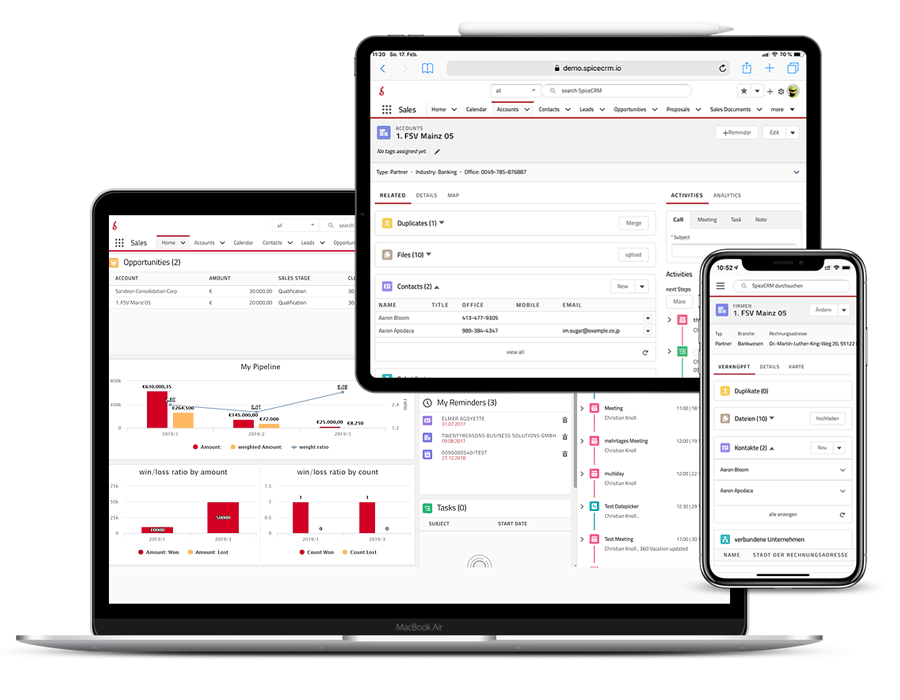
SpiceCRM is a flexible CRM platform that combines classic CRM functions with a comparatively open platform approach.
Accounts, contacts, leads, opportunities, and activities are only the starting point here. On the same technical basis, further processes, data models, workflows, and applications can arise.
The essential difference from a heavily standardized sales CRM therefore lies less in a single function than in the extensibility of the platform.
A company can, for example, start with a classic sales process and later add service, projects, product management, quoting processes, or custom business processes.
Especially for grown organizations, this approach can be interesting. Instead of introducing yet another individual system for each new process, it can be examined whether several customer-related workflows can be sensibly brought together on a shared platform.
Which customer-related processes does SpiceCRM support?
1) When forecast and sales reality diverge: sales automation
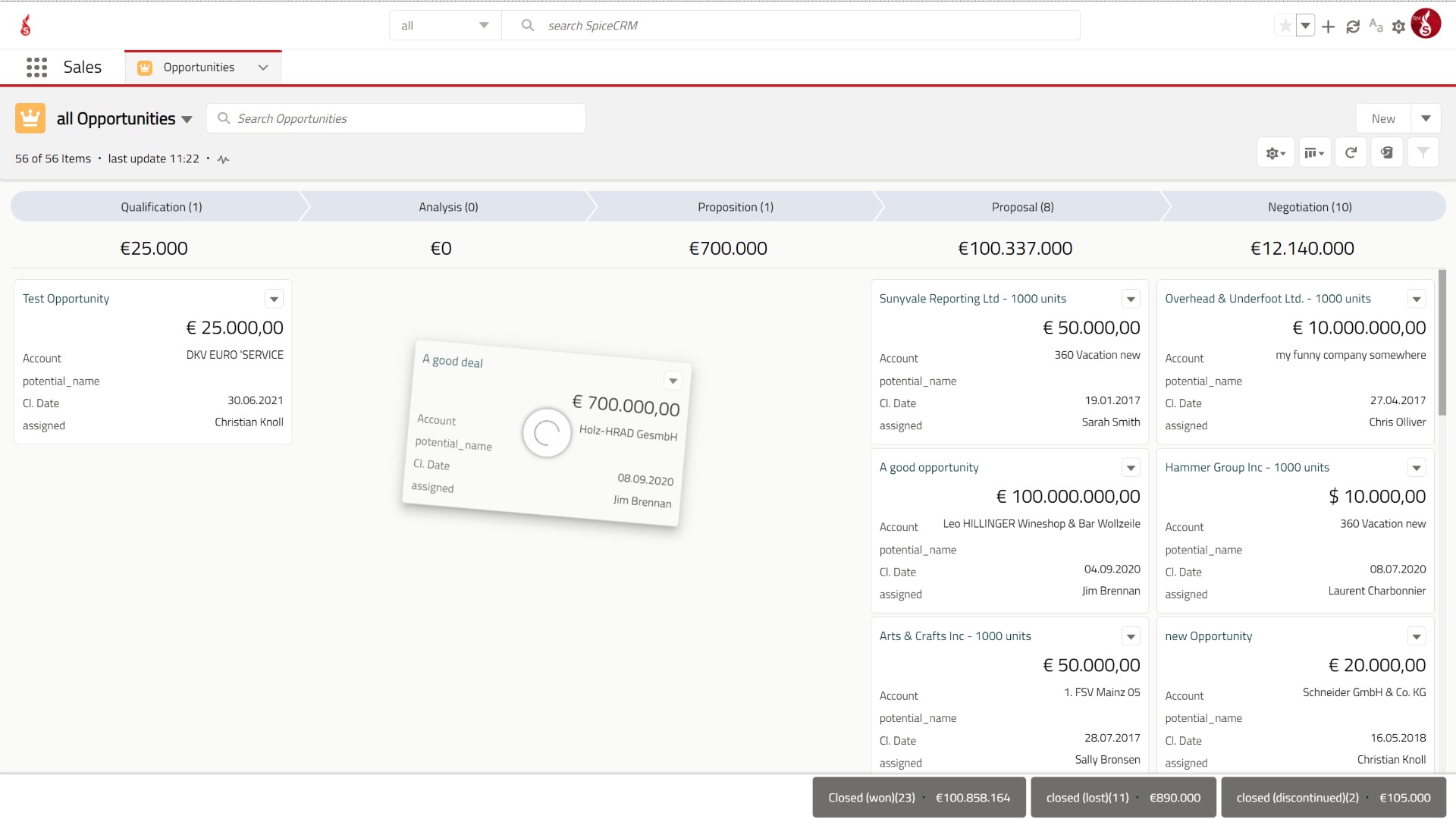
For many companies, CRM still begins in sales. What is decisive here, however, is not to document as many activities as possible. A functioning sales CRM must above all create transparency about which opportunities are realistic, where decisions are pending, and which next steps are necessary.
SpiceCRM supports classic sales processes from leads and opportunities through to pipeline management and forecasting.
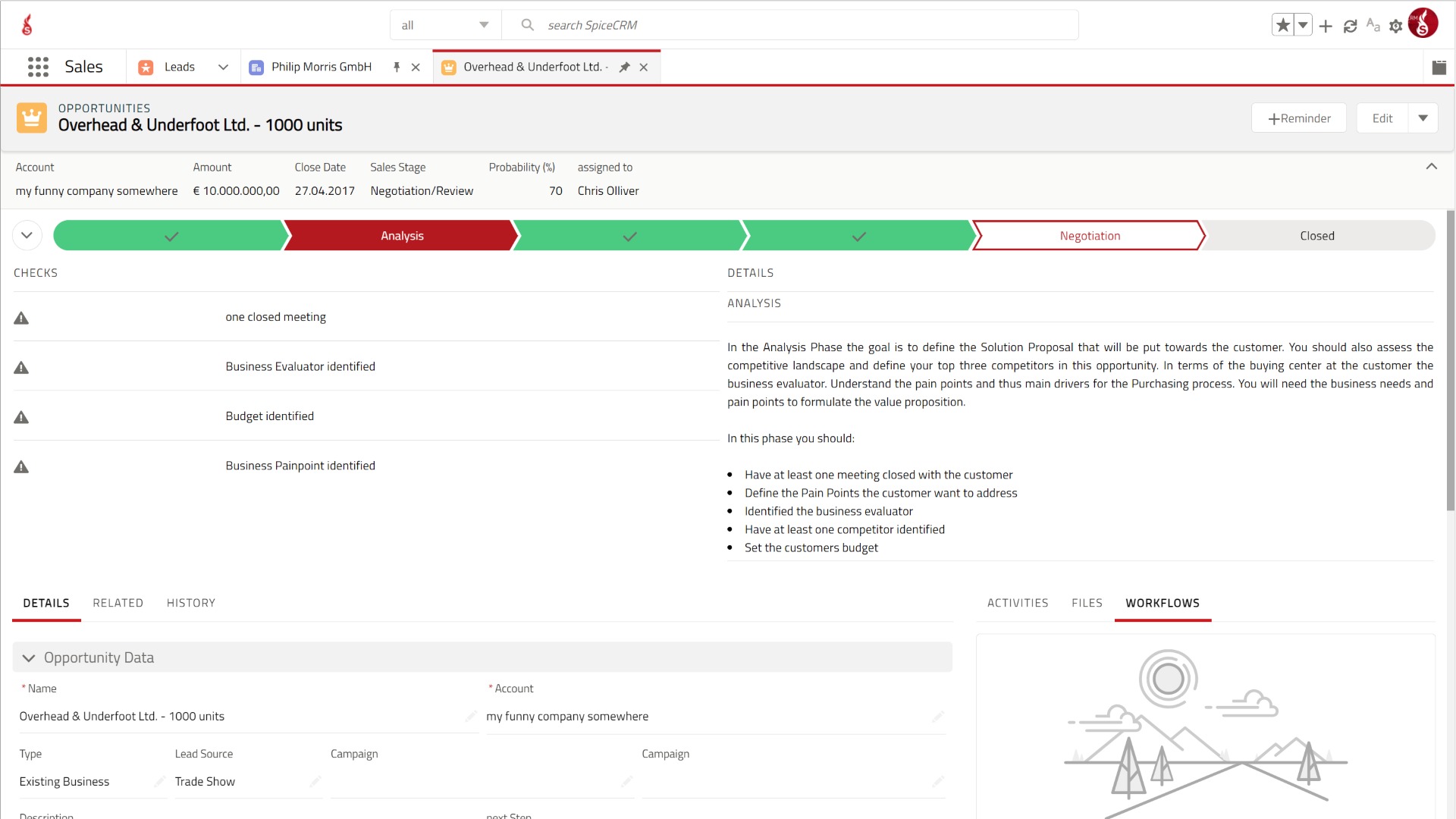
The platform becomes especially interesting where the standard sales process is not identical for all products, regions, or business models. Sales phases, roles, screens, data structures, and workflows can be adapted to the organization.
This allows, for example, a simple direct sales model to be mapped just as well as a multi-stage B2B process with partners, specialist dealers, technical checks, or more complex quoting phases.
The decisive benefit does not arise from introducing yet another opportunity database. It arises when the CRM makes the actual sales process visible and manageable.
2. When leads lose context in the handover: marketing and lead management
In many companies, marketing and sales still work in technically and organizationally separate worlds. Marketing generates contacts and campaign responses, while sales later tries to find out why a prospect is actually relevant.
At the latest during the handover of a lead, this separation becomes problematic.
SpiceCRM makes it possible to connect targeting, prospecting, lead management, and sales processes on a shared data basis.
This allows information from marketing activities to become an immediate part of the later sales process. The sales employee sees not only a new lead, but can trace which activities and interests preceded it.
Especially with longer B2B sales cycles, this context is relevant. Marketing then does not simply generate leads, but delivers information on which sales can continue to work.
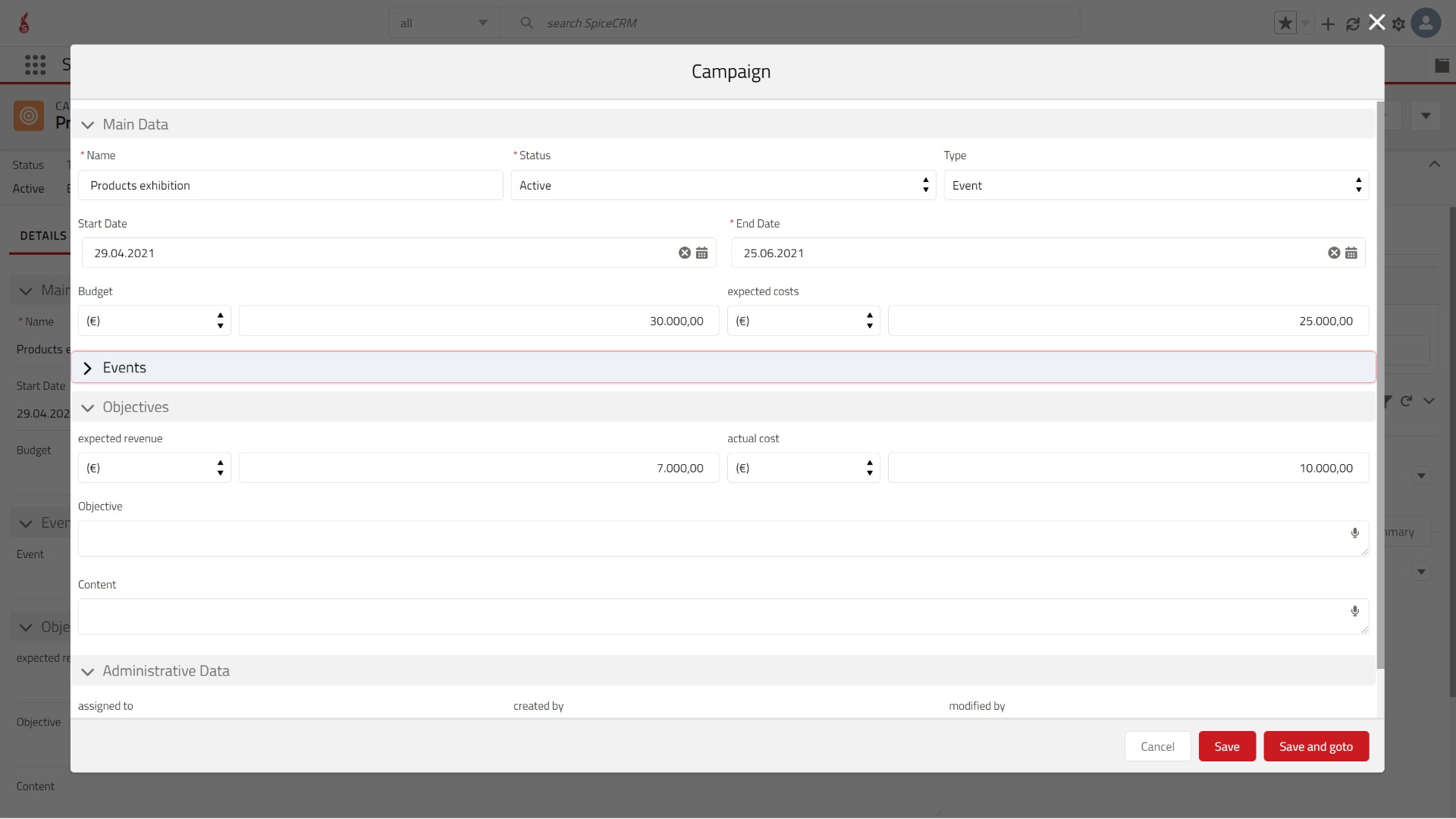
- structure audiences and prospects
- prepare marketing campaigns
- qualify leads
- manage handovers from marketing to sales
- bring together campaign and sales information
- evaluate conversion along the funnel
3. When sales knows nothing about current customer problems: service management
The customer relationship does not end when the contract is closed. In many business models, the part that decides on renewal, additional business, and long-term customer loyalty begins afterward.
It becomes problematic when sales and service work with separate information levels for this.
An account manager, for example, prepares a customer appointment. In the CRM, everything looks positive. At the same time, the separate service system contains several open tickets and perhaps even an escalation. For the customer, both areas are part of the same relationship – internally, however, they are often considered separately.
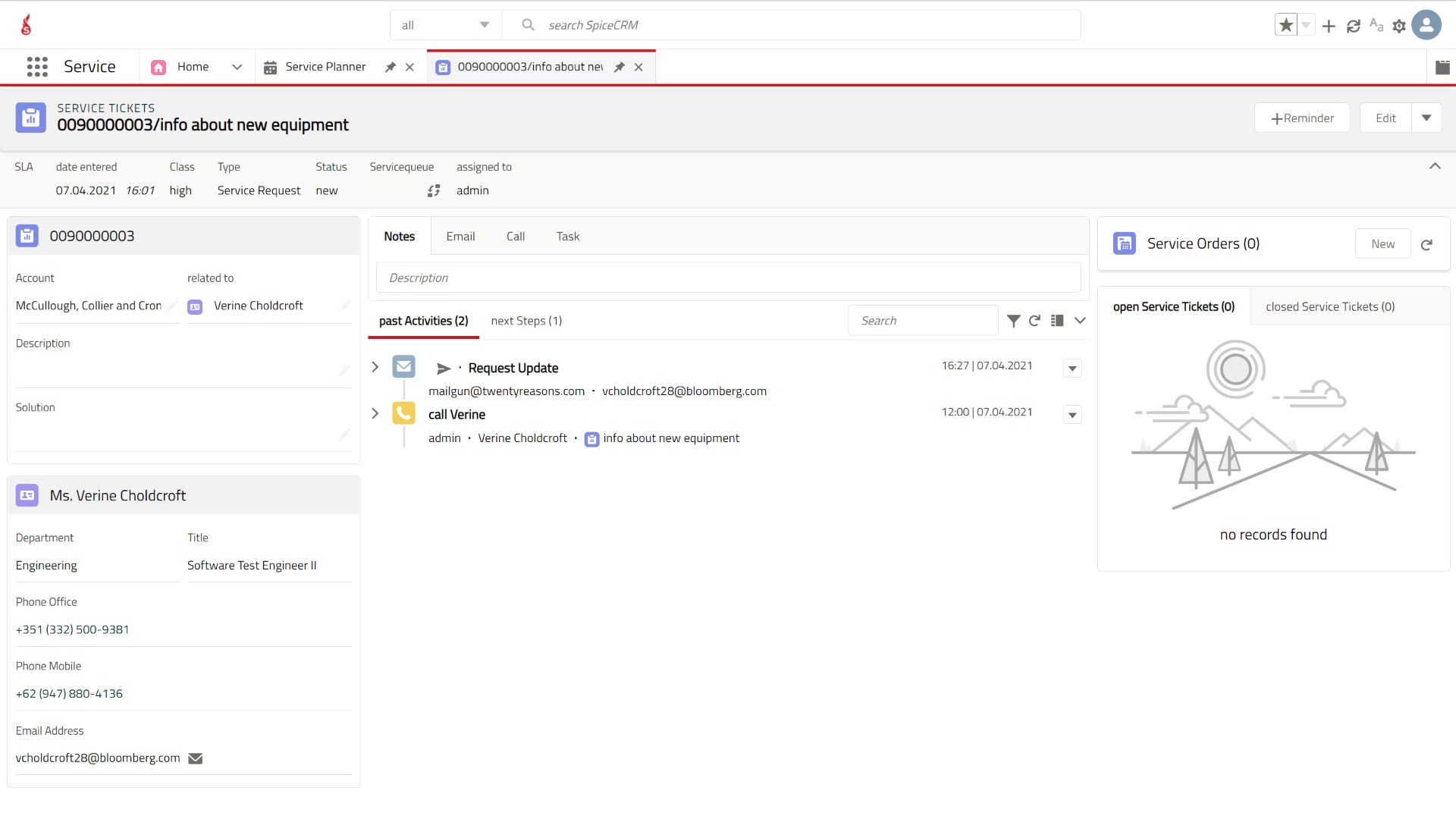
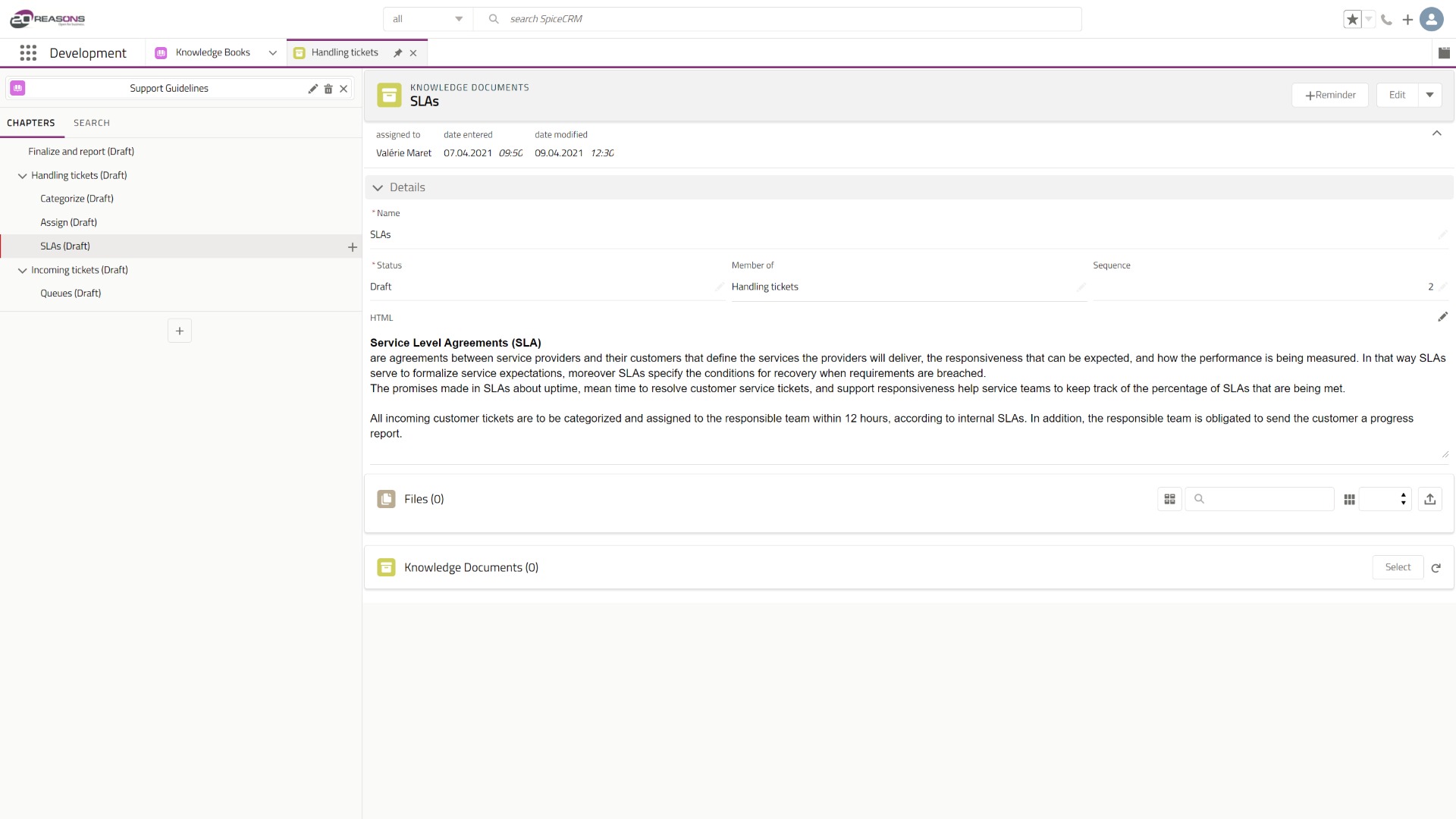
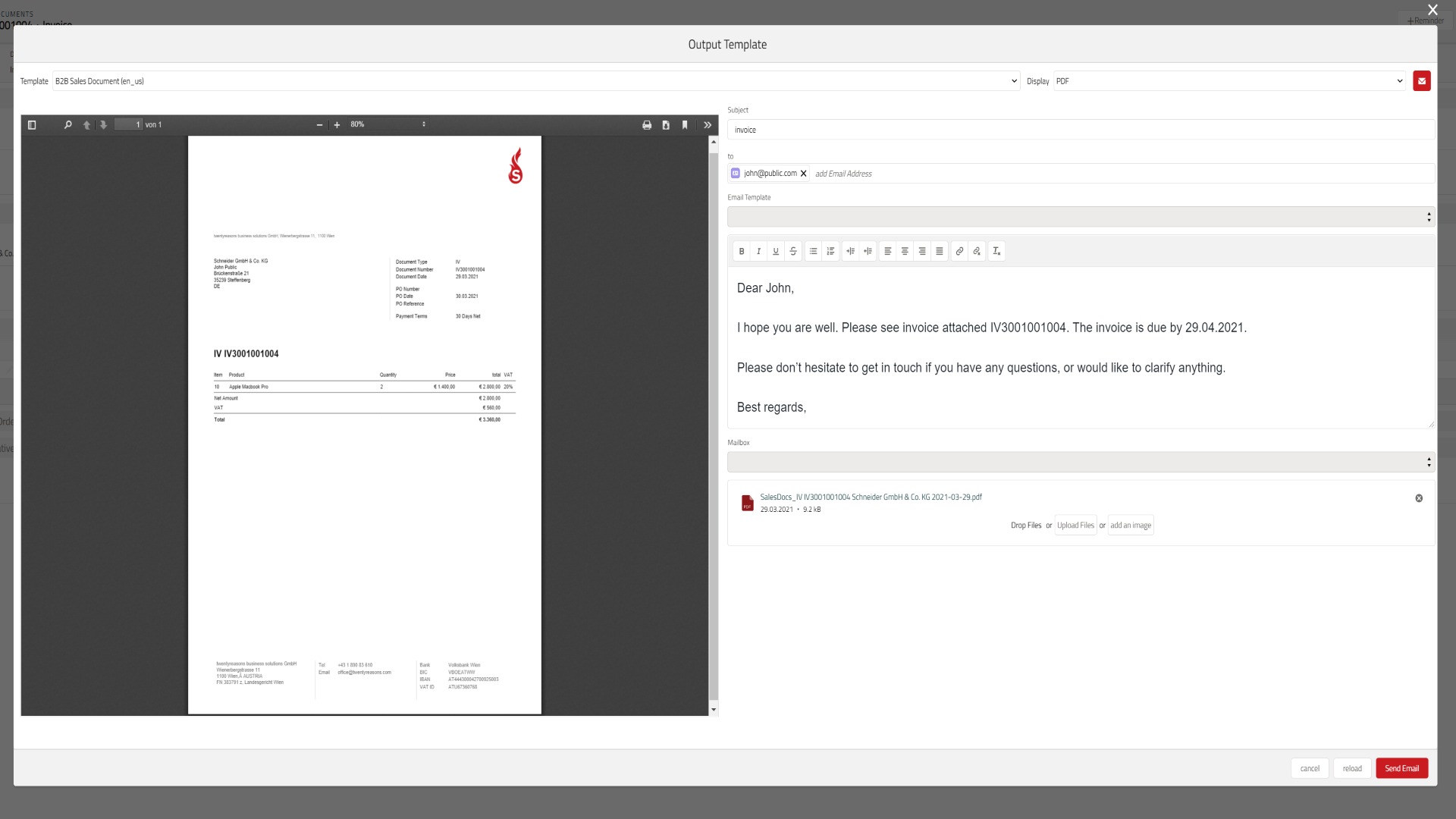
SpiceCRM can connect service requests, tickets, SLAs, escalations, and customer histories with accounts, contacts, products, or assets.
This creates a shared view of the customer relationship. Sales can take relevant service information into account, while service gains access to customer, contract, and contact information.
This allows companies, for example, to:
This creates an end-to-end customer view instead of separate sales and service databases.
- record service requests centrally
- classify and prioritize tickets
- monitor SLAs
- automate escalations
- link service cases with accounts, contacts, products, or assets
- make customer histories jointly usable for sales and service
4. When Excel begins between opportunity and order: product and quoting processes
In simple sales models, product name, quantity, and price are often sufficient. With more complex quotes, the reality looks different.
Products have variants. Customers receive different price lists. Configurations must be checked technically. ERP data plays a role. Approvals are needed, and in the end a correct quote or contract is meant to arise from an opportunity.
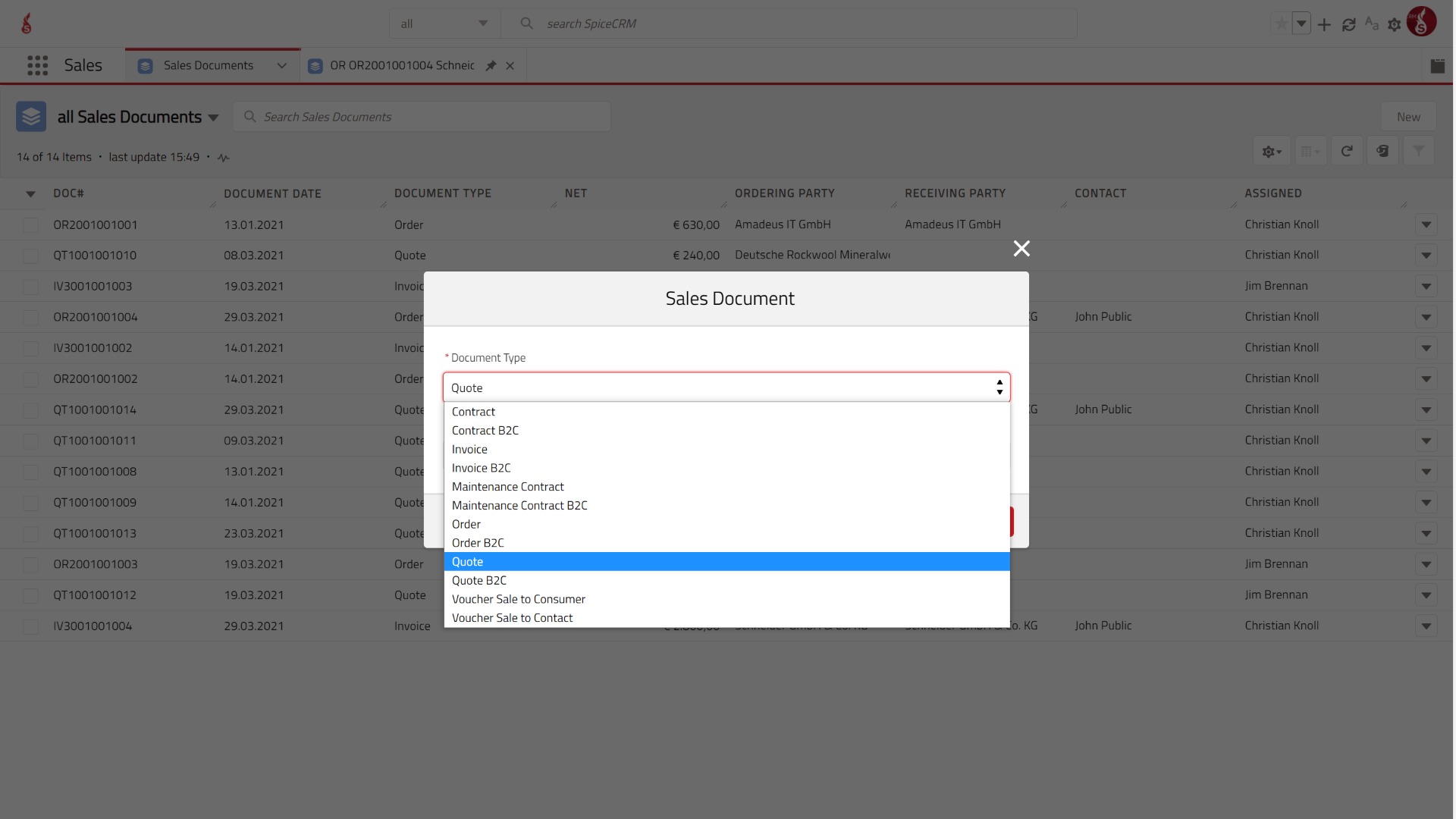
SpiceCRM can connect product management, variants, price lists, and product configuration with the sales process.
This turns the opportunity into more than just a record with an expected revenue. It can become part of an end-to-end process from needs assessment through configuration to quote creation.
Precisely at this point, the difference between a classic sales CRM and a platform on which more advanced business logic can be implemented becomes apparent.
This is interesting above all for companies that:
- offer many products or product variants
- use different price lists
- have complex quoting processes
- want to integrate ERP data into the sales process
- want to connect sales and product logic more closely
At this point it becomes clear why SpiceCRM should be understood as a platform rather than just a classic sales CRM.
5. When “Closed Won” is only the beginning: project management in the CRM
In service, engineering, or project companies, the actual service delivery often only begins after the contract is closed.
Exactly there, the next media break arises in many organizations. Sales hands over information via email or meeting to a project team, after which the case disappears from its view.
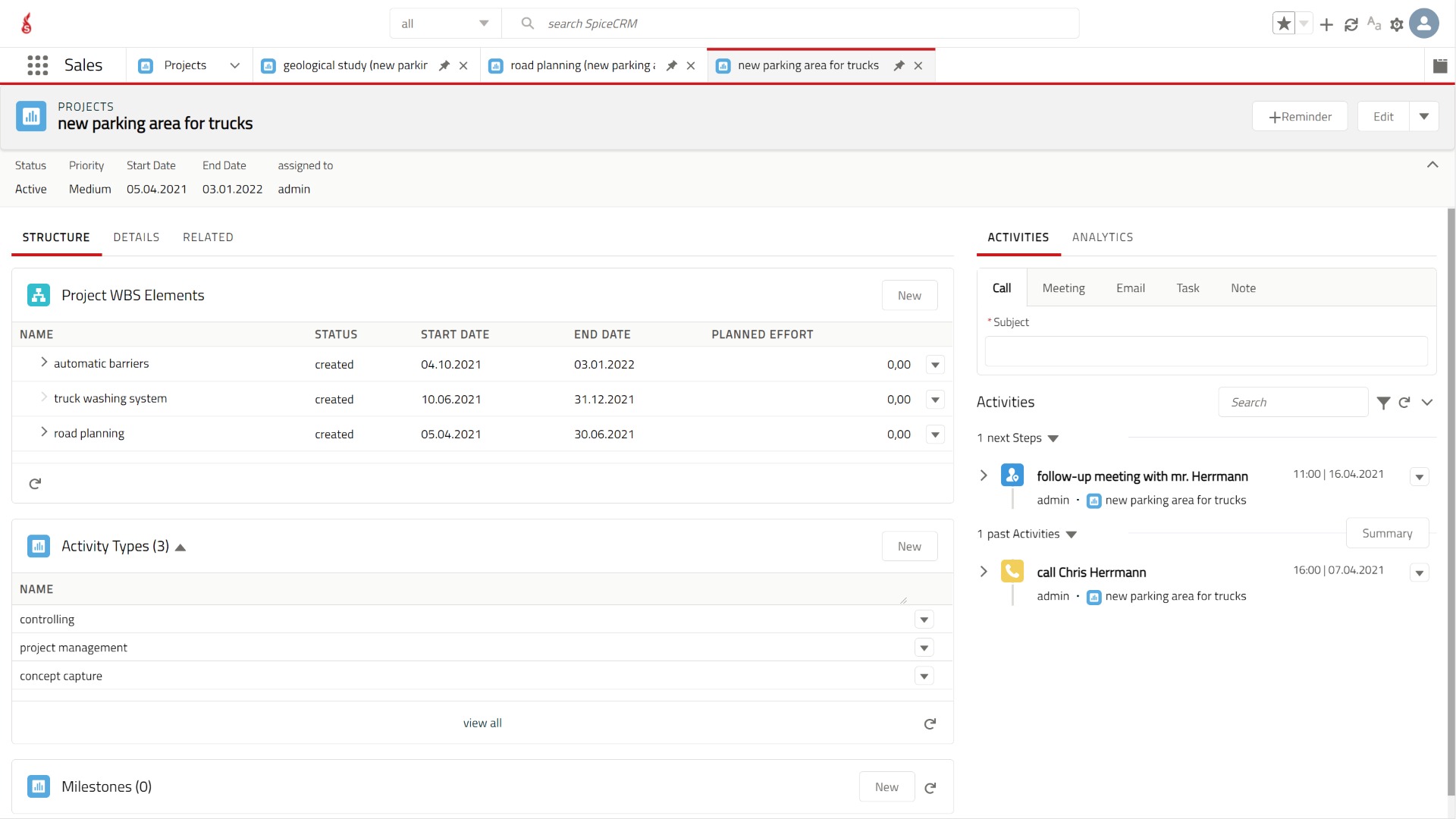
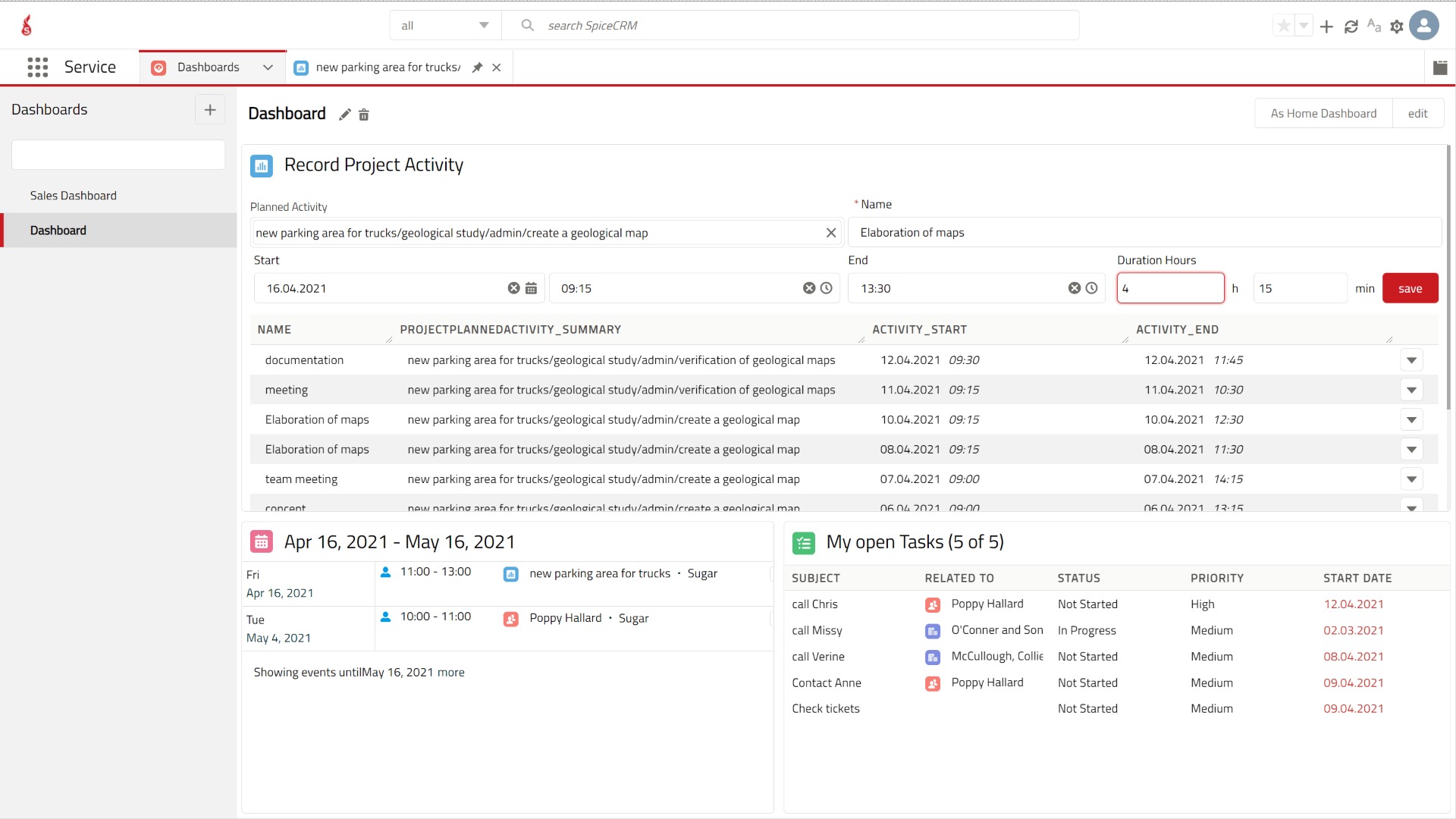
SpiceCRM can map project management as part of the customer platform. Project planning, tasks, resources, milestones, and further project-related information can stay connected with the account, contacts, and original opportunity.
This makes the transition from sales to delivery more transparent.
This is also relevant for sales. Project status, open topics, or new requirements can provide indications of expansion and follow-up business.
The CRM then accompanies the customer relationship not only up to the order, but beyond it.
Typical scenarios are:
- the opportunity becomes a project after closing
- project tasks are generated directly from the CRM process
- customer information stays connected to the project
- project status becomes visible for sales and management
- follow-up potential can arise from ongoing projects
This reduces information losses between sales and delivery.
6. When the standard process is no longer enough: custom processes and customizing
Standardization makes sense in the CRM. But hardly any company works permanently with standard processes only.
New business models, products, regions, regulatory requirements, or organizational changes create new requirements for data models and workflows.
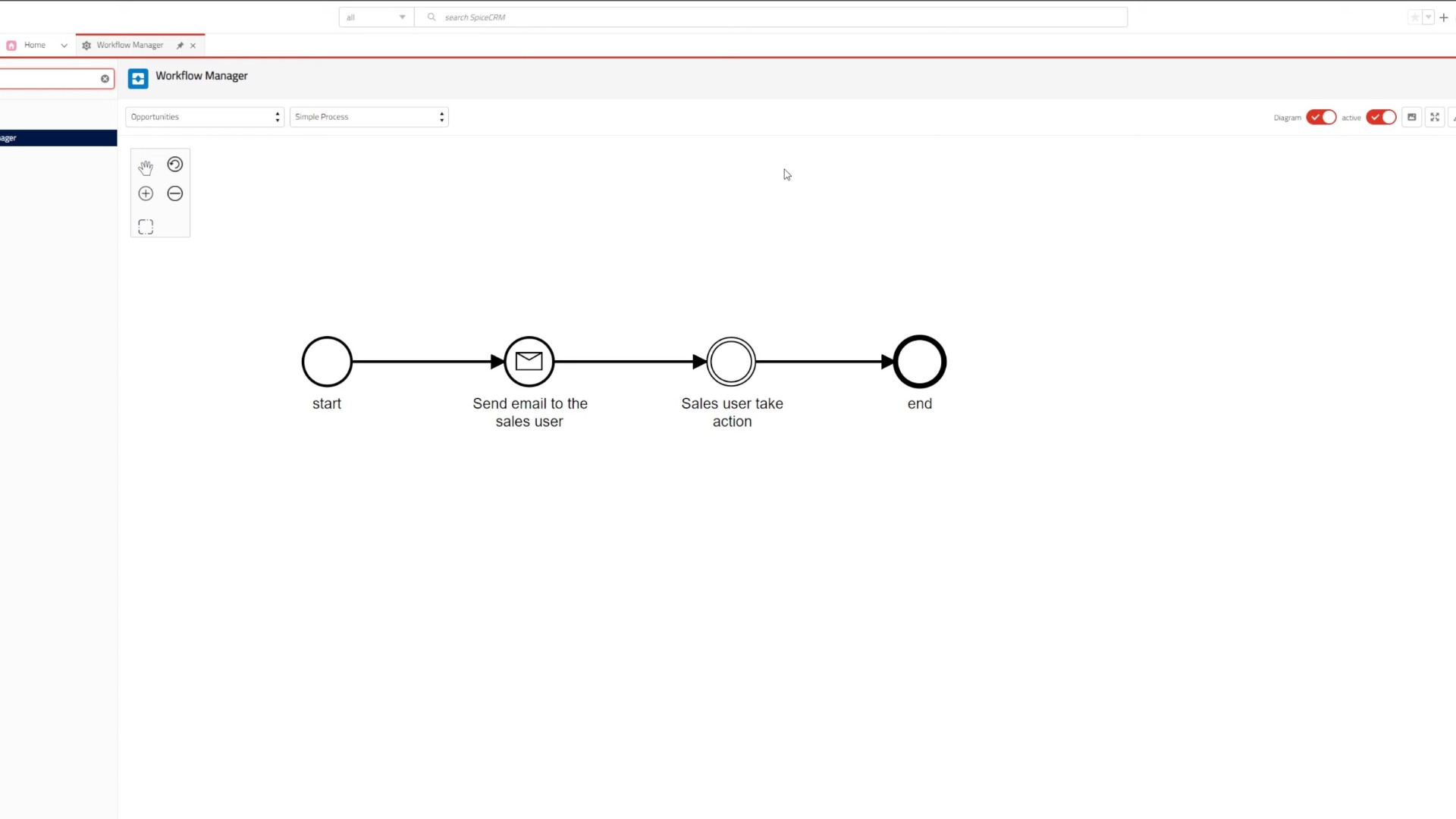
SpiceCRM can therefore be extended with custom modules, data objects, fields, relationships, role-based interfaces, workflows, dashboards, and process logic.
The decisive point here is not to customize as much as possible.
On the contrary: good CRM projects use standard functions where they are sufficient, and customize only where a real functional difference exists.
This keeps the platform maintainable and can nevertheless map real company processes.
SpiceCRM can be extended, among other things, with:
- custom modules and data objects
- custom fields and relationships
- role-based interfaces
- workflows and automations
- customer-specific process logic
- custom dashboards and evaluations
- integrations with third-party systems
This allows the platform to be developed further step by step along with the company.
Open architecture: The CRM does not have to own all the data itself
A CRM rarely stands alone. ERP, accounting, email, calendar, marketing, telephony, data warehouse, or industry-specific systems often have to be connected.
SpiceCRM relies here on open APIs and an open architecture. The vendor explicitly names integration with other systems as well as cloud and on-premise operation as central characteristics.
On our landing page, we mention, among other things, integration options with Office 365, Google Workspace, and SAP as well as open data APIs.
Especially in larger CRM projects, this openness is an important factor. The CRM can thereby form a central customer platform without having to physically own all the data itself.
For example:
- customer master data from the ERP can be integrated
- order and invoice information can become visible in the CRM
- activities from email and calendar can be adopted
- product or contract information can be integrated
- CRM data can be passed on to BI and reporting systems
The benefit arises from fewer system changes and better process continuity.
Cloud or on-premise: the operating model remains a customer decision
Not every company pursues the same IT strategy.
For some organizations, cloud operation is the economically most sensible option. Others require their own operation due to data sovereignty, regulatory requirements, existing infrastructure, or integration architecture.
SpiceCRM supports both cloud and on-premise scenarios.
This choice is especially relevant where the CRM architecture is part of a more comprehensive IT or data strategy.
The operating model should therefore not be considered in isolation based on the CRM. Integrations, security, governance, update strategy, and long-term operating effort are also decisive.
This can be especially interesting for companies with:
- high requirements for data sovereignty
- existing data center strategies
- complex integrations
- regulatory requirements
- custom infrastructure models
User interface: Showing less can be more important than more functions
A CRM can be excellently designed functionally and still fail in everyday use.
Often this is not due to missing functions, but to users seeing too much information, fields, and options.
SpiceCRM enables role-based interfaces. A sales employee can therefore receive a different view than a service agent, project manager, or managing director.
This allows the interface to be aligned more strongly with the respective task.
For adoption, this is decisive: a good CRM workplace does not show everything that is technically available. It shows as precisely as possible what the user needs for their next decision.
Which companies is SpiceCRM suitable for?
SpiceCRM can be used both for smaller organizations and for larger enterprise scenarios. The vendor describes various deployment sizes from small teams through to installations with several hundred or thousands of users.
From our perspective, the platform is especially interesting when several of the following requirements come together:
- sales, service, and marketing are to work on one platform
- custom processes must be mapped
- ERP or back-office systems are to be integrated
- cloud and on-premise must be available as options
- open APIs and technical openness are important
- the CRM is to be extended with further processes later
- companies want to retain more control over their CRM architecture in the long term
The platform approach is also particularly suitable for companies whose CRM is meant to be not just a sales tool, but a central process platform for customer-related workflows.
Industry solutions and complex areas of use
The strength of a platform is not shown by having as many functions as possible. What is decisive is whether several processes can be sensibly connected with one another on a shared data and process basis.
The larger an organization becomes, the more frequently handovers arise between departments, roles, and systems.
Exactly these handovers are often the places where information is lost or manual work arises.
SpiceCRM can therefore be used both as a classic CRM and as a starting point for more advanced customer-related processes.
The following overview shows typical usage scenarios and the business situation behind each.
Ten typical areas of use for SpiceCRM
| No. | Area of use | Typical benefit |
|---|---|---|
| 1 | Lead management | Capture, qualify, and hand over prospects to sales in a structured way |
| 2 | Sales automation | Manage opportunities, activities, pipeline, and forecast centrally |
| 3 | Quoting processes | Connect products, prices, configurations, and quotes with one another |
| 4 | Marketing | Link audiences, campaigns, and lead processes with CRM data |
| 5 | Customer service | Handle tickets, SLAs, escalations, and customer history centrally |
| 6 | Project management | Map customer projects, tasks, resources, and milestones in the CRM |
| 7 | Product management | Manage products, variants, price lists, and customer-specific quotes |
| 8 | Reporting | Evaluate sales, service, and management information together |
| 9 | System integration | Connect the CRM with ERP, Office, back-office, and other applications |
| 10 | Custom process platform | Implement custom modules, workflows, and data-driven business processes |
Practical example: Do not introduce everything at once
A typical company does not start with the requirement to build a “CRM platform.”
Usually there is first a concrete problem. For example, sales lacks a reliable pipeline, forecasts are consolidated in Excel, and customer information is spread across several systems.
Instead of immediately turning this into a large transformation project, SpiceCRM can first be introduced with a clearly limited sales process.
In a first phase, accounts, contacts, opportunities, activities, pipeline, and forecast are implemented. What is decisive is that this core works productively and is actually used by the users.
In a second phase, ERP information can be added. Orders, products, or contract information are then available in the CRM context without the users having to switch constantly between applications.
Afterward, service can be integrated, for example. Tickets and customer requests are connected with accounts, contacts, and products.
Further processes such as project management, quote configuration, or custom workflows only follow once the benefit is clearly defined.
Exactly this phased approach is, in our experience, often more successful than the attempt to implement all requirements on the first day.
It is important that the benefit of each phase becomes measurable. In a real project, for example, quote cycle time, the number of manual handovers, forecast quality, or the time spent searching for information could be compared before and after the rollout. Where robust customer figures are available, these should be used at this point – for example “quote cycle time reduced from [X] to [Y] days” or “[X] percent less manual coordination effort.”
This creates not only a technically functioning CRM. It creates a platform whose benefit remains verifiable with each expansion stage.
SpiceCRM and SugarAI: Two platforms, different starting points
Since we use both SugarAI and SpiceCRM, the question inevitably arises as to which system is better suited.
A blanket answer to this would be of little help.
Both platforms can map extensive CRM processes. Differences exist, among other things, in technology, user interface, product strategy, operating model, licensing, pricing, and extensibility.
Therefore, a decision should not be made via a long feature checklist. It is more sensible to select a few real end-to-end processes and test both platforms against them: Which data is needed? Which systems must be integrated? Which roles work in the process? Which customization is necessary? How is the system to be operated and developed further in the long term?
From these questions, it usually becomes much faster apparent which platform fits the respective organization better.
Conclusion: SpiceCRM is interesting when the CRM is meant to become a process platform and to replace Salesforce
SpiceCRM is more than a classic sales CRM. Its real strength lies in the ability to connect sales, marketing, service, projects, integrations, and custom business processes on a shared technical basis.
SpiceCRM has an interface based on the Salesforce Lightning Design System (SLDS) and supports end-to-end processes in marketing, sales, service as well as in product, project, and quality management.
This makes the platform particularly interesting for companies that want to replace Salesforce and where customer processes are today spread across several systems, departments, and manual handovers.
A good CRM project starts with a clear delimitation into implementation phases, a measurable goal, and a limited first use case or customer process. After that, the platform is extended in phases – always where the next expansion step brings a traceable benefit.
Are you currently evaluating whether SpiceCRM fits your CRM strategy? We are happy to support you with a discovery as well as later with implementation, migration, integrations, and change management.