The project manager at the customer is enthusiastic. The technical presentation went well, the need seems clear and the opportunity has been at “Proposal” in the CRM for weeks. Sales expects to close. Then purchasing suddenly gets in touch, IT asks for additional security evidence and management wants to reassess the investment altogether.
Such situations do not necessarily arise because sales did a poor job. Often the sales process was conducted mainly with one person, while the actual buying decision has long been influenced by several departments. Anyone who only knows their own main contact may see the interests of the other parties involved too late.
A structured buying center in the CRM helps to close exactly this gap. It shows who is involved in a specific buying decision, which requirements and approvals are still missing and where a deal remains at risk despite positive conversations. This requires neither a complicated org chart nor as many new mandatory fields as possible. What matters is a suitable data model, a small amount of meaningful information and a sales process that derives concrete next steps from it.
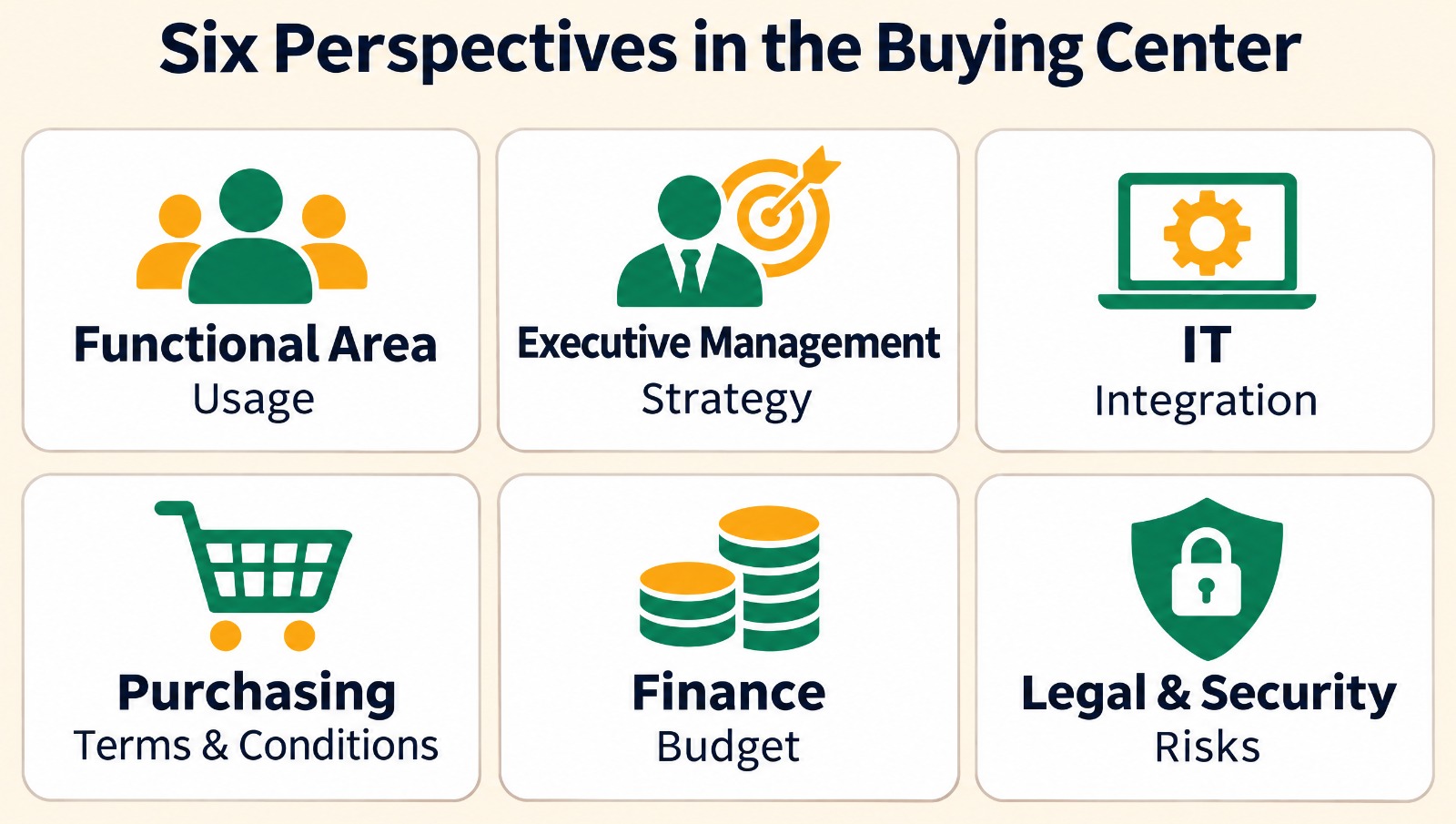
Table of contents
- What is a buying center – and why does it belong to the opportunity?
- Statistics: B2B buying decisions are team decisions
- A good contact is not yet an aligned buying center
- Ten buying center roles and their significance for sales strategy
- Mapping the buying center in the CRM: the data model decides
- Which information really needs to be maintained
- From people directory to sales decision: five checks
- Stage gates and automation: as much control as necessary
- More contacts do not automatically mean more consensus
- Three concrete situations from B2B sales
- SugarAI, SpiceCRM and SuiteCRM: different paths to implementation
- Consider permissions and data protection before the rollout, not after
- Which metrics show whether buying center management is working?
- Typical mistakes during introduction
- Practical example: a technically convincing deal almost fails due to missing approvals
- Buying center and AI: useful support, not automatic assessment of people
- Checklist: Can you really steer your buying center in the CRM?
- Conclusion: Don’t collect more contacts – enable better decisions
What is a buying center – and why does it belong to the opportunity?
The buying center describes the people and roles who prepare, influence, review, enable or approve a specific business purchasing decision. In a B2B project, this can include the business department, future users, IT, information security, purchasing, finance, legal and management. Those involved do not necessarily pursue the same goals: while the business department expects a quick solution, IT asks about integration risks and purchasing about contractual terms.
The distinction between organization and buying decision is important. An org chart shows who holds which formal position in a company. The buying center shows which role this person takes on for this particular investment. The head of IT may be a co-decision-maker on the business side when a CRM is introduced, merely a technical reviewer for a service contract and not involved at all in another project.
The buying center role should therefore not be treated in the CRM as a permanent attribute of a contact across the board. It belongs in the context of contact and opportunity. External consultants or group functions can also exert influence without being employed by the buying company themselves.
Statistics: B2B buying decisions are team decisions
Current studies confirm that B2B sales increasingly has to take into account the interests of entire decision-making groups.
Forrester, “The State of Business Buying, 2026”: The basis is the Buyers’ Journey Survey 2025 with almost 18,000 business buyers surveyed worldwide. Forrester reports an average of 13 internal stakeholders and nine external influencers around a B2B buying decision. 53% of the buying processes examined involve procurement professionals as decision-makers. In addition, 94% of buyers surveyed in groups of six or more people see clear benefits of broader involvement, such as better risk assessment or easier budget approval. Source: Forrester, press release of January 21, 2026 and Forrester, analysis of January 21, 2026.
Gartner, “B2B Buyer Teams Demonstrate Unhealthy Conflict”, 2025: In a survey of 632 B2B buyers conducted in August and September 2024, Gartner reported that 74% of the buying teams examined showed unhealthy conflict during the decision process. Groups that reached consensus were 2.5 times more likely to describe their deal as high quality. Source: Gartner, press release of May 7, 2025.
The studies look at different samples and questions. The figures cited are not a fixed target for the number of contacts to be maintained in the CRM. Nor do they prove that introducing a stakeholder matrix alone improves the win rate. They do show, however, why focusing on a single contact is risky in complex decisions.
A good contact is not yet an aligned buying center
The most important contact in sales is often a business advocate. They know the problem, want to bring about change and may even support the vendor internally. In everyday sales, such a contact is often recorded as the “decision-maker”. This label only makes sense, however, if the person actually has the necessary authority.
A champion is not automatically the budget owner. An economic decision-maker does not have to be able to evaluate the solution in detail. A technical reviewer can block an implementation without deciding on the purchase price. And purchasing can still impose requirements on tendering, liability or contract terms despite a positive business evaluation.
The crucial question is therefore not just: “Whom do we know?” It is: Which perspectives are relevant to this decision, and which of them have we already reliably understood?
This does not mean approaching as many people as possible unsolicited. A good sales process clarifies together with the existing contact how the decision is being prepared at the customer and which people should sensibly be involved. Sensitive internal coordination in particular is better resolved through respectful questions than through aggressive attempts at contact.
Ten buying center roles and their significance for sales strategy
The following table describes ten typical functions in demanding B2B buying processes. It is intended as an aid to decisions and conversations, not as a mandatory staffing list. One person can take on several roles, and some roles are not relevant for a specific opportunity.
| Role / perspective | What they typically focus on | What should be clarified in the CRM | Sensible next step |
|---|---|---|---|
| 1. Initiator | Trigger, pressure to act, desired change | Which problem triggered the buying process? | Confirm trigger and priority |
| 2. Business sponsor | Business benefit and internal support | Who is driving the initiative in the business department? | Agree on shared success criteria |
| 3. Economic decision-maker | Investment, business case, alternatives | Who can actually approve the budget? | Validate the economic benefit |
| 4. User representatives | Day-to-day suitability and acceptance | Which user groups are affected? | Organize a hands-on test or workshop |
| 5. Technical reviewer | Architecture, integration, operations | Which technical requirements are still open? | Schedule the technical review early |
| 6. Information security / data protection | Data access, risks, evidence | Which reviews and documents are required? | Clarify security and data protection questions |
| 7. Purchasing | Comparability, terms, procedures | When and according to which rules will the purchase be made? | Align on purchasing process and deadlines |
| 8. Finance / controlling | Budget source, costs, cost-effectiveness | Which financial planning or approval is needed? | Prepare a business case that can be verified |
| 9. Legal / compliance | Contracts, liability, internal policies | Which contract clauses or rules are critical? | Start the contract review in good time |
| 10. Executive sponsor / approver | Strategic priority and overarching decision | Who decides in the event of conflicting goals or escalations? | Establish management alignment |
A mature buying center analysis also distinguishes between a formal role and actual influence. A technical specialist without signing authority can be decisive for the project if their assessment is a mandatory prerequisite for approval. Conversely, a senior executive does not have to be involved in every operational assessment.
Mapping the buying center in the CRM: the data model decides
Many CRM systems know accounts, contacts and opportunities as well as relationships between these objects. For a simple scenario, it is enough to link several contacts to an opportunity and assign each of them a role. As soon as a company also wants to record influence, position, open objections, approval status or history, the relationship itself becomes a business record. A sensible model can look like this: Account → Opportunity → Buying center participation ← Contact
The buying center participation therefore links a contact to exactly one opportunity. Information that applies only to this buying decision can be stored there. A contact remains as a master record and can at the same time have a different role in other opportunities. For more demanding deals, seven fields on this relationship are often sufficient:
- Role in the deal: for example budget approval, technical review or business sponsor.
- Influence: high, medium or low – with a clearly defined meaning.
- Stance on the initiative: supportive, open, critical or unknown; ideally only with a verifiable basis.
- Engagement status: identified, contacted, requirements clarified or approval given.
- Open question or requirement: for example a missing IT security certificate.
- Next step with owner: what happens by when, and who takes care of it?
- Last validation: when were role and status last reviewed?
Not every organization immediately needs its own CRM module for this. With only a few criteria, existing contact-opportunity relationships and suitable extensions can be enough. A separate intermediate object becomes interesting when it needs its own activities, rules, approvals, history or integrations. The decision should be based on concrete reports and processes, not solely on what is technically feasible.
One important modeling mistake should be avoided: “decision-maker” does not simply belong on the contact as a single field. After all, the same person can approve a smaller renewal themselves, but only make a recommendation for a larger investment.
Which information really needs to be maintained
The temptation is great to record detailed profiles, influence scores and relationship assessments for every person involved. In everyday practice, this often leads to incomplete data that is laborious to maintain but hardly improves decisions.
A tiered approach is better. For smaller, standardized deals, one main contact and clarity about the approval are often enough. For larger or riskier opportunities, the relevant perspectives are added step by step. Requiring a complete stakeholder map as early as lead qualification, on the other hand, would usually be neither practicable nor justified.
The distinction between confirmed information, assumption and unknown facts is particularly important. “Budget has been approved” must not be equated with “Our contact does not expect any problems”. An assumed positive stance of other departments is not yet an internal consensus either.
Where information is missing, this is not a data error at first, but an open sales question. The CRM should make this uncertainty visible and help plan the next sensible contact or piece of evidence.
From people directory to sales decision: five checks
A buying center view only creates value when it changes behavior in sales. For larger opportunities, a short review along five questions is suitable:
1. Do we know the actual decision path?
Is it clear which bodies recommend, review, negotiate and approve? If a central approving body is unknown, the deal must not be considered secure just because of a positive conversation with the business side.
2. Is there a solid economic reason for the decision?
The technical solution can be convincing and still fail because of an unclear investment priority. The business case must be understandable to the role responsible for budget and economic goals.
3. Are technical, legal and organizational hurdles visible early enough?
Information security, data protection or integration do not have to be fully reviewed in every phase. It should, however, be known whether these areas need to be involved and what consequences this has for the decision.
4. Is support broader than a single person?
If only one champion is actively involved, this creates a concentration risk. In the event of a job change, vacation or changed priorities, access to all other parties may then be lost.
5. Which concrete action improves the decision situation?
Another meeting is only helpful if it is clear which question it is meant to clarify. This can be the joint evaluation of a pilot project, a coordination meeting between the business department and IT or the early clarification of purchasing terms.
These five checks can become part of an opportunity review. What matters is not that sales gives all stakeholders a green status. More valuable is an honest overview of where the decision is still open.
Stage gates and automation: as much control as necessary
For sales operations, the question is how this review can be translated into a binding process without worsening CRM adoption. One possible rule is: before the “binding proposal” stage, it must be documented who gives economic approval and whether technical or contractual reviews are required. If one of these questions is unanswered, the system should display a notice and trigger a task. A complete technical review report does not necessarily have to be available at this point.
For large projects, additional approval by the sales manager can make sense. For standard deals, the same review effort would be inappropriate. Rules should therefore be differentiated by deal size, product type, industry, integration effort or risk category.
Automation helps in particular with traceable triggers: an important approver is unknown, the last validation was some time ago or an agreed technical appointment has been missed. Responsibility for the business assessment, however, remains with sales and the specialists involved. An automatically calculated traffic light must not turn missing information into apparent certainty.
More contacts do not automatically mean more consensus
When it comes to buying centers, the frequent recommendation is to build as many contact relationships as possible. In complex deals, this idea is understandable but falls short.
A good multithreading approach does not mean working on five departments independently of one another, each with different sales arguments. Rather, it should help to create a shared picture of the decision. The business department, IT and purchasing can have different requirements, but in the end need a shared understanding of what benefit is to be achieved, what risks exist and how the implementation can succeed.
In practice, a joint validation workshop can make more sense than several uncoordinated individual meetings. In a demanding software rollout, the business department could describe the desired processes, IT could explain binding architectural boundaries and project management could define a realistic rollout sequence. The vendor helps to make open contradictions transparent.
Such a shared working basis does not eliminate every difference of opinion. It does, however, create the prerequisite for the buying team to resolve conflicts early and on the basis of the same information.
Three concrete situations from B2B sales
Technical solution for an industrial customer: The production manager wants to introduce a new platform. The technical evaluation is positive, but central IT has architecture guidelines and purchasing requires a formal vendor comparison. In the CRM, this opportunity should not be considered “almost won” as long as the decision process, review requirements and responsibilities are open.
Company-wide CRM rollout: Sales management is the sponsor of a new CRM project. Customer service, IT, data protection and finance, however, influence the project. The buying center should also show the future user groups, because a lack of acceptance or integration requirements can change the investment decision.
Contract renewal with expansion: An existing account is satisfied, but the new expansion falls under a different budget responsibility. The previous main contact remains important but may not be able to approve the new initiative themselves. The buying center for the new opportunity should therefore be reviewed again and not simply copied from the previous deal.
In all three cases, the value of the CRM documentation lies in deriving a concrete next step. The number of contacts recorded alone would not be a sufficient indicator of success.
SugarAI, SpiceCRM and SuiteCRM: different paths to implementation
The business logic of a buying center is largely platform-independent. In the technical implementation, however, the available functions and the necessary customization effort differ.
SpiceCRM explicitly describes functions for buying center and account team in its product description for “Opportunity 2 Contract”. This makes it possible to directly address the distinction between the decision-making body on the customer side and the internal sales team. What remains decisive is how these functions are configured in the specific version used and integrated into the sales stages.
SuiteCRM documents the assignment of several contacts to an opportunity and an opportunity role, for example decision maker, evaluator or influencer. A simple role model can be built on this. For additional criteria such as verified influence, objections or validation status, it must be checked which extensions are actually required.
SugarAI has relationships between opportunities and contacts; the documented database schema also includes a contact-related role on the opportunity-contact link. Which information is available in the user interface and how additional attributes, automations or custom modules can be implemented depends on the product version and configuration used.
In all three cases, a buying center solution does not have to be maximally complex. The most sensible implementation is the one that supports a concrete sales process and whose data can be maintained reliably.
Consider permissions and data protection before the rollout, not after
Stakeholder data is personal data. In addition, buying center notes can contain sensitive business assessments, for example on budget approvals or ongoing contract negotiations. Purpose limitation, data minimization, accuracy and appropriate access rights therefore belong in the concept from the outset. These principles can be found, among other places, in Article 5 of the GDPR.
Companies should be particularly careful with subjective personal assessments. Statements such as “is difficult”, “is easily influenced” or speculation about motives have little place in professional CRM documentation. A factual, action-oriented note is better: “IT requires a documented penetration test before approval” or “Budget decision will be made at the next investment committee meeting”.
Access should be based on the actual task. Sales reps need the relevant buying process information; not every personal assessment needs to be widely visible in the company. Appropriate retention and deletion rules should also apply to legacy data, departed contacts and closed opportunities. The specific legal basis for processing must be examined for each company; the B2B context does not automatically make personal data freely usable.
Which metrics show whether buying center management is working?
A good analysis does not simply count contacts per opportunity. It measures whether there is more clarity on the relevant roles and whether open decision risks are addressed in good time.
Buying center coverage: Share of the roles defined as necessary for an opportunity to which a confirmed person or responsible unit is assigned. The required roles must be defined per deal type before the calculation. Otherwise, the metric is easy to manipulate.
Verified economic approval: Share of relevant opportunities for which the budget and approval path has been clarified through traceable information. An assumed decision-maker is not enough.
Review before proposal submission: Share of opportunities for which technical, legal and commercial review requirements are known in good time. What is measured is the identification of the review steps, not necessarily their completion.
Single-contact dependency: Share of larger opportunities in which only one person actively provides access to the customer’s decision-making body. This metric shows a possible risk without automatically downgrading every deal with only one contact.
Late approval obstacles: Number or share of deals in which decision-relevant requirements emerge for the first time after the final proposal. A clear definition prevents normal renegotiations from being counted as errors.
Decision time after proposal: Time between a consistently defined proposal stage and the documented decision. This metric should be evaluated separately by deal type and complexity.
The win rate can be monitored in addition. However, it is unsuitable as the sole proof: win rates also depend on price, competition, market, lead quality, proposal scope and sales strategy. Anyone who wants to better assess the effect should look at comparable groups of opportunities over sufficiently long periods.
Typical mistakes during introduction
A first mistake is equating job title with influence. A managing director may formally approve, while the essential preparation of the decision takes place elsewhere. Nor should a committed business contact automatically become the economic decision-maker without a solid review.
A second mistake is too much documentation. If ten roles, four scales, several free-text fields and regular mandatory updates are required for every opportunity, additional administrative work is created. The CRM then becomes not more accurate, but less complete.
Third, buying center data is sometimes only updated as part of the annual review. In the meantime, employees may have changed, budgets may have been frozen or requirements reassessed. A seemingly complete map is then more dangerous than a visibly incomplete one.
Finally, companies confuse a positive mood among contacts with a binding buying decision. Especially when several business departments are involved, verifiable information on budget, approvals, risks and shared success criteria is needed.
Practical example: a technically convincing deal almost fails due to missing approvals
The following scenario is an illustrative model example. The company, the figures and the results are freely chosen. They do not describe a proven MyCRM customer project or a general forecast of success.
Initial situation
A mid-sized provider of industrial automation solutions works with a CRM and regularly wins complex investment projects in the six-figure euro range. Sales maintains opportunities, proposal values and the next activities, but often records only the most important business contact per deal.
Several opportunities remain in the proposal stage for a surprisingly long time after a positive technical workshop. Only late does the team learn about investment approvals, information security reviews or different requirements from purchasing. Sales management sees the forecast order value, but not reliably which decision is actually still pending at the customer.
Phase 1: Analyze decision risks retrospectively
Sales operations and sales management examine 40 comparable complex opportunities from a completed period. They map which roles were involved in the decisions and when important approvals became known.
This shows that the economic approval path was traceable in the CRM for only 14 of the 40 opportunities. Technical review criteria were documented before the final proposal in 18 of 40 cases. In twelve opportunities, significant approval obstacles only emerged after the proposal had been submitted.
Phase 2: Introduce a lean buying center model
For suitable opportunities, contacts are linked with role-related information. The team initially agrees on the most important perspectives: business department, economic decision-maker, technical review and purchasing. Other roles are only added if they are relevant to the respective decision.
A simple CRM review separates confirmed findings from open questions. It is also determined who clarifies the approval path and which colleagues can provide support on IT or contract questions. Data is maintained as far as possible as part of regular sales activities, not in an additional weekly report.
Phase 3: Connect sales stages with real decision steps
Before submitting a binding proposal, sales now checks whether the economic approval process is known and whether technical or legal reviews are required. Missing information initially triggers notices and tasks, not a blanket technical lock.
For a larger project, the team then holds a joint workshop with production, IT and purchasing. It becomes clear early on that an integration review and an internal budget approval are required. Both are taken into account in the schedule instead of only becoming visible in the final negotiation.
Phase 4: Pilot and evaluation
After the introduction, a further group of 40 more complex opportunities is examined. In this illustrative comparison, the figures develop as follows:
| Metric | Baseline group (40 deals) | Follow-up group (40 deals) |
|---|---|---|
| Economic approval path traceable | 14 / 40 (35%) | 28 / 40 (70%) |
| Technical review criteria documented before final proposal | 18 / 40 (45%) | 31 / 40 (around 78%) |
| Significant approval obstacles first emerging after proposal | 12 / 40 (30%) | 6 / 40 (15%) |
| Median from final proposal to documented decision | 62 days | 53 days |
The figures illustrate how a pilot could be evaluated. Even with comparable deal types, the changes would not yet prove that the new buying center model alone caused the results. Seasonality, competition, team composition and different buying processes could also play a role.
The model company’s most important progress is initially better transparency. A deal is no longer “hot” just because the main contact is enthusiastic. The team can name who still has to agree, which questions are open and which action actually moves the opportunity forward.
Buying center and AI: useful support, not automatic assessment of people
AI can make it easier to maintain stakeholder information. Conceivable are role suggestions from meeting notes, summaries of open review requirements or notices of missing participants. An opportunity review can also benefit from a summary that highlights conflicting dates, missing approvals and assumptions that have not been checked for some time.
This is exactly where a clear boundary is important. No supposedly reliable personal influence score may be derived from an email. An AI system should neither diagnose hidden motives nor declare a person a “blocker” without review. What makes sense are verifiable indications with a reference to their source, which an employee confirms or rejects.
The better roles, responsibilities and open questions are structured in the CRM, the easier it is to use AI as a supporting tool. However, it is not a prerequisite for a functioning buying center. The business terms and the sales process must be right first.
Checklist: Can you really steer your buying center in the CRM?
The following checklist is suitable as an initial review for sales operations, sales management and CRM administration. Often, just a few adjustments are enough to make decision-relevant gaps visible earlier. More extensive enhancements should only follow once the teams are using the simple model reliably.
- The relevant decision perspectives are defined for complex opportunities.
- Buying center roles are maintained per opportunity and not only on the contact.
- A contact can take on different roles in different opportunities.
- The actual economic approval path is traceable or marked as open.
- Business sponsor and economic decision-maker are not automatically equated.
- Technical and legal review requirements are identified in good time.
- Purchasing and finance are taken into account when they influence the process.
- External influencers can be appropriately included where needed.
- Confirmed information, assumptions and unknowns can be distinguished.
- Critical stakeholder information has a traceable as-of date.
- Data maintenance is tiered according to deal size and complexity.
- CRM screens only contain information that supports concrete sales decisions.
- Next steps with owners exist for identified gaps.
- Opportunity reviews take consensus and approval risks into account.
- Automatic notices do not replace business confirmation.
- The key metrics compare suitable groups of opportunities.
- Personal data is protected in a purpose-bound, factual and appropriate manner.
- Insights from lost and delayed deals are fed back into the sales process.
Conclusion: Don't collect more contacts – enable better decisions
Complex B2B deals are rarely lost because one contact too few was stored in the CRM. It becomes critical when the sales team does not understand the customer’s actual decision process or only recognizes open approvals after the final proposal has already been sent.
A properly mapped buying center links people, roles, requirements and next steps to the respective opportunity. It helps sales understand different interests at the customer, distinguish between business and economic decision-makers and address obstacles in good time. The effort should always match the value and complexity of the deal.
Anyone who wants to develop their CRM further in this respect should start with a simple question: For which of our most important opportunities do we really know today how the decision will be made? The answer is usually more meaningful than yet another overview of pipeline volume and win probability.
MyCRM helps companies implement such sales processes functionally and technically – with suitable data models, opportunity structures and tailored extensions in SugarAI, SpiceCRM or SuiteCRM. The goal is not more documentation, but a CRM that helps with concrete sales decisions.
Sources and further information
- Forrester (2026): The State Of Business Buying – press release – figures on internal and external participants, procurement and benefits of larger buying groups.
- Forrester (2026): The State Of Business Buying – analyst post – context on the Buyers’ Journey Survey 2025 with almost 18,000 business buyers.
- Gartner (2025): B2B Buyer Teams Demonstrate Unhealthy Conflict – survey of 632 B2B buyers on conflict and consensus.
- SpiceCRM: Opportunity 2 Contract – product description of buying center and account team.
- SuiteCRM: Contacts and opportunity roles – documentation of contact assignment and opportunity role.
- SugarAI: Opportunities–Contacts database schema – technical documentation of the contact role on the relationship.
- EUR-Lex: General Data Protection Regulation, Article 5 – principles relating to the processing of personal data.
Related MyCRM articles
- Planning your CRM data model properly – on modeling relationships with their own attributes.
- Partner sales in the CRM – for opportunities with additional sales partners involved.
- Planning CRM permissions properly – on access rights to sensitive CRM information.