The contract is signed, the opportunity in the CRM is set to “Won” and sales can book the successful deal. From a sales perspective, an important goal has been reached. For the customer, however, the actual collaboration often only begins now.
What exactly was promised during the sales process? Which technical prerequisites need to be in place? Who organizes the rollout, which contacts are involved and when should the customer be able to work productively with the solution for the first time?
In many B2B companies, this information exists somewhere, but not in one shared place. Part of it sits in the opportunity, further details are in the quote, technical requirements were discussed in emails and certain commitments are known only to the responsible sales rep.
The consequences often show within just a few days of closing. The implementation team has to request information again, Customer Success tries to clarify expectations and the customer feels they have to explain certain things a second time. What should be the positive start of a long-term business relationship turns into a phase full of coordination and delays.
This is exactly where a well-organized customer onboarding process in the CRM can make a considerable difference. The prerequisite, however, is that companies do not simply introduce additional task lists and status fields, but design the handover between sales, implementation, service and Customer Success as a binding business process.
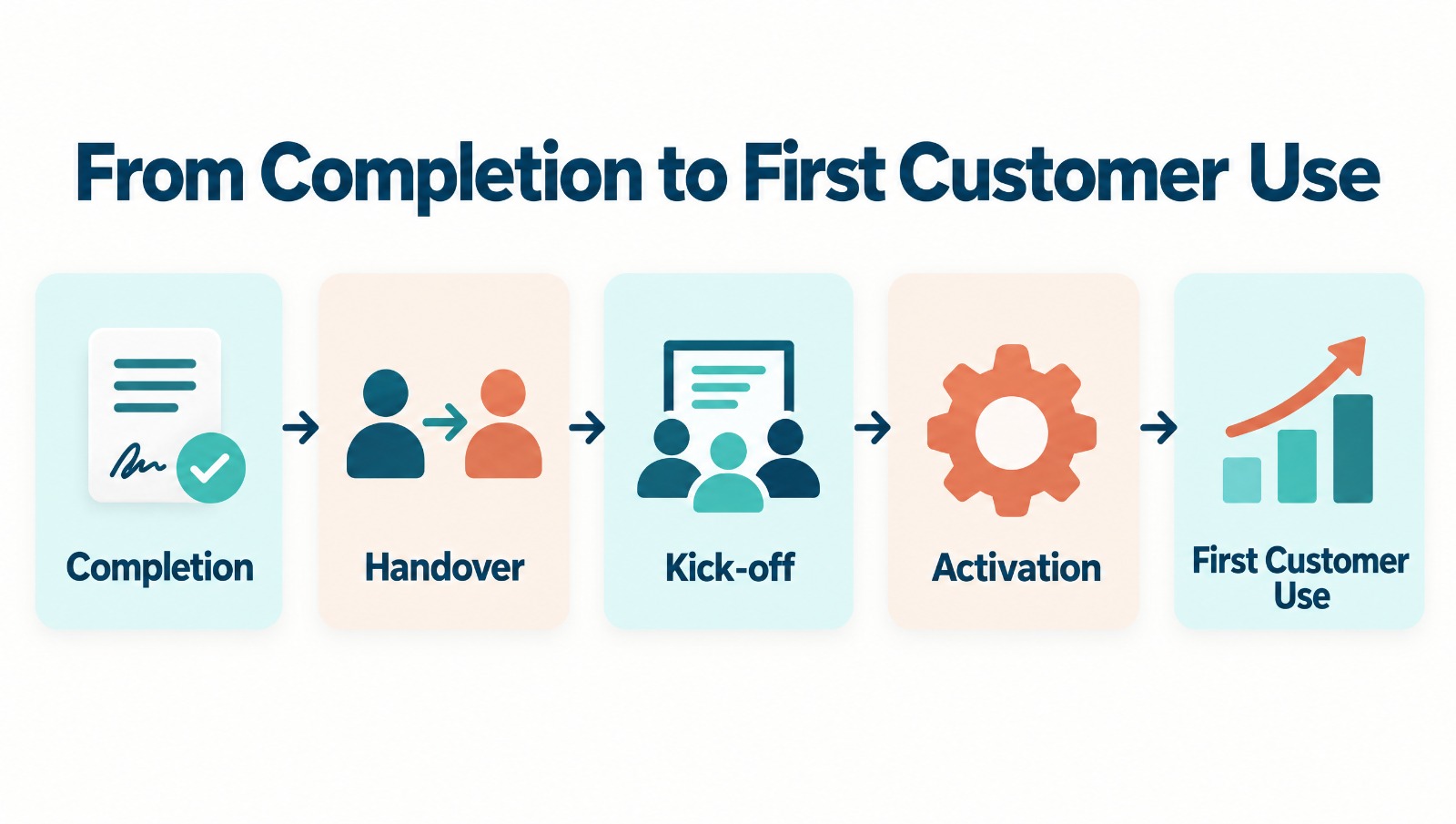
Table of contents
- Why customer onboarding in B2B is often harder than expected
- Customer onboarding is more than a technical implementation
- Statistics: How well does customer onboarding actually work?
- The most important interface lies between sales and Customer Success
- When should an onboarding process start in the CRM?
- Ten building blocks for effective customer onboarding in the CRM
- The right data model: separating opportunity, order and onboarding
- Who takes on which responsibility?
- CRM, project management or Customer Success platform?
- Automation: what the CRM should take over – and what is better left to people
- Time-to-value: the most important metric is not the go-live
- Typical mistakes in customer onboarding
- Practical example: from unclear handovers to a measurable onboarding process
- How companies can improve customer onboarding step by step
- The next step: using AI sensibly in customer onboarding
- Checklist: Is your customer onboarding in the CRM well organized?
- Conclusion: Signing the contract is not the end of the customer process
Why customer onboarding in B2B is often harder than expected
With simple products, getting a new customer started can be very straightforward. An account is set up, the customer receives an introduction and starts using the product. In more complex B2B business, the situation is different.
A machine manufacturer, for example, has to clarify technical requirements, install equipment, train employees and activate service contracts. At a software company, data migrations, integrations, user permissions, training and functional acceptance may be required. A technical service provider may first have to record sites, coordinate contacts and set up operating processes. The real problem rarely lies in the number of tasks alone. What is often more difficult is the coordination between the people and departments involved.
Sales knows the customer’s expectations, but after closing is often already busy with new opportunities. Implementation focuses on the technical rollout. Customer Success wants to make sure the customer achieves their goals, while service is mainly interested in stable support.
Each department looks at the same customer from a different perspective. Without a shared process, this leads to information gaps, contradictory expectations and unnecessary queries.
The situation is particularly critical when individual commitments were made during the sale. A certain integration is supposed to be available earlier than originally planned, for example, additional training was agreed or the customer expects a particularly short rollout period.
Such agreements do not have to be a problem. They only become one when the downstream teams know nothing about them or when it remains unclear who is responsible for delivering them.
Customer onboarding is more than a technical implementation
A successful implementation first of all means that a solution has been technically provided. Successful customer onboarding goes further. A customer may already have working software, set-up users and completed training without actually using the solution in a meaningful way. Conversely, a project that is not yet fully completed technically can already deliver a first measurable benefit. Companies should therefore consider three different goals:
Technical readiness: The required systems, access, configurations and integrations are available. This is the prerequisite for use, but not yet proof that the customer is achieving their business goals.
Operational activation: The intended employees can work with the solution and have understood the most important processes. This includes suitable training, clarified responsibilities and, where applicable, integration into existing work processes.
First measurable customer value: The customer achieves a previously agreed result. This can be a successfully completed business process, a first productive transaction, a completed analysis or the handling of a specific use case.
The third point in particular often receives too little attention in practice. Many companies measure whether a project has been officially completed. Far less often do they systematically check whether the customer has actually achieved the expected value.
For robust customer onboarding, these goals do not necessarily have to be reached at the same time. They should, however, be clearly defined, traceable in the CRM and each assigned to a responsible person.
Statistics: How well does customer onboarding actually work?
Current studies show that while customer onboarding is recognized as an important process in many companies, its operational implementation still has considerable gaps.
Thinkific – The State of Customer Onboarding 2026
For the study, conducted together with Centiment, 699 Customer Success and onboarding professionals and leaders were surveyed.
- 69% of leaders said their onboarding processes are fully documented and consistently applied. Among operational practitioners, only 46% confirmed this.
- 48% of respondents cited higher early churn or declining customer activity within the first 90 days as a consequence of inconsistent onboarding processes.
- 41% reported additional support requests or escalations in this context.
- Only 17% tracked expansion and upselling as downstream success metrics.
Source: Thinkific, The State of Customer Onboarding 2026.
OnRamp – State of Customer Onboarding 2026
In the fourth quarter of 2025, OnRamp surveyed a total of 161 leaders from Customer Success, onboarding, implementation and revenue operations. The published report shows that 62% of the Customer Success leaders surveyed had no real-time visibility into their customers’ onboarding progress. Source: OnRamp, State of Customer Onboarding 2026.
Rocketlane – State of Customer Onboarding 2025
In another vendor study with more than 950 onboarding and implementation professionals, 45% of the teams surveyed reported that separate tools and siloed information make their work more difficult. Source: Rocketlane, State of Customer Onboarding 2025.
The studies come from companies that themselves offer solutions in the customer onboarding space. They should therefore be seen as indications of relevant challenges, not as representative figures for all B2B companies. In particular, the surveys do not allow any generally valid cause-and-effect relationships to be drawn between a single onboarding measure and later customer retention.
Nevertheless, the results reveal a recurring pattern: what is often missing is not the insight that onboarding matters, but a binding process, transparent responsibilities and a shared data basis.
The most important interface lies between sales and Customer Success
The later quality of customer onboarding is often decided before the contract is even signed. During the sales process, requirements are gathered, expectations aligned and specific services agreed. This information is valuable because it explains why the customer chose a solution and what result they expect.
If it is not handed over in a structured way after closing, the downstream team starts part of the analysis all over again. That costs time and can irritate the customer. A structured sales-to-Customer-Success handover should therefore cover at least four topics.
Contractual and commercial basis: Which products, services or service packages were agreed? Which services are explicitly not included in the scope? Which dates are contractually binding and which were only discussed as planning assumptions?
Customer goals and success criteria: Which specific problem does the customer want to solve? Which results were described as particularly important during the sales process? Which business processes must work first for the customer to see value?
Organization and contacts: Who is the customer’s functional project lead, who decides on acceptance and who can answer technical questions? A distinction should also be made between the economic decision-maker, the operational contact and the later main user.
Technical and organizational prerequisites: Which systems need to be connected? Which data is required? Which approvals, resources or preparatory work does the customer have to provide themselves?
This information should not be stored exclusively in free-text notes or documents. Some of it needs structured CRM fields so that completeness, responsibility and risks can later be evaluated systematically.
This does not mean, however, that every piece of information has to be mandatory at the opportunity stage. Too many required fields can make the CRM harder to use. A better approach is a functionally justified handover process that only has to be complete when responsibility actually passes to the next team.
When should an onboarding process start in the CRM?
A common approach is to automatically create an onboarding record when an opportunity changes to “Won”. That can make sense, but it is not always sufficient as a business rule.
Depending on the company, there can be differences between a won opportunity, a signed contract, a commercial order confirmation and an actual order. Several products within one opportunity can also have different start dates. A clean process therefore needs a clear trigger.
After a confirmed deal, for example, the CRM can first create a handover record. This only becomes an active implementation once the commercial prerequisites are met and a responsible employee has been named. If essential information is missing, the system should not create a seemingly complete handover. A visible interim status with open items and a clear owner is better.
For larger companies, it is also important that a deal does not necessarily create only a single onboarding record. With several sites, services or staggered rollouts, it can make sense to link one customer and one order to several onboarding records. This keeps the structure traceable even when the company later orders additional services or activates individual sites separately.
Ten building blocks for effective customer onboarding in the CRM
A good onboarding process does not consist of as many work steps as possible. What matters is that the essential information and responsibilities are clearly defined. The following table shows ten building blocks that can prove effective in process design for mid-sized and larger B2B companies.
| Building block | Implementation in the CRM | Responsibility | Check criterion |
|---|---|---|---|
| 1. Defined start | Create onboarding only after a confirmed trigger | Sales Operations | Correctly started records |
| 2. Complete handover | Record services, commitments and open items as binding | Sales | Complete handovers |
| 3. Named owner | Assign an operational onboarding owner | CS / Implementation | Records without an owner |
| 4. Customer goals | Document expected value and first success criteria | Sales + CS | Goals per onboarding |
| 5. Contacts | Assign functional, technical and commercial roles | Account Management | Key roles filled |
| 6. Customer involvement | Record required data, access and approvals | Implementation + customer | Open customer deliverables |
| 7. Milestone plan | Plan kick-off, configuration, training and go-live | Implementation | Adherence to schedule |
| 8. Risk management | Record blockers, owners and escalation paths | Onboarding owner | Blocked records |
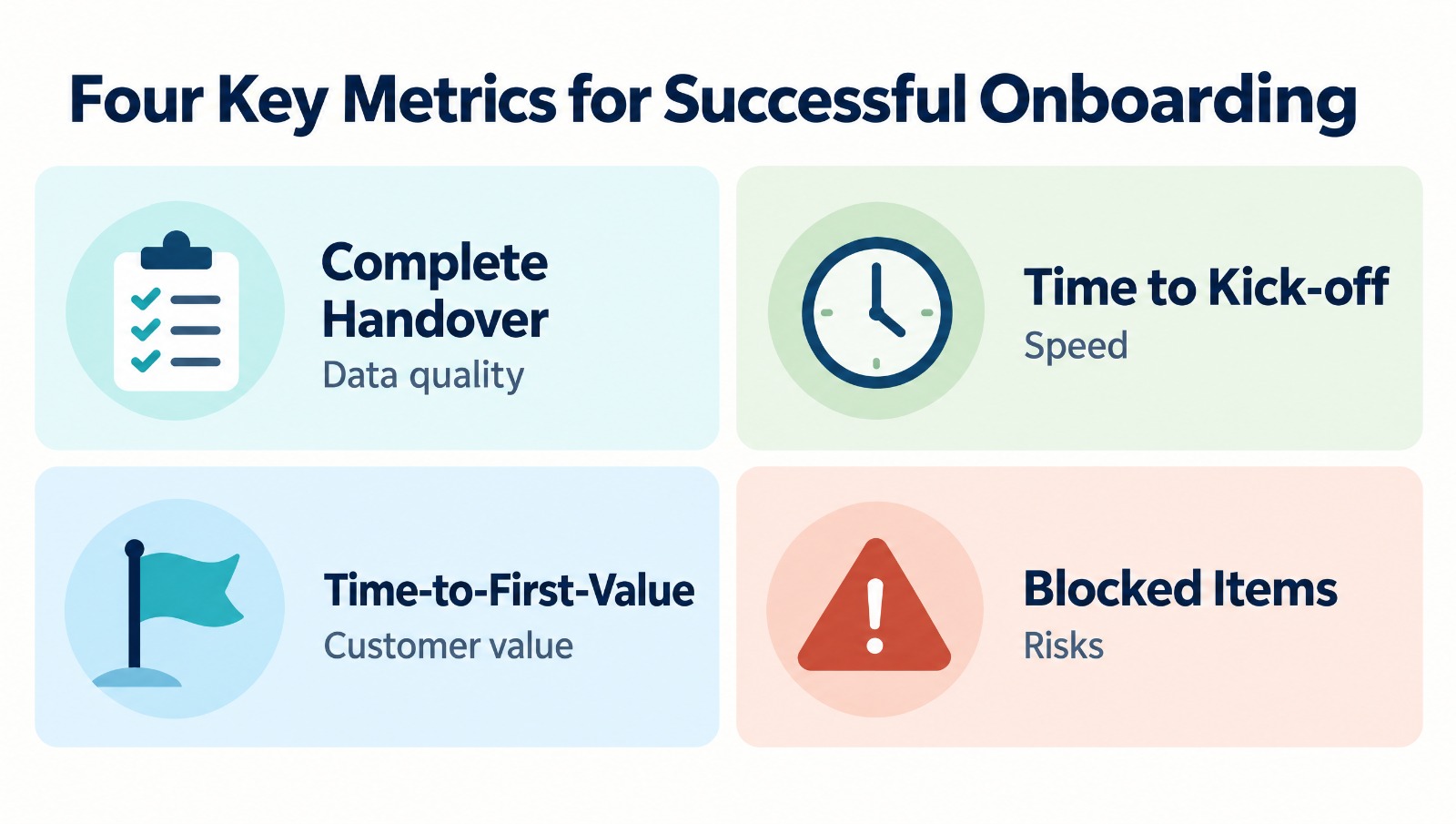
| 9. First customer value | Define measurable first success and its date | Customer Success | Time-to-first-value |
| 10. Completion and handover | Document functional acceptance and transition to regular operations | CS + Service | Accepted handovers |
The table does not describe a rigid standard model. Companies with simple products may only need part of this structure, while complex implementation projects require additional approvals or technical milestones.
What matters is defining for each building block who provides the information, who checks it and what happens if it is missing. Only then does documentation become a manageable process.
The right data model: separating opportunity, order and onboarding
For the technical implementation, a fundamental question arises: should onboarding continue to be managed within the opportunity, or does it need its own object in the CRM?
For very simple business processes, additional fields and tasks on an opportunity may be enough. As soon as several teams are involved, individual milestones are tracked or a customer has several rollout projects at the same time, however, this approach quickly becomes confusing.
In such cases, a separate onboarding record usually makes more sense. It can be linked to the customer, the original opportunity, the order or contract, the contacts involved and the relevant tasks and service cases.
This has several advantages. The original opportunity remains traceable as a sales record, while the onboarding process gets its own states and responsibilities. In addition, later extensions or additional implementation projects can be created cleanly as new records. A possible status model is: Preparation → Handover review → Planned → In progress → Activated → Acceptance → Completed
For blocked records, a clearly defined waiting or risk status should also be provided. Not every small delay justifies a separate process state, however. A separate risk classification is often more meaningful than an ever-longer list of status values.
The separation between progress and success is particularly important. An onboarding can be 90% complete even though a crucial integration is not working. Conversely, the first valuable use case can already be running successfully even though further training is still to come. Companies should therefore record planned milestones, results actually achieved and open risks separately.
Who takes on which responsibility?
Responsibility for onboarding must not become unclear just because several departments are involved. Sales remains responsible for handing over the sales information correctly. This includes in particular making special commitments, agreed services and open items visible. After the handover, sales does not have to accompany every implementation step, but should remain available in the event of commercial conflicts or contradictory customer expectations.
The onboarding owner takes over operational coordination. They ensure that tasks are assigned, deadlines tracked and blockers raised in good time. In a software company, this role may sit with Customer Success or Professional Services; in a technical services company, with project or implementation management.
Customer Success is primarily responsible for the question of whether the customer achieves their agreed goals. This role can be identical to the onboarding owner, but does not have to be. Especially in larger projects, distinguishing between technical project management and long-term customer care is helpful.
Finally, service needs a traceable transition to regular operations. This includes information on installed components, contacts, support agreements, known limitations and measures still outstanding.
For each phase, there should be exactly one operationally responsible role. Other departments can contribute or grant approvals, but must not create a situation in which, in the end, nobody feels responsible for the next step.
CRM, project management or Customer Success platform?
Not every onboarding step necessarily has to be carried out in the CRM. For manageable rollouts, it is often enough to control the process directly with CRM records, tasks, templates and workflows. This avoids additional systems and keeps information available where sales and Customer Success work anyway.
For more extensive implementation projects, a specialized project management solution can make sense. It may offer more detailed resource planning, dependencies, project budgets or options for collaborating with external parties.
A Customer Success platform, in turn, can be helpful when numerous customers are supported in parallel and extensive adoption data, segmented customer programs or standardized success plans are needed. The decision should not depend on the number of available functions, but on the specific process. For the system architecture, a clear division of tasks is recommended:
- The CRM manages the customer relationship, sales and contract information, the responsible contacts and the overall onboarding status.
- A project management system can manage detailed project plans, resources, technical tasks and their dependencies.
- An ERP system may remain the leading system for commercial orders, invoices and contractually relevant line items.
- The service desk handles support cases operationally during or after the rollout.
What matters is that the systems do not independently create different versions of the truth. If a technical go-live has been confirmed in project management, this status should become reliably visible in the CRM without an employee having to maintain it manually again.
At the same time, companies should avoid synchronizing all tasks and project information between all applications. It makes more sense to first identify the relevant business events, responsibilities and status information.
Automation: what the CRM should take over – and what is better left to people
A structured onboarding process opens up numerous opportunities for automation. After a confirmed deal, for example, an onboarding record with a suitable template can be created automatically. The CRM can determine the responsible owner, trigger a handover review and prepare tasks for a kick-off.
Reminders can be triggered when information is missing. If a milestone is overdue or a required customer approval remains open for too long, the system can flag the record and notify the person responsible. Such automations are particularly valuable when they reduce routine work and prevent important steps from being forgotten.
Fully automated communication makes less sense in situations that require functional clarification. A customer whose rollout is blocked by an unexpected technical limitation usually does not need a series of standardized reminders, but a competent contact who understands the situation.
The automatic creation of an onboarding record can also cause problems if an order has not yet been confirmed or several systems trigger the same record. Checks for duplicate records, error handling and a clear link to the order are therefore part of the technical implementation.
With SugarAI, SpiceCRM or SuiteCRM, such scenarios can generally be designed using suitable data models, automations and, where needed, custom extensions. Which functions are available out of the box and how much development effort is required depends on the product, version, edition and existing architecture. A good implementation therefore starts with defining the process, not with choosing the first workflow trigger.
Time-to-value: the most important metric is not the go-live
Many companies mainly measure project dates and task progress in customer onboarding. This information is necessary, but does not yet answer the crucial question: when did the customer first get concrete value from the solution they bought? This is where the time-to-value (TTV) metric comes in.
It describes the time between a defined starting point and the first demonstrable customer value. In a B2B software rollout, this value could be reached, for example, when an agreed business process has been completed productively for the first time. For time-to-value to be reliably comparable, however, companies must define exactly when measurement begins and which event counts as first value.
If measurement starts at contract signature for one customer and only at the technical kick-off for another, there is no meaningful basis for comparison. Nor does it make sense to compare very simple standard products with extensive integration projects without segmentation. A practical definition of the metric could be: Time-to-first-value = date of the first confirmed customer value minus date of the binding contract signature
In addition, the time between kick-off and first customer value can be evaluated separately. This makes it possible to distinguish whether delays arise before the project starts or during the actual implementation. In addition to time-to-value, further metrics are useful:
- Handover completeness: share of onboarding records for which all information defined as mandatory is complete.
- Time-to-kick-off: time between the confirmed deal and the first agreed project meeting.
- Blocked days: time during which a record cannot proceed due to a documented dependency.
- Early escalation rate: share of customers with a relevant escalation within a defined period, for example 90 days.
- Activation rate: share of customers who reach the agreed first productive use case within a defined time window.
Not every metric needs its own dashboard. For many companies, a simple report is enough at first, showing how many customers are in which phase, which records are blocked and how long it takes to reach the first measurable value.
It is also important not to hastily interpret later customer retention and renewals as a direct result of a single onboarding measure. Anyone who wants to prove the economic effect should observe comparable customer groups over longer periods and take into account differences in contract size, product complexity and starting situation.
Typical mistakes in customer onboarding
A common mistake is to understand onboarding solely as a task list. There are then many activities, but no shared definition of when the customer is actually ready or which results are to be achieved.
Equally problematic is a handover in which the implementation team receives all the information, but nobody remains responsible for its accuracy. As a result, missing data is only discovered during implementation.
Too many standardized processes can also become a problem. A customer with a simple standard configuration does not need an extensive implementation project. An international enterprise customer with several integrations, on the other hand, cannot be properly supported with the same short checklist.
Another mistake lies in the uncritical use of automation. If an incomplete record automatically triggers a workflow, existing errors are often just passed on to other departments faster.
Finally, customer involvement is often underestimated. If the customer lacks technical contacts, required data or approvals, the internal team can be as well organized as it likes. Without documented dependencies and clear escalation paths, the process still comes to a standstill. Reliable onboarding therefore does not need as many rules as possible, but a manageable structure with clear responsibilities and justified exceptions.
Practical example: from unclear handovers to a measurable onboarding process
The following scenario is an illustrative model example. The company, metrics and results are freely chosen sample values and not documented results of a specific MyCRM customer project.
Initial situation
A mid-sized provider of technical B2B software wins an average of 40 new customers per quarter. The solutions are often adapted to individual processes and sometimes have to be connected to ERP systems or existing data sources. Sales already works with a CRM. For the subsequent rollout, however, the teams use a combination of emails, spreadsheets and a project management system.
After the contract is signed, important information is forwarded by email. Implementation creates a new project, while Customer Success tries in parallel to capture customer goals and contacts.
The problem
In the model company, only 61% of handovers are fully documented. The median time between the confirmed deal and the kick-off is nine working days. The first agreed customer value is reached after an average of 58 calendar days. For 22% of new customers, there is at least one relevant escalation within the first 90 days.
These figures are not necessarily a sign of poor employee performance. Rather, there is a lack of binding handover criteria, clear process ownership and a shared view of open dependencies.
Phase 1: Analyze the actual handover process
First, the company reviews the last 20 completed onboardings together with sales, implementation and Customer Success. In doing so, the most frequent queries, delays and unclear responsibilities are identified. The teams realize that information on special agreements, technical contacts and required customer data in particular is regularly missing.
On this basis, binding handover criteria are defined. At the same time, it is determined which information is actually mandatory and which can only be gathered during the kick-off.
Phase 2: Introduce a dedicated onboarding model in the CRM
A dedicated onboarding record is introduced in the CRM and linked to the customer, opportunity and order. After the confirmed deal, the system creates a new record with a suitable template. Sales adds the agreed services, customer goals and special commitments. A responsible onboarding owner only takes over the record after a defined handover review.
Two process variants are set up for different customer types: a simplified rollout for standard customers and an extended model for projects with integrations and individual requirements.
Phase 3: Connect milestones and systems
The project management system remains responsible for detailed technical tasks and resource planning. The CRM, on the other hand, takes over the overall onboarding status, customer ownership and information on success criteria. Important events such as a confirmed kick-off, technical provisioning, the first productive use case and completed acceptance are synchronized between the applications.
If required information or approvals are missing, this appears in the CRM as a documented blocker. This gives Customer Success transparent visibility of progress without having to manage all project details themselves.
Phase 4: Pilot and measure the impact
After a pilot phase, the processes are rolled out to further customer groups. The company regularly reviews handover quality and analyzes the causes of delayed milestones. In this illustrative scenario, the metrics develop as follows after the introduction:
- Handover completeness rises from 61% to 92%.
- The median time to kick-off falls from nine to four working days.
- Time-to-first-value drops from 58 to 41 calendar days.
- The early escalation rate falls from 22% to 12%.
Using the same measurement method, the improvement in time-to-first-value would correspond to a reduction of 17 calendar days, or around 29%. This calculation describes the model example only and is not a general forecast of the impact of CRM projects.
The economic benefit does not come only from faster rollouts. The teams have to request less information, responsibility for open items is clearer and management can recognize early on which customers are having difficulties after the contract has been signed.
To evaluate an actual CRM investment, project costs, ongoing maintenance effort, time saved and possible changes in customer retention would also have to be taken into account.
How companies can improve customer onboarding step by step
Not every company immediately needs an extensive Customer Success system or a completely new process model. In many cases, it is worth first examining the handover between sales and implementation. If the most important information is available in a structured way and a responsible employee takes over the record, numerous coordination problems can already be avoided.
The next step is to make relevant onboarding milestones visible in the CRM. Only then should additional automations be introduced. Without a traceable process and reliable data, they can even increase complexity.
In the long term, the company should also feed the insights from onboarding back into sales. If certain customer groups regularly fail because of the same technical prerequisites, this information already belongs in the qualification and quoting phase. In this way, customer onboarding improves not only the work after closing, but also the quality of future sales decisions.
The next step: using AI sensibly in customer onboarding
Artificial intelligence will be able to support customer onboarding processes in several areas. For example, extensive sales notes or service descriptions can be analyzed for relevant handover information. An AI assistant can detect missing information, prepare an initial project overview or point out conflicting dates.
Useful applications are also conceivable in ongoing support. From tasks, status updates and service cases, AI can derive possible delay risks and provide a summary to the people responsible.
However, technical capability must not be confused with business approval. A system should not, for example, independently commit to binding customer dates or interpret contract contents without review.
Especially in complex B2B projects, functional review remains crucial. AI can prepare data and ease routine work, but it does not replace contractual clarification, a reliable data basis or clear responsibility.
This once again shows why structured CRM processes matter: only when responsibilities, status values and success criteria are properly defined can automation and AI reliably build on them.
Checklist: Is your customer onboarding in the CRM well organized?
Companies can use the following 18 checkpoints to assess their existing processes. Not every point has to be fully met right away: the checklist mainly helps to identify the biggest process gaps and sensibly prioritize the next improvements.
Sales and handover
- It is clearly defined when a won deal triggers an onboarding process.
- Contract scope and special customer commitments are handed over in a structured way.
- The key functional and technical contacts are documented.
- The expected customer goals are traceable for every onboarding.
- There are binding criteria for the completeness of the handover.
Processes and responsibilities
- Every onboarding record has a clearly named operational owner.
- Roles and responsibilities between sales, implementation, Customer Success and service are defined.
- Customers of different complexity can be supported through suitable process variants.
- Dates and owners are documented for all key milestones.
- Required customer information, approvals and contributions are actively tracked.
CRM and integrations
- Onboarding records are clearly linked to the customer, opportunity and, where applicable, order or contract.
- It is defined which system is the leading system for which information.
- Relevant milestones and blockers are visible in the CRM.
- Automations check business prerequisites and avoid duplicate records.
- Permissions protect confidential contract, customer and project information.
Success and continuous improvement
- The first measurable customer value is defined for each product or customer group.
- Time-to-value, handover quality and relevant delays are evaluated regularly.
- Insights from onboarding problems are fed back into sales, product management and process improvement.
Conclusion: Signing the contract is not the end of the customer process
A won customer is not yet a successfully onboarded customer. In B2B business in particular, several departments, technical prerequisites and organizational decisions often lie between contract signature and productive use.
If companies organize this phase merely through emails, spreadsheets and informal coordination, unnecessary delays quickly arise. At the same time, information from sales remains unused, even though it would be crucial for a successful rollout.
Well-structured customer onboarding in the CRM creates a shared foundation here. Sales commitments are handed over traceably, responsibilities are clearly defined and progress can be tracked through meaningful milestones and metrics.
This is not about moving as many tasks as possible into the CRM or necessarily replacing existing systems. The crucial question is how a company reliably guides its customers from the first sales promise to demonstrable value.
Anyone who wants to improve their CRM processes should therefore not only check how effectively new customers are won. Equally important is the question of how well the company actually leads these customers into successful collaboration after closing.
MyCRM helps companies design these transitions functionally and technically – from analyzing existing processes and suitable data models in SugarAI, SpiceCRM or SuiteCRM to integrating sales, implementation and service processes.
Sources
- Thinkific / Centiment (2026): The State of Customer Onboarding – The Onboarding Gap – survey of 699 Customer Success and onboarding professionals and leaders.
- OnRamp (2026): State of Customer Onboarding – survey of 161 onboarding and Customer Success leaders, conducted in Q4 2025.
- Rocketlane (2025): The State of Customer Onboarding – survey of more than 950 onboarding and implementation professionals.