CRM systems (Customer Relationship Management) are still considered a necessary evil in many small and mid-sized companies. They are introduced to document customer data, manage contacts, and make processes traceable. In reality, however, a different picture often emerges: systems gather dust, data is not consistently maintained, and the added value for sales and customer management remains limited.
Yet this passive understanding of CRM is increasingly becoming a strategic disadvantage. With the emergence of so-called “Agentic AI” – proactive, action-capable artificial intelligence – a fundamental transformation is beginning. CRM systems are evolving from mere databases into active players in sales.

CRM today: Documentation instead of support
Many executives still view CRM primarily as a control and documentation tool. This is also reflected in internal implementation: sales staff are required to manually record conversations, appointments, and activities. This often involves considerable administrative effort – which has little to do with actual sales work.
The result is sobering: poor data quality, low user acceptance, and a CRM system that ultimately costs more than it delivers. The actual task – to relieve and strengthen sales – falls by the wayside. This is precisely the misconception of many organizations: CRM was not designed as an aid, but as a control mechanism.
The paradigm shift: From CRM to ARM
Agentic AI in practice: What CRM must deliver in the future
Unlike traditional automations, Agentic AI goes one step further. The systems not only analyze existing data, but make independent decisions within defined rules. They recognize patterns, assess risks, and identify opportunities – in real time.
A modern, agentic CRM can, for example:
- Search emails for potential leads and capture them automatically
- Generate follow-up tasks without requiring human action
- Consolidate and interpret customer signals from various channels
- Alert salespeople to churn risks or cross-selling opportunities
Challenges and risks of Agentic AI in CRM
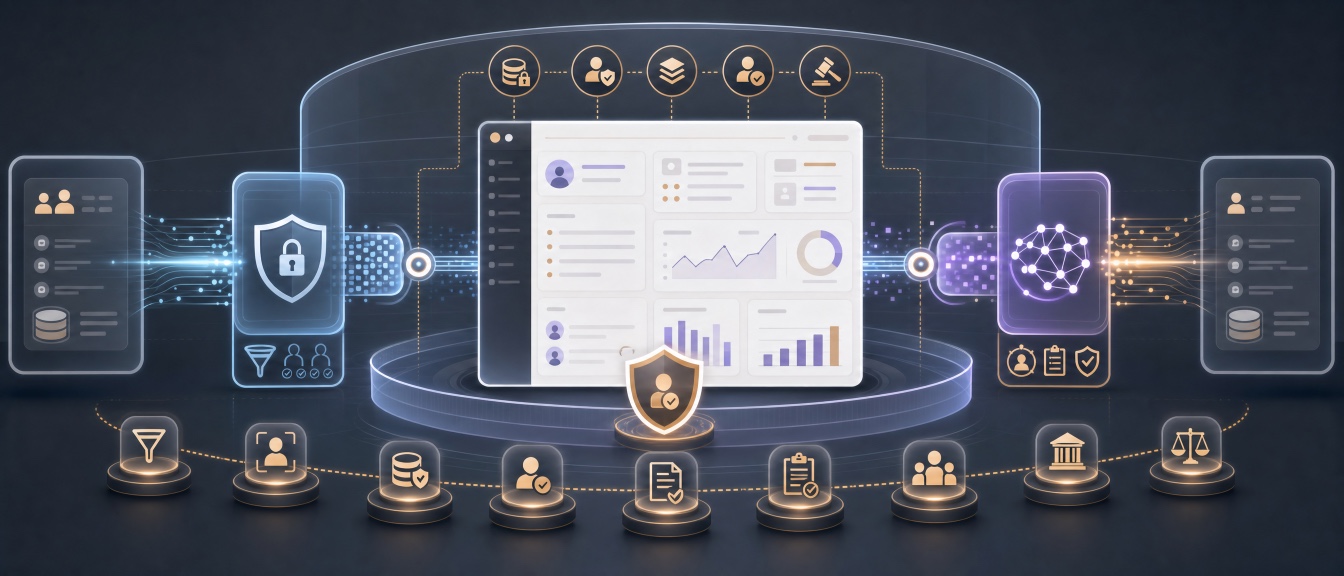
As promising as Agentic AI is – its use also brings new challenges that executives should think about early on. Questions around data privacy and data security are particularly critical.
Potential risks at a glance:
- Black box decisions: Many AI systems make decisions based on complex models whose logic is not always traceable. This can lead to uncertainty among employees, especially when they are expected to rely on these decisions.
- Misinterpretation of data: If the data foundation is incomplete or flawed, even the best agents can draw wrong conclusions. Poor data quality therefore remains a central problem even in the AI-supported world.
- Over-automation: When processes are over-automated, customer relationships can sometimes suffer – especially in sensitive sales phases where empathy and human judgment are crucial.
- Dependency on technology providers: Agentic AI requires not only technological infrastructure, but also trust in the providers. Those who make the wrong decisions here may end up creating dependencies.
Additionally, companies must carefully control which data is passed to the AI – and in what form. Especially with personal information, it must be ensured that no sensitive data is processed unprotected or forwarded to external systems. Questions of data anonymization, access control, and transparency of data flows are also gaining massive importance.
These risks are not an argument against using Agentic AI – but they are an appeal for a conscious, responsible approach to the technology. Companies should define clear guardrails, ensure transparency, and actively involve their employees in the transformation.
The strategic significance for executives
For executives, the question is no longer whether a CRM is used, but which tasks this system should independently take over in the future. The choice of software moves to the background – more important is understanding the underlying AI capabilities.
A CRM with Agentic AI is no longer an experimental field. In times of skilled labor shortages, rising customer expectations, and growing competitive pressure, it is a strategic tool that creates real relief. Those who invest now gain not only efficiency advantages, but set the course for future-proof growth.
The paradigm shift also means: It is no longer the human working for the system, but the system working for the human. The CRM becomes a platform that operationally supports rather than merely documents. For executives, this means a new way of thinking about processes, roles, and responsibility.
Conclusion – Setting the right course now
The coming years mark a profound transformation in Customer Relationship Management. Companies that continue to view CRM as an archive will lose efficiency and innovative power. However, those who take the leap now and embrace Agentic AI position themselves better not only technologically, but also strategically.
CRM is no longer a passive tool – it is an active co-creator of sales success. Executives are called upon to embrace this change and ask the right questions:
- Which processes can be automated through AI?
- Where does Agentic AI specifically relieve my team?
- How do I manage the transition from a documentation system to a digital sales assistant?