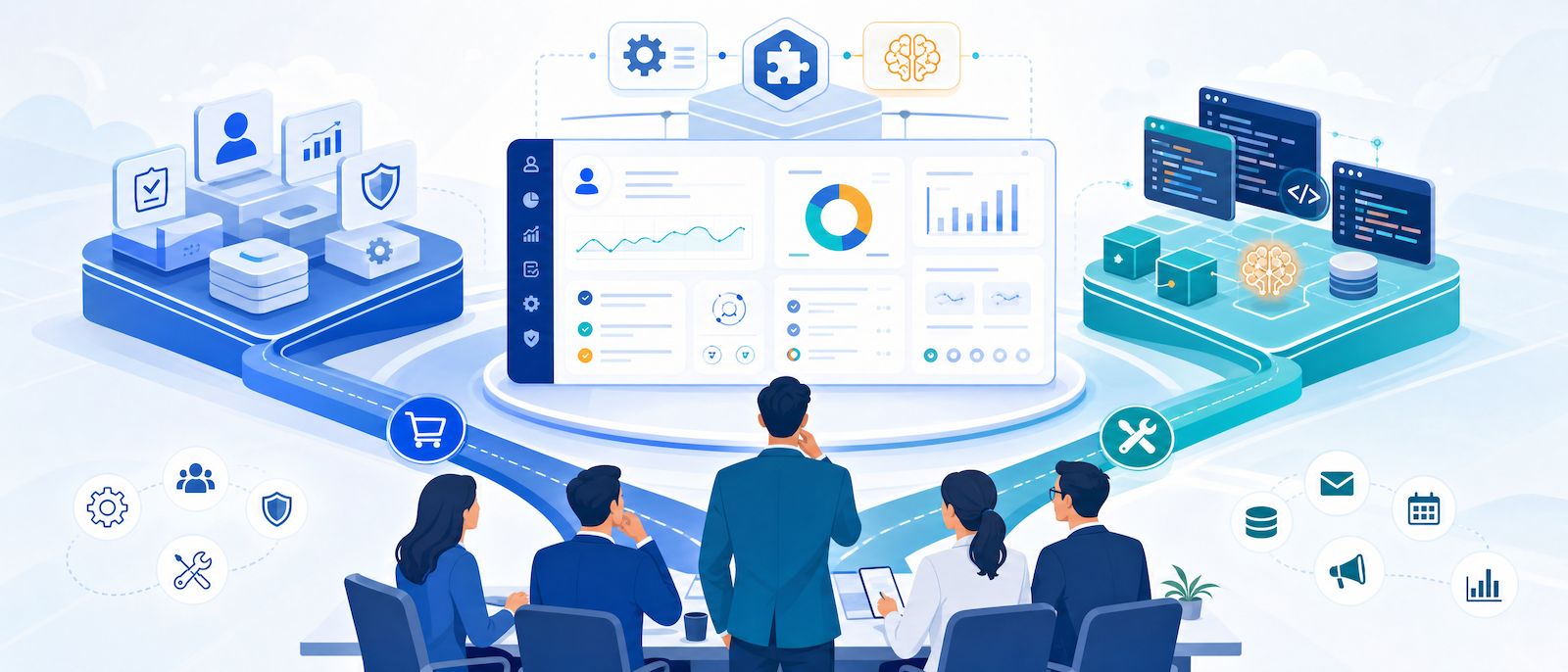
AI makes it easier to conceive CRM applications faster, build prototypes, and implement custom functions. Nevertheless, the decision between a standard solution, custom development, and a hybrid approach remains a strategic investment question in which process complexity, maintainability, integrations, governance, and long-term operating costs must be carefully evaluated.
Table of contents
Before companies decide whether to buy, customize, or build a CRM themselves with the help of AI, they should approach the decision in a structured way. AI-assisted development makes building your own solution feel far more attainable than it used to be. But that doesn’t change the fact that CRM systems must be operated, maintained, integrated, and functionally evolved over the long term. The following sections show where standard solutions make sense, when custom development can bring a real advantage, and why a hybrid approach is often the best answer. The table of contents helps you jump straight to the decision areas that matter most to you.
- Why build vs. buy in CRM is being debated anew
- Statistics: Why speed alone is not enough
- What “building a CRM yourself with AI” means in practice
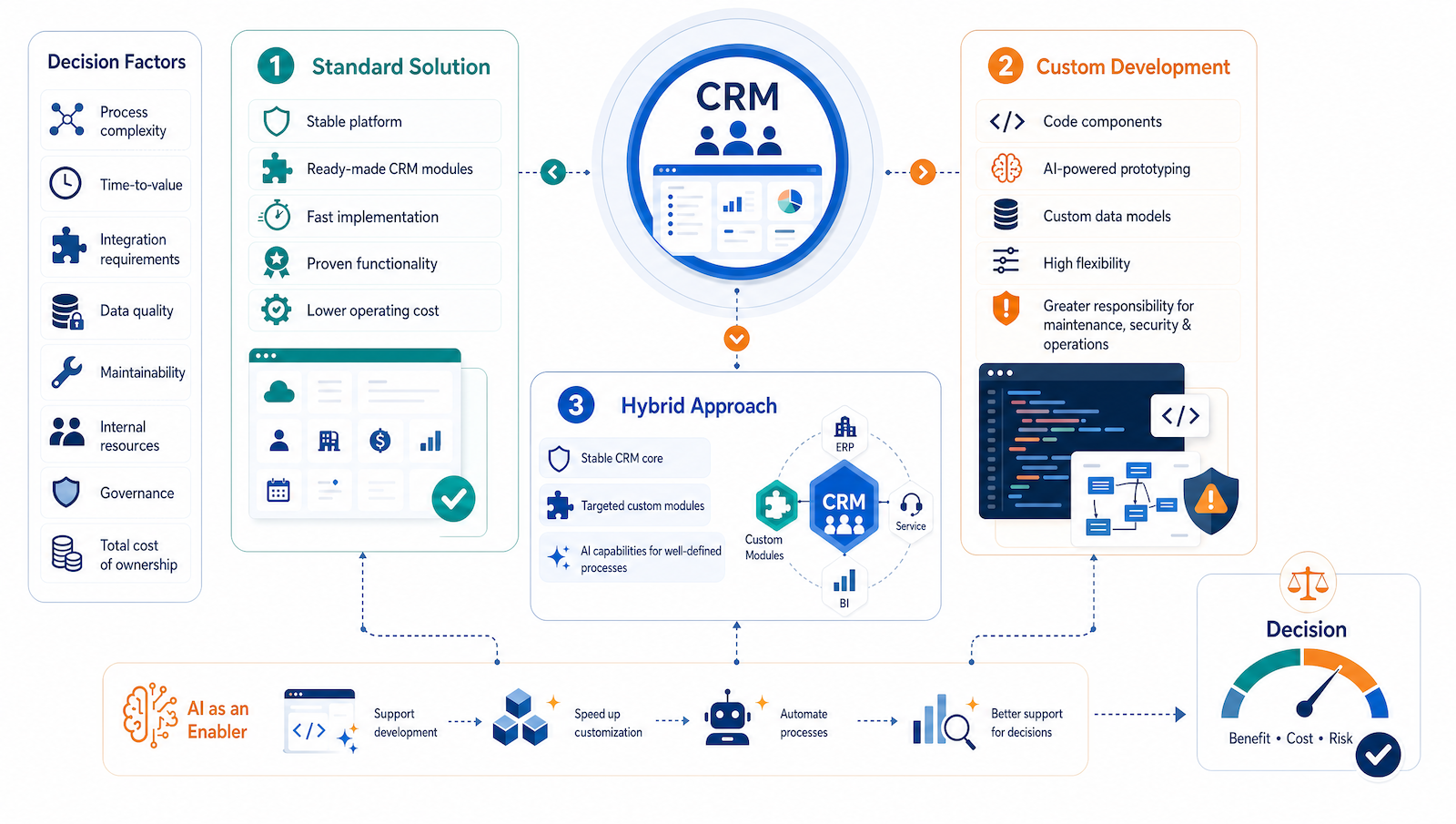
- When a standard solution is the better choice
- When custom development can make sense
- Why the hybrid approach is often more realistic
- 10 decision factors for build vs. buy
- What role AI plays in development, customization, and operations
- Typical mistakes in the build-vs.-buy decision
- Practical example from everyday work: standard, customization, and agile rollout
- Checklist: Should you build your CRM yourself or buy it?
- Conclusion
Many companies are currently asking themselves a question that was much easier to answer just a few years ago: should we buy a CRM, customize one, or build our own with the help of AI? The idea is understandable. With AI-assisted development, prototypes, interfaces, data models, workflows, and integrations can be created faster than ever before. Suddenly, building your own CRM solution seems realistic. And yet a CRM is never just software development — it is a permanent business system involving data, processes, integrations, security, operations, and user adoption.
Why build vs. buy in CRM is being debated anew
The classic build-vs.-buy question is not new. What is new, however, is that AI significantly reduces the perceived effort of custom development. Business units see that with modern development tools, screens, workflows, and analyses can be built quickly. IT teams experience that AI can assist with code, documentation, tests, and interface drafts. Management therefore rightly asks whether a custom-developed CRM solution might be cheaper, more fitting, and more independent than an established standard CRM.
This consideration is not wrong. But it is also not automatically right. Because a CRM consists not only of input screens, lists, and reports. It is a system that manages customer data, steers sales processes, maps service cases, documents activities, administers permissions, serves interfaces, and supports management decisions. Those who build a CRM themselves take on not only control over the solution, but also responsibility for further development, operations, security, documentation, and long-term maintainability.
That is exactly why the question should not be answered ideologically. It is not about whether standard is fundamentally better or custom development fundamentally more modern. The right decision depends on how strongly your own processes deviate from the standard, how important differentiation is, which integrations are needed, what resources are available internally, and how much operational complexity the company can bear permanently.
This trade-off is especially important for mid-sized companies. Many have very specific sales, service, or quoting processes. At the same time, they do not want to build their own software department that permanently operates a business-critical CRM system. This is exactly where a tension often arises: the standard does not fit completely, but complete custom development is also risky. In many projects, this leads to a third option: a stable CRM core with targeted customization where the process really demands it.
Statistics: Why speed alone is not enough
The discussion about custom development is, through AI, often strongly shaped by speed. That is understandable, but too short-sighted. Fast prototypes are helpful, but they do not determine the long-term success of a CRM system. What matters is whether the solution can be cleanly embedded into existing processes, whether the data quality is right, whether integrations work, and whether governance, security, and maintenance remain manageable.
Current figures from the AI and integration space show exactly this tension. AI is widely used, but scaling, integration, and clear value creation remain difficult. For build-vs.-buy decisions in CRM, this is especially relevant. Because those who build themselves must master exactly these topics themselves or deliberately buy them in. Those who buy standard must check whether the system offers enough flexibility for their own processes. Both paths have risks, just in different places.
| Metric | Value | Significance for build vs. buy in CRM |
|---|---|---|
| Companies that regularly use AI in at least one function | 88 % | AI has arrived in everyday business and also influences software and CRM strategies. |
| Companies that have already scaled their AI programs | approx. 33% | The leap from prototype to stable operations remains difficult. |
| Organizations with challenges integrating AI into existing processes | 95 % | Integration is one of the central risk factors in custom development and AI-supported customization. |
| Organizations that cite data integration as the biggest hurdle | 80 % | CRM decisions must take data flows and interfaces into account early. |
| Generative AI projects that, according to Gartner, could be abandoned after the proof of concept | at least 30% | Unclear benefit, cost, data quality, and risk controls slow down many AI initiatives. |
What “building a CRM yourself with AI” means in practice
When companies today talk about a self-developed CRM with the help of AI, they often mean several things at once. Some think of a completely custom CRM that is built faster with AI-supported development. Others mean a lean internal application that covers only certain processes. Still others want to extend an existing CRM with their own AI functions, agents, or automations. These differences are important because they lead to very different project and operating costs.
A complete custom development means that the company is itself responsible for the data model, user interface, permission concept, workflows, interfaces, reporting, security, logging, updates, and support. AI can help develop parts faster. But it does not relieve the company of product responsibility. Every custom function must be tested, documented, secured, and later further developed.
A partial development is often more realistic. Here, an existing CRM remains the central core, while certain special processes are supplemented individually. This can be a quoting module, an industry-specific lead logic, a special service triage, or an AI-supported assistant for recurring tasks. In such scenarios, AI helps particularly strongly because it can accelerate development, prototyping, and customization without the entire CRM having to be rebuilt.
It is also important to distinguish between prototype and production system. A prototype may emerge quickly, be incomplete, and test assumptions. A production system must run stably, respect permissions, process data correctly, handle errors, and interoperate with other systems. Exactly at this point, the seemingly simple build decision becomes a genuine architecture and operations question.
When a standard solution is the better choice
A standard solution usually makes sense when the central CRM processes in the company fundamentally follow established patterns. Sales pipelines, contact management, activities, service cases, dashboards, campaign references, roles, and permissions are similar enough in many companies to be solidly mapped with a good CRM platform. The advantage is obvious: companies start faster, benefit from existing functions, and do not have to build basic CRM mechanics themselves.
But standard does not automatically mean rigid. Modern CRM systems can be configured, extended, and integrated. Fields, roles, workflows, dashboards, automations, and interfaces can be adapted to your own way of working. Systems with a flexible data model and a clean API in particular offer a good middle path here: the foundation is proven, yet the expression can still be individual.
Another advantage lies in operations. Updates, security fixes, core functions, user administration, and many basic technical topics are carried by the vendor or partner. This is especially important for companies that use CRM intensively but do not want to build permanent internal product development for their own CRM. The actual investment then flows more strongly into process design, data quality, rollout, training, and integration.
A standard solution is also strong when time-to-value is important. Those who want to introduce a robust CRM quickly should not first develop their own platform. In sales and customer service in particular, value often emerges earlier when an existing system is cleanly introduced and selectively adapted. The decisive question is then not: Does the standard fit 100 percent? But rather: Does the standard cover the basics stably, and can the truly differentiating processes be sensibly supplemented?
When custom development can make sense
Custom development can make sense when the CRM itself is part of the business differentiation. This is not the case in every company. But there are situations in which standard logic restricts too strongly. This applies, for example, to very special quoting logics, complex partner networks, particular service processes, industry-specific data models, or heavily regulated workflows that can only be mapped in the standard with great effort.
Custom development can also become attractive with very high integration depth. When CRM processes are tightly connected with product configuration, ERP, billing, logistics, service platforms, or proprietary data sources, a custom application or a custom module can be economically sensible. What matters then is whether the individuality creates real benefit or merely preserves historically grown special paths.
Another reason can be data sovereignty. Companies from regulated industries or with particularly sensitive information must in some cases exert stronger control over where data is processed, which models are used, and which systems gain access. In such cases, a custom or sovereignly operated solution can be sensible. But this only applies if the company also brings the necessary competence for security, operations, and maintenance.
Custom development also becomes interesting when speed in very specific internal processes is more important than the feature scope of a large CRM standard. AI-supported development can help here to build small, focused applications faster. Nevertheless, every custom development should be critically questioned: Is the process really differentiating? Will the solution be maintained long-term? Is there a budget for operations and further development? And is it clear who remains the owner, both functionally and technically?
Why the hybrid approach is often more realistic
In many companies, the best answer is neither pure buying nor complete self-development. The realistic path often lies in between. A stable CRM system maps the standard processes: contacts, companies, activities, opportunities, service cases, roles, permissions, and reports. Custom extensions arise where they are truly necessary from a business perspective. AI supports both the customization and selected automations and assistance functions.
This hybrid approach has several advantages. Companies do not have to start from scratch. They keep a proven CRM base while avoiding being completely forced into standard processes. The customization concentrates on the areas where it creates real value. This reduces risk, accelerates rollout, and makes the solution more maintainable.
This approach is strong especially in connection with AI. The standard CRM provides the data model, user administration, workflows, interfaces, and reporting. Custom AI building blocks can build on top: conversation summaries, prioritizations, data quality checks, service classification, next-best-action logic, or agentic support for clearly described processes. This does not create an isolated special solution, but an extension of the existing CRM workplace.
For many mid-sized companies, this is economically the most robust option. They do not buy every function blindly, but they also do not build the entire CRM themselves. Instead, it is examined where standard suffices, where configuration is enough, and where genuine custom development becomes necessary. Exactly this differentiation determines cost, acceptance, and long-term flexibility.
10 decision factors for build vs. buy
The build-vs.-buy question should not be answered from the gut. It needs a structured evaluation, because emotional arguments quickly pull in both directions. Advocates of standard solutions point to speed, security, and proven functions. Advocates of custom development point to precise fit, independence, and differentiation. Both sides have good points. What matters is which criteria actually have the greatest impact on benefit, cost, and risk in the specific company.
The following table helps to evaluate the most important factors soberly. It is deliberately not intended as a rigid scoring model. It is meant to structure a discussion among management, IT, the business unit, and those responsible for the CRM. Often this alone makes it visible whether a standard solution suffices, whether targeted customization is enough, or whether genuine custom development is justifiable.
| Nr. | Suggestion/idea | Description |
|---|---|---|
| 1 | Assess process complexity | The more the workflows deviate from the standard, the more worthwhile a custom extension becomes. |
| 2 | Clarify differentiation | Only processes that bring a real competitive advantage usually justify larger custom development. |
| 3 | Check time-to-value | If fast benefit is important, much speaks for standard with targeted customization. |
| 4 | Analyze integration needs | Deep ERP, service, data, or portal integrations raise the demands on architecture and operations. |
| 5 | Consider data sovereignty | Sensitive or regulated data may require private, sovereign, or local operating models. |
| 6 | Assess maintainability | Custom development permanently requires budget, know-how, documentation, tests, and further development. |
| 7 | Assess resources realistically | Without an internal or reliably external product team, a custom CRM quickly becomes a risk. |
| 8 | Check standard capability | Many requirements can be solved through configuration, workflows, or add-ons without developing from scratch. |
| 9 | Plan for governance | Permissions, approvals, audit, data protection, and process responsibility must be clarified regardless of the chosen path. |
| 10 | Assess the hybrid option | Often a stable CRM core with custom modules is more economical than pure build or pure buy. |
What role AI plays in development, customization, and operations
AI changes the build-vs.-buy question because it accelerates certain work steps. It can support requirements structuring, prototyping, data modeling, code drafts, tests, documentation, and process descriptions. This makes custom solutions tangible faster. Early concept phases in particular benefit from this, because variants become visible faster and business units can respond more concretely.
At the same time, AI-supported development must not be confused with finished product quality. Code that is generated quickly must still be understood, reviewed, tested, and maintained. Process logic must be correct from a business standpoint. Permissions and security rules must be implemented cleanly. Interfaces must run stably. And the solution must still work when requirements, data models, or legal frameworks change.
AI can therefore accelerate development, but it does not replace architecture responsibility. It even makes bad decisions visible faster. Those who develop without clear processes, without a data model, and without governance do not automatically produce a better solution with AI. They may only produce technical debt faster. That is exactly why the quality of the preparatory work is decisive.
AI is especially valuable in the hybrid model. It can help configure standard CRM systems faster, build documentation, prepare test cases, design custom modules, or describe agent processes. This does not reinvent the entire CRM. Instead, existing stability is combined with targeted customization. For many companies, this is the most pragmatic path.
Typical mistakes in the build-vs.-buy decision
A common mistake is evaluating custom development based only on the initial development costs. That is too short-sighted. A CRM is not a one-time project, but a permanent system. After the first go-live come new requirements, role changes, interface adjustments, data protection questions, new reports, new teams, new products, and new processes. Those who do not budget for these costs significantly underestimate custom development.
A second mistake is writing off standard solutions too early. Many companies compare their idealized dream solution with a poorly configured demo. That is not a fair comparison. What matters is not whether a standard CRM fits perfectly out of the box. What matters is whether it can be configured, integrated, and extended with reasonable effort so that the process is cleanly supported.
A third mistake is underestimating integrations. CRM systems in particular rarely stand alone. They need ERP data, marketing information, service histories, email and calendar integration, documents, portals, BI, and sometimes external AI services. If these data flows are not properly planned, every solution becomes difficult – whether bought or self-built.
A fourth mistake is a false understanding of independence. A custom solution does not automatically make you independent. It only shifts dependencies. Instead of the CRM vendor, the company then depends on its own development team, individual service providers, frameworks, cloud infrastructure, or hard-to-maintain code. Real independence comes from clean architecture, documented processes, clear data models, and switchability – not from custom development alone.
Practical example from everyday work: standard, customization, and agile rollout
A mid-sized company in technical B2B sales faced exactly this decision. Management was dissatisfied with the existing CRM and examined whether a new system could be built in-house with AI-supported development. The thought was understandable. Their own quoting processes were special, there were complex product variants, several service levels, and a tight ERP connection. At first glance, a custom solution seemed attractive.
In the analysis, however, it became clear that not the entire CRM had to be custom. Contacts, companies, activities, opportunities, roles, service cases, and standard reports largely followed familiar patterns. What was truly special was above all the quoting logic, certain approval processes, and the connection between service history and sales steering. Therefore, the project was not set up as a complete custom development, but as a hybrid approach: a stable CRM as the core, targeted customization in the differentiating processes, and AI support for documentation, data quality, and later automation.
The rollout was phased and agile. In phase one, the core processes were mapped close to standard in the CRM, data was cleaned, and responsibilities were clarified. In phase two, the special quoting logic was connected as a custom module. In phase three, AI-supported functions were added: summaries from customer meetings, alerts about missing quote data, and suggestions for next activities. Each phase was tested and refined with a small user group before further teams were involved.
The measurable benefit came not from radical custom development, but from the right division. The rollout time dropped significantly compared to a complete new development. The first productive functions were available after a few weeks. Quote processing in the pilot became about 28 percent faster because mandatory information was visible earlier and approvals ran more clearly. At the same time, the CRM remained maintainable because standard functions were not unnecessarily rebuilt. That was exactly the decisive point: customization where it creates value, standard where it carries stably.
Checklist: Should you build your CRM yourself or buy it?
Before companies make a build-vs.-buy decision, a sober self-check is worthwhile. This decision should not be made solely out of frustration with existing systems. Nor should it arise solely from enthusiasm for AI-supported development. What matters is whether the chosen solution fits the company in the long term. This includes process maturity, technical capabilities, governance, budget, and the ability to continuously evolve the system. Those who examine these points carefully avoid costly detours and reach a sustainable decision faster.
- Are your CRM processes really so individual that standard solutions are not enough?
- Are there clearly defined processes that bring a real competitive advantage through custom development?
- Can central requirements also be solved through configuration, workflows, or extensions of a standard CRM?
- Do you have enough know-how, internally or through a partner, for operations and further development on a permanent basis?
- Are interfaces to ERP, marketing, service, BI, and other systems cleanly described?
- Is it clear which system should be the leading one for which data?
- Have roles, permissions, data protection, and governance been evaluated before the decision?
- Have the long-term costs for maintenance, tests, documentation, and further development been taken into account?
- Are there sensitive data or regulatory requirements that demand a special operating model?
- Has a hybrid approach been examined before deciding on a complete custom development?
- Can the first project phase be started small, phased, and measurable?
- Are there clear criteria for when build, buy, or hybrid is economically more sensible?
Conclusion
AI makes custom development in the CRM environment more interesting. It lowers entry barriers, accelerates prototyping, and can make custom functions tangible faster. Nevertheless, the build-vs.-buy decision remains a strategic investment question. A CRM must be operated, integrated, secured, and evolved over the long term. Those who look only at fast development often underestimate maintenance, governance, data quality, and user acceptance.
For many companies, a hybrid approach will therefore prevail. A stable CRM core reliably maps standard processes. Custom extensions arise where they bring real functional or economic benefit. AI supports development, customization, and automation, but does not replace the architecture decision. Exactly this sober division protects against oversized custom developments and against standard solutions that miss reality.
Your next step: Examine your CRM strategy against three decision questions: Which processes are truly differentiating, which standard functions carry stably, and where does customization generate measurable benefit? That is usually where it is decided whether build, buy, or a hybrid approach is economically sensible for your company.