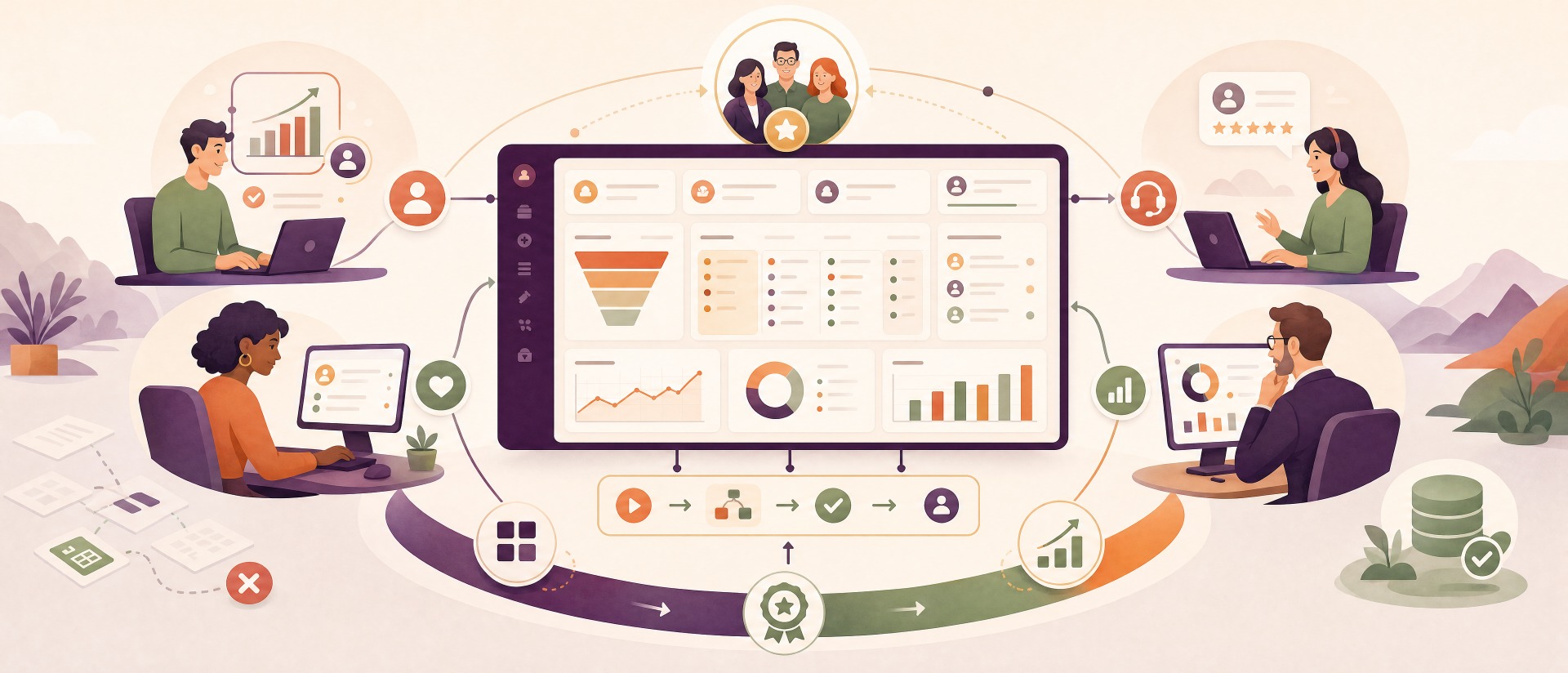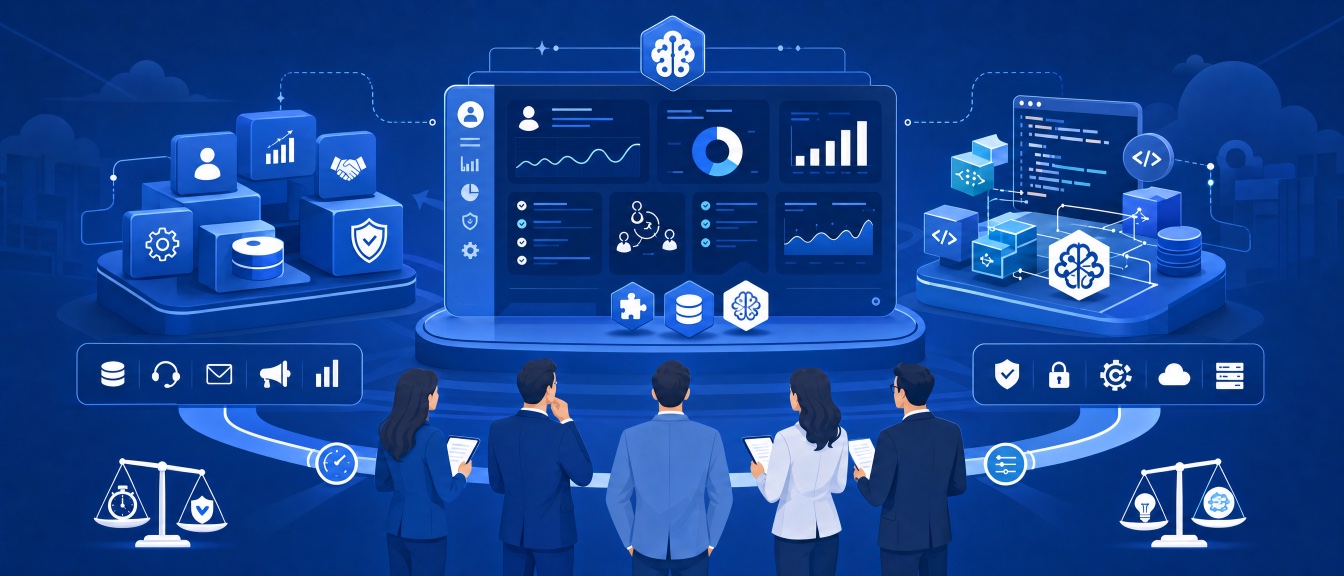
Many organizations face the same strategic question: should the new CRM fit their industry as closely as possible, should it be built on a flexible platform, or does custom development make sense? On paper, all three options are possible. An industry solution speaks the right language from day one and brings typical workflows with it. A CRM platform offers more flexibility around data models, processes, integrations, workflows, roles, reporting, AI capabilities and hosting. Custom development promises maximum freedom, but also comes with a high level of responsibility for architecture, operations, security, maintenance and long-term development.
That is why the decision is not trivial. It is not only about which solution looks best in a demo today. It is about which technological foundation will keep the organization capable of acting in the long run. This question becomes particularly relevant in industries with complex member, service, customer or patient relationships. These environments are not only about leads, opportunities and closing deals. They are about guests, members, partners, insured persons, patients, service providers, service cases, locations, stays, appointments, complaints, feedback, communication and traceability across an entire journey.
Typical examples include tourism associations, travel providers, retail and wholesale organizations, hospitals, health insurers and other organizations in the healthcare sector. SpiceCRM already addresses these areas with industry approaches for Healthcare, Tourism and Retail & Wholesale. In the healthcare context, the focus includes the patient journey, patient feedback, communication, complaint management and integration into existing system landscapes. In the tourism context, the focus includes omnichannel inquiry management, booking systems, tourism organizations and the guest journey. In the retail and wholesale context, the emphasis is on the customer journey, personalized interactions, omnichannel processes and long-term customer loyalty.
The decisive question is therefore not: which solution looks best in the demo? The better question is: which architecture will support our organization long term without blocking us in three years through overly narrow industry logic, missing interfaces, high customization costs or too much custom-build complexity?
Industry solutions: quick to understand, but not automatically future-proof
Industry solutions have a real advantage: they feel immediately familiar. A tourism association does not think in classic sales terms, but in regions, partner businesses, guests, events, destinations, campaigns, inquiries, and local offerings. A retail or wholesale organization thinks in B2B and B2C customer groups, products, categories, prices, loyalty, e-commerce, omnichannel communication, and service cases. A hospital thinks in patients, referrers, appointments, stays, treatment phases, feedback, aftercare, and integration into existing hospital information systems. A health insurer thinks in insured members, benefits, service offerings, complaints, communication, and care along the patient journey.
When a piece of software already brings these terms with it, the impression quickly arises: “This fits us.” And sometimes that is true. For clearly defined requirements, an industry solution can be the right path. Especially in healthcare, tourism, or the retail and wholesale environment, industry-specific data models, process templates, and integration patterns can considerably ease the start. For healthcare, SpiceCRM describes, among other things, patient journey, patient feedback, appointment processes, HIS integration, 360-degree view, and complaint management. In the tourism context, it involves, among other things, customer journey, travel agencies, tour operators, tourist associations, booking systems, local events, guest communication, and cross-channel processes.
The critical point, however, lies elsewhere: a good industry solution is not automatically a good platform. It can be functionally suitable, but reach limits technically and organizationally. This often becomes apparent only later, when additional requirements arise. Then it is no longer just about terminology, but about data quality, permissions, roles, interfaces, reports, automation, duplicate logic, document processes, portals, or integration into core systems, ERP, DMS, newsletters, telephony, web shops, booking systems, HIS systems, or insurance-related specialist applications.
CRM platforms: less industry appearance, more flexibility
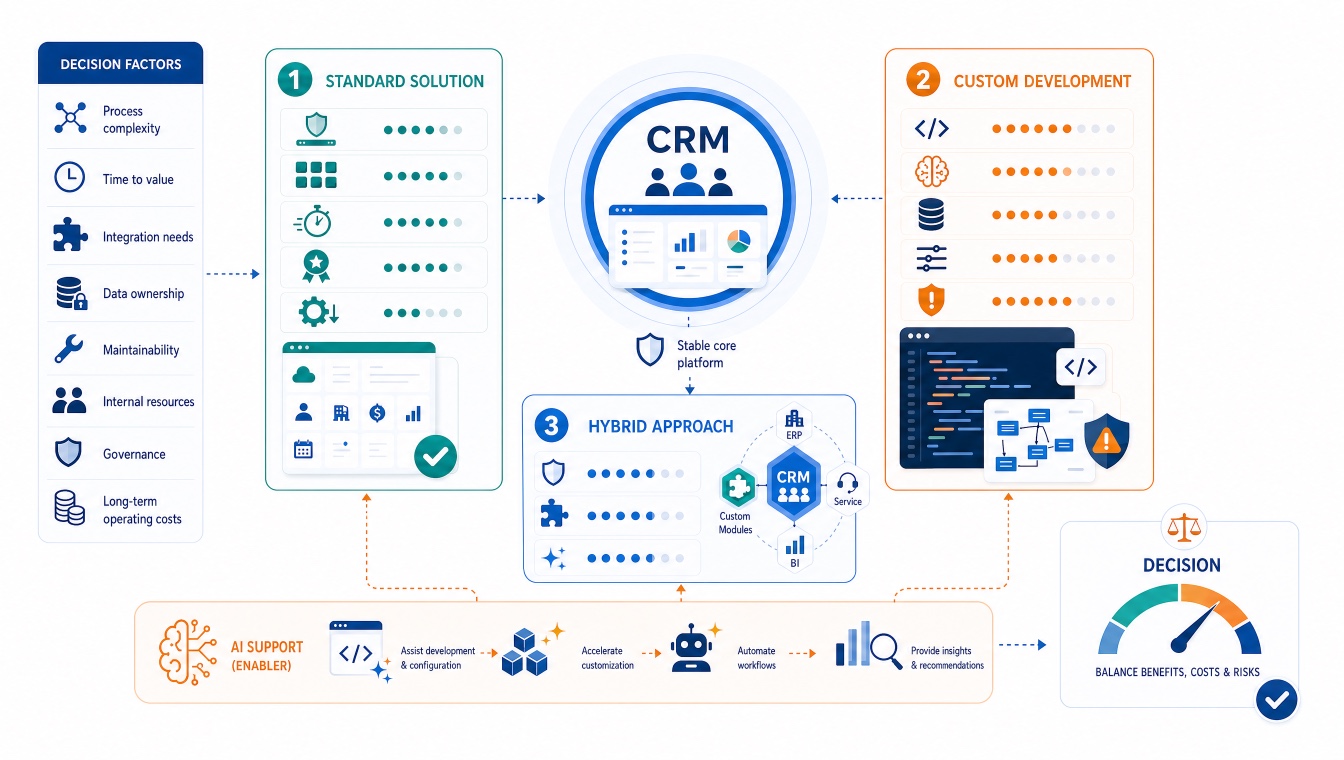
A CRM platform follows a different approach. It does not always bring every industry-specific term and process fully preconfigured. But it can be adapted more closely to the actual organization. This becomes especially important when processes are not only meant to be administered, but actively developed further. In complex service, member, patient or customer relationships, this is often a decisive factor.
The advantage of a platform is not that everything should be developed from scratch. That would be the wrong conclusion. The strength of a platform is not proven by implementing as many special requests as possible in the first project. It is proven by building processes step by step, creating productive value early and avoiding a system that becomes too narrow for future requirements. A good platform strategy therefore deliberately distinguishes between standard processes, differentiating processes and integration requirements.
For a tourism association, this can mean that member businesses, partners, campaigns, events, regions, interests and communication history are connected in a shared CRM layer. For a travel organization, it can mean that guests, offers, booking inquiries, feedback, campaigns and partner communication no longer run in separate silos. For a hospital, it can mean that referrers, patient communication, aftercare processes, appointment logic, feedback and service inquiries are structured more clearly. For a health insurer, it can mean that insured persons, benefit processes, prevention offers, partner networks, complaints and communication along the patient journey become more transparent and easier to manage.
Custom development: maximum freedom, but rarely the best starting point
Custom development sounds attractive at first. Especially organizations with very specific processes often think: “Our workflows are so unique that no standard system can map them properly.” That thought is understandable. If you build your own data models, interfaces, workflows and integrations, you can theoretically create exactly the system that fits the organization. In practice, however, custom development is rarely just a development project. It is a long-term architecture, operations and maintenance decision.
The real effort does not arise with the first prototype. The real effort comes afterwards: user management, roles and rights, interfaces, data migration, reporting, duplicate logic, documentation, security, data protection, updates, performance, monitoring, bug fixing, release management and continuous development. There is also the question of who will understand and develop the system in the long run. If this knowledge is tied to individual developers, external service providers or internal key people, a new dependency quickly emerges. The custom-built system may fit functionally, but becomes organizationally risky.
This does not mean that custom development is fundamentally wrong. It can make sense when a process is truly differentiating, when standard solutions permanently create too much friction, or when an organization deliberately wants to build its own digital services. But even then, starting from zero is rarely necessary. A platform can be the much better starting point. It already provides basic CRM functions, user logic, data models, rights concepts, workflows, reporting, integration capabilities and user interfaces. Individual specialist processes can then be built more selectively without having to develop the entire foundation yourself.
The strategic recommendation is therefore: do not build from scratch too quickly, but also do not blindly accept standard software. A platform approach is often the most sensible route: stable CRM base functions are used, while only the truly differentiating processes are added individually. This avoids both a rigid industry product and a custom-built system that is difficult to maintain. Instead, it creates a controllable platform architecture that can grow with the organization.
Why large platforms are not automatically the best answer
SAP and Salesforce are powerful platforms. They have strong ecosystems, many industry offerings, and extensive technical possibilities. For large organizations with sufficient budget, clear governance, internal project capacity, and a long-term operating model, this can be exactly the right path. What is decisive, however: large platforms do not unfold their value by being introduced as unadapted as possible. They unfold their value when they are seriously used as a platform.
A conversation from practice captures this dilemma well. An employee of a large automotive supplier from the Stuttgart area said, in essence: “SAP is actually the solution we need.” The problem, he said, was not that the platform was unsuitable. Rather, the problem was that the organization would need a precise adaptation to the actually lived processes, but this adaptation was neither consistently budgeted nor cleanly planned in terms of time.
Exactly here, in many projects, the dangerous gap arises between management decision and user reality. At the management level, it is often assumed that the standard will already largely fit. In practice, it then turns out that the standard seems structurally correct but does not fit everyday work at decisive points. The consequence is workarounds, manual rework, Excel shadow processes, duplicate data maintenance, and frustration among users. The system is then formally introduced, but operationally it is perceived as a ball and chain.
This is not a criticism of SAP, Salesforce, or other large platforms. On the contrary: large platforms can be very powerful when introduced consistently. But this also means that one needs sufficient financial and temporal staying power. Those who do not cleanly analyze, prioritize, and implement the company’s process reality end up not with an efficient standard, but with a cumbersome compromise solution. Then management has indeed pushed through the rollout, but users work against the system every day.
SpiceCRM as a third way: platform capability with vertical connectivity
SpiceCRM can be an interesting third way in this field of tension. Not as narrow as many pure industry solutions, but also not as heavyweight as large enterprise platforms. What is decisive: SpiceCRM is not just a general CRM platform, but already brings concrete functional approaches for selected industries. These include healthcare with patient journey, patient feedback, appointment and communication processes, as well as integration into existing HIS landscapes. They include tourism scenarios with guest journey, tourism associations, partners, events, booking systems, and cross-channel communication. And they include retail and wholesale scenarios with B2B/B2C separation, product management, loyalty, e-commerce, omnichannel, and service processes.
This creates a different starting situation than with a completely empty platform. You do not start from scratch, yet remain flexible enough to build your own processes, data models, roles, interfaces, and reports. Exactly here lies the strategic difference: a vertical industry solution often delivers a quick fit but can become narrow later. A large enterprise platform delivers enormous possibilities but often demands a lot of budget, time, and governance. SpiceCRM can lie in between: industry-oriented enough for a faster start, open enough for long-term customization, and controllable enough regarding data, system, extensions, and hosting.
The product logic of SpiceCRM also fits this. The Core Edition is described as a GPL version that covers relevant CRM processes, marketing, sales, basic service processes, and reporting requirements. The More Edition adds, among other things, product management, sales documents, quotes, extended reporting, service functions, groupware integration, SAP connector, and further integrations. For organizations with demanding processes, this separation is important because they can distinguish between platform base, pre-built extensions, and individual customization.
Another point is the development toward AI-supported automation. In release 2026.01.001, SpiceCRM names, among other things, integrated generative AI, automatic task creation from meetings, email signature recognition, document data capture, and improved ACL permission management. This is strategically relevant because many CRM projects today are no longer meant to merely store data. They are meant to relieve employees, accelerate processes, and make existing information more usable.
For CRM projects, this is an important lesson. Standard makes sense where processes are truly standardizable. Customization is necessary where the process makes a difference, creates acceptance, or prevents operational friction. The real art lies in drawing this line cleanly. Those who save in the wrong place often pay double later: with lower acceptance, poorer data quality, more manual effort, and slower process speed.
Statistics: Why CRM strategy is also risk management
CRM projects are often viewed too functionally. The focus is then on screens, fields, workflows, dashboards, and interfaces. That is important, but not sufficient. A CRM decision is always also an architecture and risk management decision. The larger the project, the longer the duration, and the more unclear the process scope, the higher the risk that costs, deadlines, and benefits diverge.
In an evaluation of CRM ROI case studies, Nucleus Research arrived at an average return of 8.71 US dollars per dollar invested. This shows that CRM projects can be economically very attractive when implemented correctly. At the same time, studies on IT project risks show how critical duration, complexity, and false assumptions are. An analysis of 1,355 public IT projects showed, among other things, that projects took on average 24 percent longer than planned and that 18 percent of projects had cost overruns of more than 25 percent. In addition, each additional project year increased the average cost risk by 4.2 percentage points.
| Metric / observation | Value | Significance for CRM strategies |
|---|---|---|
| Average CRM return according to Nucleus Research | 8.71 US dollars per dollar invested | CRM can be economically very attractive when processes, data quality, and acceptance are cleanly implemented. |
| Public IT projects: average time overrun | 24 percent longer than planned | Long project durations increase risk, frustration, and political vulnerability. |
| Public IT projects with significant cost overrun | 18 percent with more than 25 percent budget overrun | Large target visions should be broken down into manageable phases. |
| Additional cost risk per further project year | 4.2 percentage points higher risk | Short, usable project phases are an important risk buffer. |
| SpiceCRM release 2026.01.001 | Generative AI, tasks from meetings, signature recognition, document capture, ACL improvements | Modern CRM platforms are increasingly evolving toward automation, data quality, and permission governance. |
The core question: standard process or differentiation process?
A good CRM decision does not begin with a product demo. It begins with the question of which processes are truly industry-specific and which are only named differently. Many organizations overestimate their uniqueness at the start. At the same time, they underestimate the points at which their particularities are actually decisive.
A tourism association may not need a fully custom platform when it is initially about contacts, partner businesses, events, and simple campaigns. A tourism organization with booking systems, regional service providers, guest segments, events, partner communication, and feedback processes, by contrast, has different requirements. A hospital may not need a classic sales CRM, but very much needs a clean view of referrers, patient communication, appointment processes, aftercare, feedback, and service cases. A health insurer needs not only master data, but traceable communication, complaints, prevention offerings, service processes, and steering along the patient journey.
The right question is therefore not: “Industry solution or platform?” The better question is: “Where do we need standard, where do we need creative latitude, and where do we need long-term architecture control?” Exactly this distinction determines whether a CRM project stays lean or later gets bogged down in manual rework, special solutions, and acceptance problems.
Decision matrix: when which path makes more sense
The selection should not be made from the gut. Decision-makers need a structured view of functionality, platform capability, cost risk, adaptability, and operations. It is important not to evaluate only the first go-live. Many systems appear strong in the demo because the standard process is well prepared. The real quality shows later, when special cases, roles, reports, interfaces, data migration, and subsequent expansion stages arrive.
| Criterion | Prefer an industry solution when ... | Prefer a CRM platform like SpiceCRM when ... | Description |
|---|---|---|---|
| Terminology | The industry-typical terms should be adopted unchanged. | Terms and data model should be deliberately adapted to your own organization. | Terminology schafft Akzeptanz, darf aber keine langfristige fachliche Enge erzeugen. |
| Process standardization | The workflows are very close to the industry standard. | Custom processes, service cases, journeys, or special logics must be mapped. | The greater the deviation from the standard, the more important platform flexibility becomes. |
| Rollout speed | A fast start with few adjustments is more important than later expandability. | A phased build-up with initial benefit and later expansion is planned. | Speed comes not only from standard software, but from clear project scoping. |
| Integrations | Few interfaces are needed. | ERP, HIS, DMS, booking systems, web shops, newsletters, telephony, or portals must be connected. | Integrations are often the point at which simple industry solutions reach their limits. |
| Reporting | Standard analyses are sufficient. | Dashboards, operational reports, and management views must be built individually. | CRM benefit often arises only through better steering and not through mere data collection. |
| Permissions and roles | The organization has few user groups and simple permissions. | Locations, regions, business units, partners, service units, or external roles must be managed in a differentiated way. | Especially in healthcare, tourism, and the wholesale environment, complex permission models arise quickly. |
| Data quality | The data set is small and manageable. | Duplicates, old master data, signature data, address quality, and import logic must be actively managed. | Data quality is not a side project, but the foundation for acceptance and automation. |
| Budget model | A clearly calculable functional standard is the priority. | License costs, customization costs, and long-term operating costs should be deliberately evaluated separately. | Open-core-oriented models can open up latitude but do not replace good project planning. |
| Operating model | Standard cloud operation without major special requirements is sufficient. | Deployment, data storage, extensibility, or digital sovereignty are weighted more heavily. | Especially with health data, service processes, and critical integrations, control and traceability play an important role. |
| Future viability | The organization wants to remain permanently close to the standard. | New processes, new target groups, AI functions, or additional portals should be added later. | A platform decision pays off when change is expected and not ruled out. |
10 concrete strategic approaches for healthcare, tourism, and retail & wholesale
After the fundamental decision, the actual work begins. It is not enough to select a software category and then go straight into implementation. Organizations should first define what role the CRM should really play in the target vision. Should it be the leading system for contacts, a communication platform, an integration layer, a reporting tool, a process engine, or all of these together? From this clarification arise realistic project phases, clean priorities, and a better view of costs and benefits.
| Strategic approach | Suitable for | Description | Benefit |
|---|---|---|---|
| CRM as a central 360-degree view | Healthcare, tourism, retail | People, organizations, roles, activities, service cases, and communication history are consolidated in a shared view. | Better overview, fewer data silos, and more consistent care. |
| CRM as a patient journey platform | Hospitals, health insurers, healthcare | Patient communication, appointments, feedback, complaints, aftercare, and prevention communication are structured along the journey. | More transparency and better steering of patient-facing processes. |
| CRM as a guest journey platform | Tourism associations, travel providers, tour operators | Information, inquiry, offer, booking, trip, feedback, and follow-up communication are accompanied across channels. | Better guest communication and higher rebooking or retention chances. |
| CRM as a member and partner platform | Tourism associations, associations, wholesale networks | Member businesses, partners, locations, contacts, interests, services, and communication are cleanly modeled. | More transparency over networks, responsibilities, and communication history. |
| CRM as an omnichannel service platform | Retail, e-commerce, healthcare service | Inquiries, complaints, responses, service cases, and follow-up activities are bundled across channels. | Faster response, clearer responsibility, and better service quality. |
| CRM as an integration layer | All three verticals | CRM connects HIS, ERP, DMS, booking systems, web shops, newsletters, telephony, portals, and specialist systems. | Fewer isolated solutions and less duplicate data maintenance. |
| CRM as a reporting and steering platform | Management, business units, service leadership | Dashboards show contact quality, service cases, open activities, complaints, campaign status, utilization, or feedback data. | Better decisions based on current data instead of individual queries. |
| CRM as a campaign and segmentation platform | Tourism, retail, health insurance | Target groups, interests, communication preferences, and responses are used in a structured way. | More relevant outreach, better response, and less wasted coverage. |
| CRM als Data qualityswerkzeug | Organizations with grown data sets | Duplicate checking, signature evaluation, import logic, data responsibility, and maintenance processes are actively organized. | Higher acceptance and a better basis for automation and AI. |
| CRM as a phased platform strategy | Organizations with limited resources | The build-out proceeds in clear phases: first master data and core processes, then workflows, integrations, reports, and special logic. | Schneller Benefit, geringeres Risiko und bessere Akzeptanz im Alltag. |
Why a hybrid approach is often the most sensible path
The best solution often does not lie at an extreme. Neither is every industry solution too narrow, nor is every platform automatically superior. In many projects, a hybrid approach makes sense: standard where the process makes no strategic difference. Customization where organization, impact, steering, or efficiency really depend on it. Integration where specialized systems still have their justification.
For a tourism association, this could mean: member businesses, partners, events, campaigns, and communication run in one CRM platform. Booking systems, website, newsletter, and event portals remain connected. The CRM then becomes not a replacement for every specialist system, but the connecting layer for relationship management, communication, and steering. This is exactly how value is created, without driving the organization into an overloaded all-in-one system.
For a hospital, this could mean: HIS, LIS, PACS/RIS, or SAP remain leading systems for medical and administrative core processes. The CRM supplements this landscape with patient-facing communication, feedback, aftercare, referrer relationships, service requests, and structured process steering. For a health insurer, it could mean: contract and benefit data remain in the core systems, while service communication, complaints, prevention offerings, and journey-oriented interactions are consolidated in the CRM. For retail and wholesale, it could mean: ERP, PIM, web shop, and logistics systems remain in place, while CRM connects customer segmentation, loyalty, service, campaigns, field sales, and potential planning.
This approach is pragmatic. It avoids a CRM becoming an overloaded all-in-one system. At the same time, it prevents data and communication from diverging across too many individual solutions. The strength lies not in fully replacing existing systems, but in the intelligent connection of relevant processes.
Practical example: How a phased rollout helped measurably
A typical example from practice: an organization with complex member and service communication initially wanted to map “everything” in a new system. Members, partners, events, service cases, newsletters, documentation, complaints, campaigns, tasks, analyses, and interfaces were all to be restructured at the same time. On paper, this was logical. In reality, it would have led to a long project, many coordination rounds, and late benefit.
We turned the approach around. Phase 0 consisted of data analysis, target vision, role model, and a realistic implementation plan. In phase 1, only contacts, organizations, activities, simple segmentation, central documentation, and three management reports were implemented. In phase 2, workflows for follow-up questions, service cases, event follow-up, and campaign communication were added. Only after that were further special processes and integrations prepared.
The result was significantly better than the originally discussed big-bang approach. The first productive benefit emerged after a few weeks instead of many months. Employees worked with real data earlier and could give feedback. Duplicates were reduced before the migration instead of laboriously corrected afterward. For the first time, management had a dashboard covering contact quality, open activities, service cases, and communication status. As a result, the manual coordination effort dropped noticeably, and campaigns could be prepared in a more targeted way.
Exactly this phased and agile rollout is often the difference between a CRM project that is used and a CRM project that was only formally introduced. Especially for organizations with many stakeholders, early benefit is more important than a perfect target vision on paper. Users are more likely to accept a system when they notice that their daily work becomes easier. Management is more likely to accept follow-up investments when initial results are visible. And IT can work more stably when not every special requirement has to be implemented at once.
What decision-makers should clarify before selecting
Before an organization compares demos, it should honestly assess its own starting situation. Software selection is only the second step. The first step is a shared understanding of which problems the CRM should actually solve. Without this clarification, demos quickly become misleading, because every piece of software looks good in its own standard. What matters, however, is not the best demo process, but the most suitable operating and development path.
Above all, one should scrutinize the term “standard” carefully. Standard can mean that a process is proven, inexpensive, and sufficient. But standard can also mean that important work realities are ignored. Those who introduce standard even though the lived process works differently at decisive points do not create simplification. They only shift the complexity to the users. That is exactly when shadow lists, manual rework, and declining data quality arise.
Checklist for the CRM decision
A good checklist does not replace a concept, but it prevents typical shortcuts. Especially in industries such as healthcare, tourism, retail, and wholesale, it is important not to collect only desired functional features. What matters is whether the solution can be permanently operated, extended, and accepted. The following questions help to compare an industry solution and a CRM platform like SpiceCRM fairly. They should ideally be answered before the final product decision, together with the business unit, IT, data protection, and management. Only then does a robust decision emerge instead of a purely gut decision.
- Are our processes really industry-specific, or above all just named differently?
- Which functions must be productive on day one?
- Which requirements can be deliberately deferred to later phases?
- Which systems must be connected, for example ERP, HIS, DMS, booking systems, web shops, newsletters, telephony, or portals?
- How complex are our roles, permissions, locations, regions, business units, partners, or service units?
- What data quality exists today, and how demanding will the migration be?
- Which reports and dashboards do management, the business unit, and operational teams really need?
- Can we adopt standard processes, or do we need our own workflow logic?
- Where does too much standard later prevent acceptance and efficient work?
- How important are open core, open standards, deployment freedom, and digital sovereignty?
- Where can AI functions realistically provide relief, for example with signature recognition, document capture, meeting tasks, or data maintenance?
- Who internally takes on process responsibility, data responsibility, and functional prioritization?
- Are there already references or project patterns in a similar vertical?
- How do we avoid a big bang and create measurable benefit early?
Conclusion: The best CRM strategy is not the narrowest solution, but the most sustainable architecture
Industry solutions have their justification. They can start quickly, speak the right language, and already bring typical workflows with them. For clearly defined requirements, this can be exactly right. It only becomes problematic when an industry solution fits well in the short term but offers too little platform capability in the long term.
Large platforms such as SAP or Salesforce can also be the right path. But they require consistent implementation, sufficient budget, time, and the willingness to map relevant processes truly cleanly. Those who believe they can permanently map complex process reality well with only a slightly adapted standard risk friction in everyday work. Then the system becomes not a tool, but an obstacle.
SpiceCRM can be a pragmatic third way in this field of tension. The platform is open enough for integrations, flexible enough for custom processes, controllable in terms of hosting, and through the existing vertical approaches for healthcare, tourism, and retail & wholesale, closer to concrete industry requirements than a fully generic CRM base. At the same time, enough room remains to build processes in phases, pragmatically, and along the real organization.
The decision should therefore not be conducted ideologically. It is not about “industry solution versus platform.” It is about the question of which model fits your own pace of change, IT capability, process complexity, and long-term strategy. Those facing this decision should not start with a product list, but with a CRM strategy check: processes, data, integrations, roles, reports, hosting, AI potential, and phase plan. Only then does it become clear whether an industry solution, a platform like SpiceCRM, or a hybrid approach is the most sensible path.