At first glance, partner sales sounds simple: instead of selling exclusively with your own sales force, distributors, specialist dealers, resellers, integrators, or other partners are added. In the CRM, a “Partner” field is therefore often added to the opportunity – and the topic is considered settled.
In practice, this rarely works.
Because indirect sales changes not only who sells, but also who owns a lead, who looks after the end customer, who influences which revenue, which information may be shared, and how reliable the forecast actually is. As soon as several partners, your own account managers, and possibly a distributor as well are involved in a deal, a classic direct sales process quickly reaches its limits.
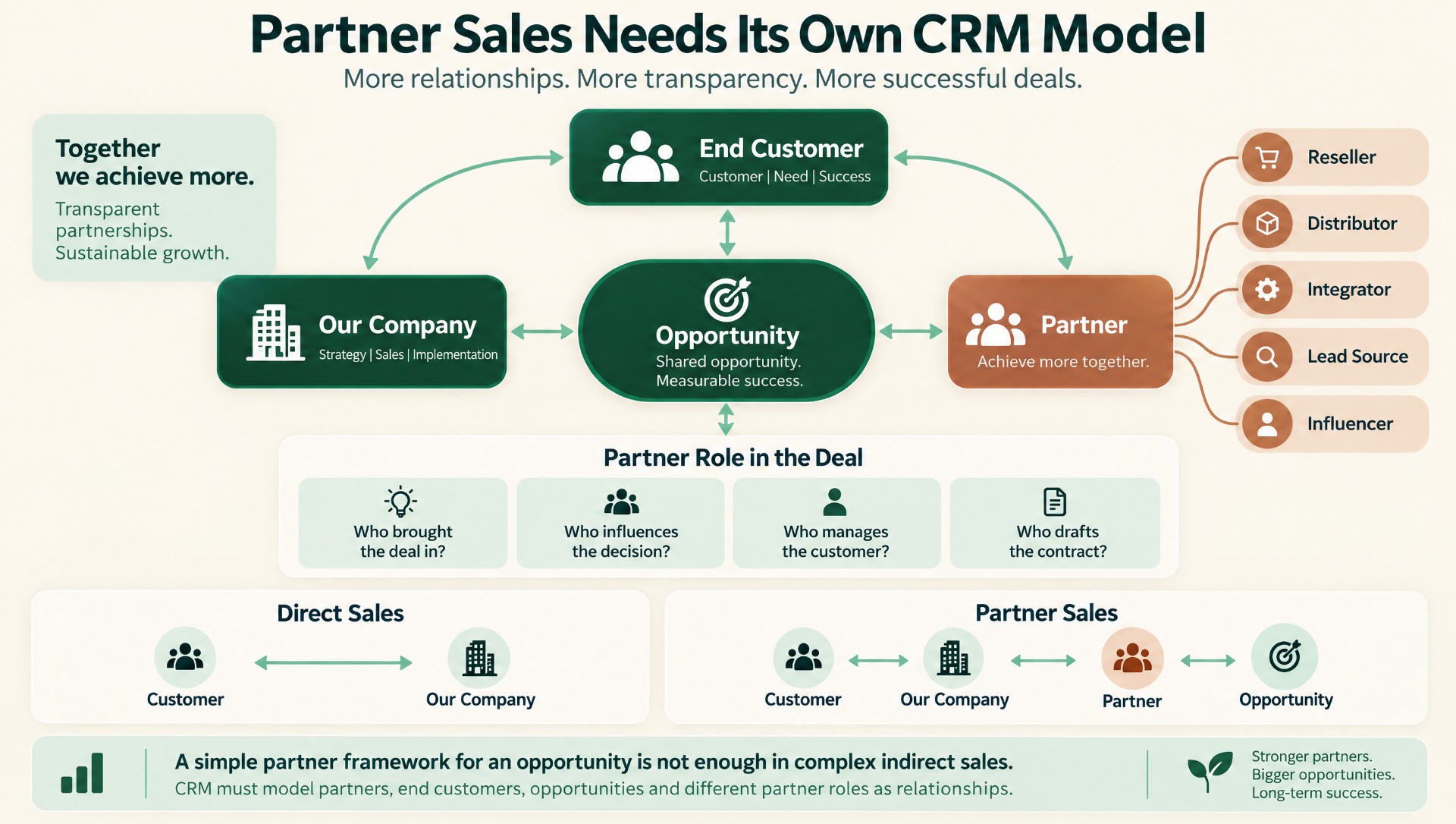
A CRM for partner sales must therefore master three things at once: customer relationships, partner relationships, and joint opportunities.
Partner sales is becoming more important – and at the same time more complex
Partner ecosystems have long ceased to be a sales model for classic software vendors only. Mechanical engineering companies, technology companies, telecommunications providers, and manufacturers with specialist dealer structures also work with different partner types.
At the same time, the boundary between direct and indirect sales is blurring. One partner can deliver a lead, another provides technical consulting, and the contract is ultimately closed directly with the manufacturer.
Therefore, it is no longer sufficient to distinguish only between “direct” and “indirect” revenue.
Current studies show how strongly partner ecosystems are now embedded in B2B sales models:
| Metric | Significance for the CRM process | Source |
|---|---|---|
| 67% of the surveyed B2B channel and partner leaders expect their indirect revenue to grow or grow strongly compared with the previous year. | Partner sales is becoming economically more relevant for many companies and must be managed correspondingly professionally. | Forrester, State of Partner Ecosystems 2025 |
| At the same time, around two thirds expect rising partner-influenced revenue. | A partner does not necessarily have to be the seller to have considerable influence on a deal. | Forrester 2025 |
| B2B buyers now use an average of around ten channels during their buying journey. | The CRM must bring together handovers and information across different direct and indirect touchpoints. | McKinsey Global B2B Pulse |
| A considerable share of B2B revenue is generated with existing customers. | Partner management does not end with the first close, but also concerns expansion, service, and customer success. | Forrester |
This makes it clear: partner sales is not a special case of normal sales. It is an operating model of its own.
In direct sales there is one relationship – in partner sales at least three
In classic direct sales, the model is relatively clear. An account manager looks after a customer. Leads are qualified and converted into opportunities. The opportunity has an owner, an expected revenue, a close probability, and a close date.
In partner sales, a further layer is added.
The company has a relationship with the end customer. At the same time, there is a relationship with the partner. And finally, there is a concrete relationship between partner, customer, and opportunity.
It is precisely this third layer that is not modeled cleanly in many CRM systems.
A field such as “Partner = Muster GmbH” is not sufficient, for example, when a distributor handles the contract, a system integrator has specified the solution, and a local specialist dealer looks after the customer. All three can be relevant for the same revenue – but in completely different ways.
The CRM should therefore not only store which partner is involved, but also what role this partner plays in this deal.
Deal registration becomes the central process
One of the most important processes in partner sales is deal registration.
A partner reports an opportunity. The company checks whether the end customer is already known, whether another partner may already be working on the opportunity, and whether the deal complies with the rules of the partner program.
Only afterward is it decided whether the partner receives protection for this opportunity.
This process should not be handled via email or Excel. The CRM should map the entire decision process traceably.
This is not only about administration. Deal registration prevents one of the biggest conflicts in indirect sales: two partners invest time in the same customer and only learn of each other shortly before the contract is closed.
A good process therefore automatically answers questions such as: who registered the deal first? Does an opportunity already exist? How long does the deal protection apply? Which minimum activity must the partner demonstrate? When does a registration expire again?
This turns an informal agreement into a manageable sales process.
Distinguishing partner-sourced and partner-influenced revenue
The differentiation becomes even more important in revenue analysis.
Partner-sourced revenue means that the partner originally brought in the opportunity.
Partner-influenced revenue, by contrast, means that a partner contributed significantly to the deal, but the opportunity arose, for example, through marketing or your own sales force.
This distinction sounds academic at first. For managing a partner program, however, it is decisive.
A technology partner may, for example, deliver only a few leads of its own but regularly ensure that existing opportunities are won. If the company looks exclusively at partner-sourced revenue, this partner appears not very successful. If, on the other hand, its influence on win rate, sales cycle, and deal size is considered, a completely different picture can emerge.
CRM systems should therefore be able to record partner contributions in a differentiated way.
The forecast must also work differently
A classic sales forecast is typically based on opportunity value, probability, and expected close date. In partner sales, this is often not sufficient.
A partner can, for example, report a deal with a probability of 80 percent even though the manufacturer itself has hardly any direct contact with the end customer. Another partner updates its pipeline only once a month. A third reports every potential inquiry as an opportunity as a precaution.
The same pipeline values thereby have completely different quality.
Additional factors should therefore be taken into account: recency of the partner information, actual customer contact, quote status, technical validation, partner history, and possibly the forecast quality of the respective partner.
The goal is not to fundamentally question partner forecasts. It is about producing a reliable overall forecast from differing information qualities.
Channel conflict must be treated as a process
Channel conflict often only becomes visible once it has already escalated.
Your own sales force is working on a customer while a partner registers a deal at the same time. Two partners claim the same opportunity. An end customer suddenly requests a direct quote, although a specialist dealer has already invested several weeks in the consultation.
Such situations cannot be avoided entirely.
But they can be made transparent.
A CRM can, for example, check whether open opportunities already exist for an account, which partner relationships exist, and when activities last took place. In the event of possible overlaps, workflows can automatically inform the responsible channel manager.
Channel conflict is thereby not resolved by word of mouth, but on the basis of traceable rules.
Partners are accounts themselves – but with a different lifecycle
The partner relationship itself also needs a structured lifecycle.
A potential partner is first identified. Qualification, contract, onboarding, certification, and first joint opportunities follow. Later, business reviews, target agreements, joint marketing activities, or escalations can be added.
This effectively creates a second funnel alongside the actual sales funnel.
Exactly here lies a frequently underestimated strength of a flexible CRM: not only customers, but also business partners can be regarded as systematically developed relationships.
Depending on the business model, resellers, distributors, integrators, technology partners, or referrers can be involved, for example. These partner types take on different tasks and therefore partly require different processes, metrics, and information.
This differentiation should also be visible in the CRM data model.
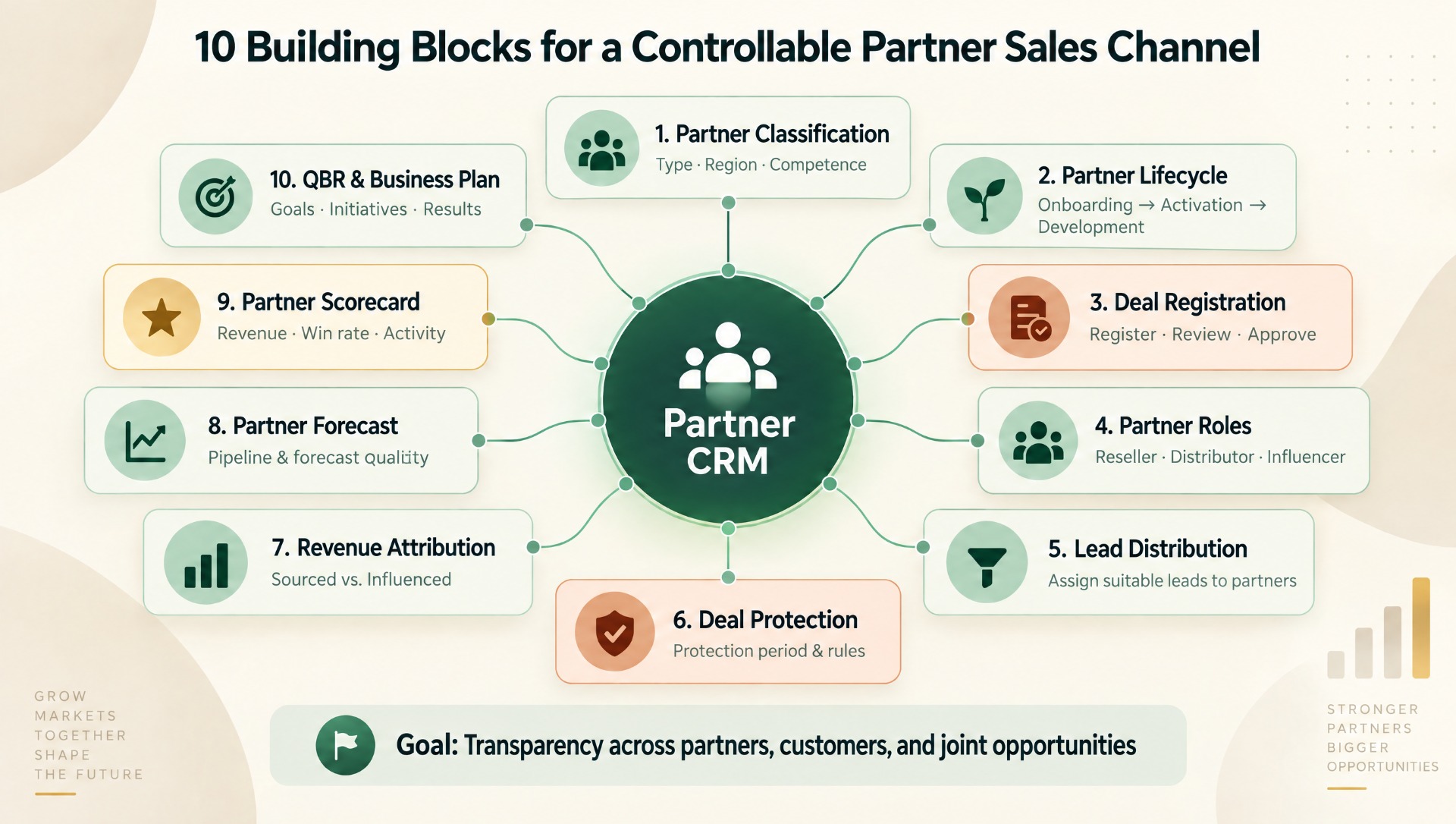
Ten CRM building blocks for manageable partner sales
A good partner sales process does not have to become a complete partner relationship management system straight away. What is decisive at first is to create transparency about the few processes that regularly influence revenue, forecast, or collaboration.
The required functions can then be extended step by step. It is important here that the chosen CRM platform enables such extensions without disproportionately high development effort. The more the partner business and business model grow, the more important this adaptability becomes.
| No. | Building block | Description | Practical benefit |
|---|---|---|---|
| 1 | Partner classification | Structure partners by type, region, industry, competence, and status. | Manage and compare partners in a more targeted way |
| 2 | Partner lifecycle | From prospect through onboarding and activation to the active or inactive partner. | Make partner development transparent |
| 3 | Deal registration | Register, review, and approve new partner opportunities in a structured way. | Reduce conflicts and duplicate work |
| 4 | Partner roles per opportunity | For example lead source, reseller, distributor, integrator, or influencer. | Assess the contribution of individual partners correctly |
| 5 | Lead distribution | Distribute leads based on region, competence, product, or partner status. | Increase response speed |
| 6 | Deal protection | Manage the protection period, conditions, and expiry of registered opportunities. | Create investment security for partners |
| 7 | Partner-sourced / influenced revenue | Measure origin and influence separately. | Assess partner performance more realistically |
| 8 | Partner forecast | Assess the partner pipeline with its own forecast rules and quality indicators. | Improve forecast quality |
| 9 | Partner scorecard | Combine revenue, pipeline, win rate, activity, certifications, and further KPIs. | Manage partner development based on data |
| 10 | QBR / business plan process | Document goals, measures, and results of joint business reviews. | Turn partner administration into real partner development |
The data model determines future viability
Especially in partner sales, it becomes apparent very quickly how flexible a CRM actually is.
A simple data model of accounts, contacts, and opportunities can be entirely sufficient for direct sales. But as soon as several partners are involved in a deal, hold different roles, or partner programs with their own processes are to be built, additional requirements arise.
A CRM should therefore either already come with corresponding structures or be extendable without deep custom development.
What is decisive, for example, is that new objects, relationships, fields, roles, and processes can be added quickly. It should likewise be possible to map different partner types and sales models without having to bend existing standard processes.
This becomes especially important because partner sales rarely stays static.
Today there may be specialist dealers and distributors. Tomorrow, technology partners, implementation partners, or platform providers are added. Business models can change too: a partner that has so far merely referred leads may later take over implementation and support of the customer.
A flexible data model makes it possible to map such developments with the CRM instead of building new isolated solutions for every change.
Which reports really help
In indirect sales, a dashboard showing total revenue alone yields little insight.
More interesting is, for example, the question of which share of the pipeline was generated by partners and which is merely influenced by partners. Equally relevant are conversion rates per partner, the average duration of a deal registration, or the share of registered opportunities without activity within the last 30 days.
Differences between partners also become visible.
One partner may deliver many leads but have a low win rate. Another brings only few opportunities, but these have high deal values and short sales cycles.
Exactly such differences provide the basis for partner development.
A capable CRM should therefore be able to build reports and dashboards not only on individual records. What is decisive is that relationships between partners, customers, opportunities, activities, and revenues can also be analyzed.
The quality of the reporting therefore depends directly on the quality of the data model.
Roles and permissions are especially important
Partner sales almost always means that information has to be shared selectively.
The partner needs information about its opportunities. But it must of course not see a competitor’s pipeline. The channel manager, by contrast, needs an overall view, while a regional sales manager may have to look at both direct and indirect opportunities.
Internal teams also need different permissions.
Here, roles and permissions should be taken into account as early as the process design. A modern CRM should be able to control access in a differentiated way by users, teams, roles, data areas, and, where applicable, individual fields.
Especially when a partner portal or other external access is added later, a clean permission architecture pays off.
Workflows reduce the administrative effort
Partner sales generates many small handovers.
A registration is awaiting approval. A partner has not entered any activity for two weeks. A deal protection is expiring. A new lead has not yet been accepted. An important partner is below its agreed pipeline target.
Such matters should not depend on a channel manager regularly checking Excel lists.
Workflows can monitor deadlines, create tasks, inform responsible owners, and trigger escalations. This gives indirect sales a process quality that has long been taken for granted in direct sales.
This becomes especially interesting when partner data is connected with ERP, quoting, service, and marketing information.
The end customer must nevertheless remain at the center
One of the greatest dangers when building a partner CRM is thinking too strongly from the perspective of your own partner program.
For the customer, however, how the internal sales model is organized is initially irrelevant.
They expect consistent contacts, correct information, and handovers that work.
Despite the partner structure, the CRM should therefore always enable a complete view of the end customer. Sales activities, partner interactions, quotes, service cases, and existing products should be brought together as far as possible.
Only then can you prevent indirect sales from creating new data silos.
Not every CRM is equally suited to complex partner sales
When selecting a CRM platform, partner sales should therefore not be assessed via individual features alone.
More important is the question of how well the system can be adapted to the actual business model.
A manufacturer with a classic specialist dealer network, for example, needs a different structure than a software company with distributors, resellers, technology partners, and implementation partners. A company with a few strategic partners in turn needs different processes than an organization with several hundred sales partners.
A CRM should not have to force such differences through extensive custom programming.
From our perspective, three characteristics are especially important: a flexible data model, quickly adaptable processes, and an open integration architecture.
Ideally, essential building blocks for this are already available as standard. Where additional structures are needed, these should be addable with manageable effort.
Process analysis should therefore always come before technical implementation.
Better to introduce partner sales step by step
We would rarely begin such a process as a large PRM project.
First, it should be clarified where the greatest loss of information or organizational effort currently arises. Often these are deal registration, a missing partner pipeline, or unclear responsibilities.
These processes can be digitalized comparatively quickly.
Afterward, reports and dashboards can be built and first KPIs measured. Only when this basis works do partner scorecards, business planning, portals, or more strongly automated integrations follow, for example.
This keeps the project manageable and delivers measurable benefit early.
Practical example: From an email partner process to a manageable pipeline
A typical example from our project practice can be shown with a mid-sized B2B company with several dozen active sales and integration partners. The specific figures are slightly condensed for anonymization, but we encounter the pattern regularly.
Before the CRM rollout, new partner opportunities were mostly reported by email. The internal channel organization then transferred relevant information manually into various lists. At the same time, the company’s own sales force managed its opportunities separately in the CRM.
The result was predictable: the overall forecast was barely consistent, duplicate opportunities were often detected late, and channel managers spent a considerable part of their time on follow-up questions.
We therefore did not try to map the entire partner program straight away.
In phase 1, only partner accounts, contacts, deal registration, and a binding link between partner, end customer, and opportunity were introduced. In phase 2, approval workflows, deal protection, and partner dashboards were added. In phase 3, partner-sourced revenue, partner-influenced revenue, and the partner scorecard were added.
Already after the first two phases, the manual effort for processing new deal registrations dropped significantly. Potential duplicate registrations became immediately visible. For the first time, the channel manager had a joint pipeline across direct and indirect sales.
Above all, however, the discussion in sales changed.
Instead of talking about who probably owns a deal, the CRM data made it possible to talk about how the deal will be won together.
Exactly therein lies the real benefit of a good partner CRM.
Checklist: Is your CRM suitable for partner sales?
A CRM for indirect sales does not have to contain every possible function from day one. But it should be able to map the fundamental relationships between partner, end customer, and opportunity cleanly.
Clear responsibilities and traceable rules for joint opportunities are equally important. Beyond that, the data model should be flexible enough to add new partner types, roles, and processes later without a fundamental system rebuild.
Only on this basis do reports and forecasts deliver truly reliable statements.
The following checklist is therefore well suited as a first reality check for existing processes.
- Partners are structured and classified by type, status, and competence.
- Partners and end customers are managed as separate relationships.
- Opportunities can be assigned to one or more partners with different roles.
- A defined process for deal registration exists.
- Possible duplicate registrations are detected.
- Deal protection and expiry date are regulated.
- Partner-sourced and partner-influenced revenue are distinguished.
- Partner pipeline and direct pipeline can be viewed separately.
- Forecasts take the quality and recency of partner information into account.
- Leads can be assigned to partners based on traceable rules.
- Response times and open partner leads are measurable.
- Channel conflicts are documented and handled according to defined rules.
- Partners have defined contacts and responsible owners.
- Roles and permissions prevent access to other partners’ data.
- Reports show win rate, pipeline, and revenue per partner.
- Partner development can be tracked over time.
- Recurring tasks are supported by workflows.
- CRM, ERP, quote, and service data produce a consistent customer view.
- The data model can be extended without elaborate custom development.
- New partner roles and sales models can be added quickly.
- Partner processes can be extended step by step.
- The benefit of the rollout is reviewed regularly against previously defined KPIs.
Conclusion: Partner sales needs its own CRM model
Partner sales does not work permanently as direct sales with an additional partner field.
As soon as partners generate leads, influence opportunities, create quotes, look after customers, or sell together with your own sales force, additional relationships and responsibilities arise. These must be visible in the CRM.
The most important foundation is therefore not necessarily a separate PRM system or an extensive partner portal. What is decisive at first is a flexible data model, clear deal processes, automatable workflows, and reliable metrics.
The CRM should not only meet today’s requirements. It must also be quickly adaptable to new partner types, sales models, and processes.
Those who start with this can digitalize partner sales step by step – and turn a sales channel that is often hard to see through into a measurable and manageable pipeline.
Would you like to structure your partner sales or review existing CRM processes?
Together we analyze which processes should be digitalized first and which requirements the CRM data model must meet so that the solution can also grow with the partner business.