Anyone comparing CRM systems usually looks first at the price per user per month. 60 euros, 90 euros, or 150 euros per user are easy to compare and just as easy to extrapolate into an annual budget. Especially with 100 or several hundred users, this quickly creates a seemingly solid basis for a decision. In practice, however, this figure says less and less about what a CRM actually costs.
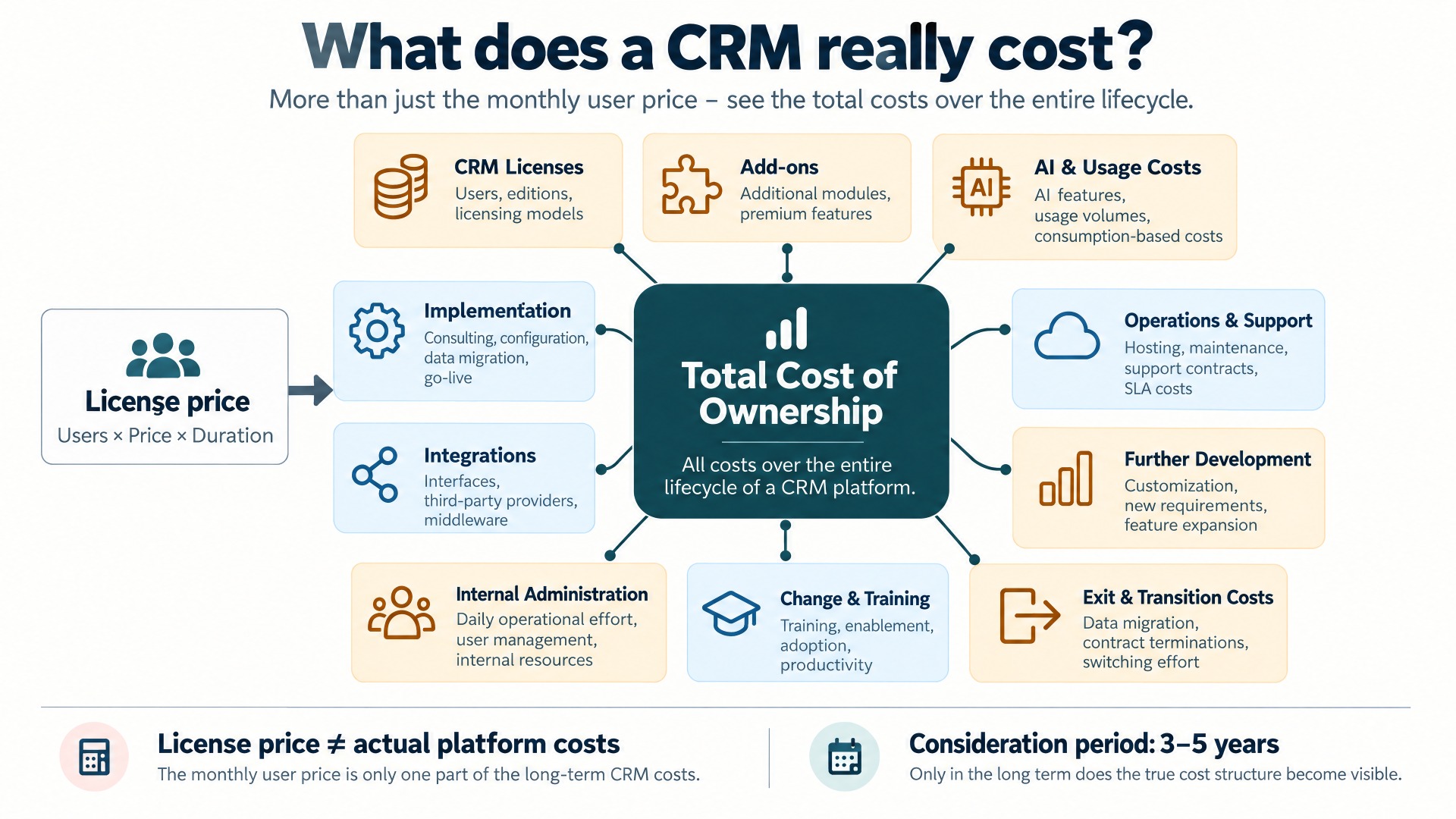
Modern CRM platforms have long consisted of more than user licenses. Added to these are integrations, add-ons, data volume, support, internal administration, and ongoing further development. With artificial intelligence, further cost models are now being added: credits, agent actions, conversations, API usage, or other consumption-based services. The decisive question is therefore no longer only what a license costs, but what it costs to operate the CRM productively and develop it further over several years.
This is exactly where the total cost of ownership – TCO for short – becomes considerably more important than the mere list price.
The license price has always been only part of the equation
Even with classic CRM projects, the price per user was never the whole truth. A system has to be introduced, configured, and adapted to the organization. Data is migrated, roles and permissions are defined, ERP, email, telephony, or marketing are connected, and employees are trained. After go-live, additional requirements arise for reports, dashboards, processes, and automations.
In addition, a CRM usually stays in the company for many years. During this time, products, sales organizations, business units, and IT landscapes change. A new ERP is introduced, a company is acquired, additional countries are added, or customer success takes on a stronger role. The CRM must be able to keep pace with these changes.
CRM is therefore not a one-off software purchase. It is a business platform that must evolve with the organization. How easy or laborious this further development is often influences the actual costs more strongly than a few euros’ difference in the monthly license price.
What is new is the mix of fixed and variable costs
What is currently changing significantly is the way prices are set. Classic user licenses are not disappearing, but they are increasingly being supplemented by consumption-based components. Salesforce, for example, offers usage-based Flex Credits and other models for Agentforce. HubSpot combines seats with credits for various AI functions. Microsoft also works with different licensing and consumption models for Copilot and agent functions.
This creates a pricing logic we already know from cloud infrastructure. Part of the costs is fixed and relatively easy to plan, while another part depends on how intensively certain services are actually used. For companies, this means a fundamental change in budgeting: the number of CRM users alone is no longer sufficient to reliably forecast future costs.
From the customer’s perspective, a hybrid model could therefore make particular sense: a moderate platform fee or low costs per active user, combined with a sufficient base allowance for typical usage such as APIs, automations, and AI functions. Only when this included volume is exceeded do additional usage-based costs arise.
This keeps basic operation predictable. At the same time, the vendor does not have to pass on very intensive usage across all customers as a flat rate. Especially with AI, this combination appears sensible, because the actual costs can vary considerably depending on the model, processing, and intensity of use.
Statistics: AI is changing the pricing logic of SaaS
This development does not only affect CRM. Across the entire SaaS industry, there is currently intensive discussion about how AI functions can be billed in an economically sensible way. Classic subscription models are therefore increasingly being combined with usage-based components. At the same time, many vendors are still experimenting with which billing unit makes the most sense for their respective products.
The following figures come from various studies of the SaaS and AI market. They are therefore not a direct CRM benchmark. They do show, however, that software pricing is moving significantly away from a pure seat model. Hybrid models in particular try to combine predictability for the customer with the usage costs actually incurred by the vendor.
| Observation | Value | Interpretation |
|---|---|---|
| SaaS platforms with AI functions that already charge for them | 86% | AI is increasingly monetized in its own right |
| Vendors expecting further changes to their AI pricing logic | 44% | Many models are still evolving |
| Software vendors with usage-based pricing | 74% | Usage-based components have become widespread |
| AI companies with hybrid pricing | 56% | Subscription plus consumption-based usage |
| AI companies with pure usage-based pricing | 38% | Costs directly tied to usage |
This development is especially relevant for companies that are signing multi-year CRM contracts today. It should not automatically be assumed that credits, allowances, or billing metrics will remain unchanged over the next five years. Transparency and the ability to control actual consumption yourself therefore become all the more important.
What this means specifically for CRM
A company with 100 CRM users was previously able to calculate its software costs relatively easily. License price times users times twelve months provided at least a usable starting point. As soon as agents and automated workflows are added, however, this logic no longer fully fits.
An AI agent can analyze opportunities, answer customer inquiries, or update records. Another creates meeting summaries or researches additional information. The use of these functions can increase regardless of whether 100 or 200 people are logged into the CRM. A company with fewer users but a high degree of automation may therefore generate higher consumption-based costs in future than a larger organization with predominantly manual processes.
This need not be negative at all. What matters is what is saved or improved through this consumption. If an agent completes a task for a manageable amount that previously took an employee ten or twenty minutes, variable billing can be economically very attractive.
The relevant question is therefore not: How many credits are we consuming? Much more interesting is: What does this business transaction cost us with and without automation?
And an account can be linked to several contracts.
Variable costs need transparency – and responsibility on both sides
Usage-based prices are not fundamentally problematic. Especially with AI, they can even be fairer than a flat-rate allocation across all customers. Those who consume little pay less. Those who use AI intensively and may achieve considerable productivity gains as a result bear a correspondingly larger share of the costs actually incurred.
The prerequisite, however, is that these costs remain transparent and controllable. The software vendor should therefore clearly state which services are already included, how consumption is measured, and how it can be tracked at any time. Warning thresholds, quotas, or budgets are equally important so that rising usage becomes visible early.
Responsibility, however, does not lie with the vendor alone. Companies themselves must define which users, processes, and agents may use which resources and how additional consumption is approved. Anyone operating extensive automations must monitor their costs just as they monitor cloud resources, software licenses, or infrastructure today.
An AI agent that generates more consumption is therefore not automatically a cost problem. If it at the same time saves considerably more working time or measurably improves a process, higher variable costs can make economic sense. What matters is that usage and benefit can be compared with each other.
A good pricing model therefore does not create maximum price rigidity, but transparency and controllability. The vendor provides the necessary information and mechanisms for this. The customer bears the responsibility for actively using these options.
From license management to consumption management
This creates a new task for CRM owners. In addition to user numbers and license types, actual consumption increasingly has to be managed as well. The principle has long been familiar from the cloud environment: a basically inexpensive service can become expensive if resources are used in an uncontrolled way. Conversely, variable costs can be very economical if they arise specifically where they generate a measurable benefit.
For CRM, this means that companies should in future monitor more closely which teams, agents, and processes actually use AI functions. This is not about avoiding every automated action as far as possible. Rather, it should be traceable why consumption arises and what business effect it produces.
When negotiating contracts, it is therefore worth talking about more than discounts on user licenses. Equally important are sufficiently sized base allowances, transparent consumption units, and the ability to set up alerts or quotas. For very intensive usage, it should also be clearly regulated who in the company may approve additional capacity.
In this way, classic license management increasingly develops into consumption management.
What really belongs in a CRM TCO?
Anyone who wants to compare CRMs seriously should not only try to determine the monthly software price as precisely as possible. It makes more sense to look at all major cost blocks over a period of at least three, preferably five years. This includes not only invoices from software vendors or implementation partners, but also internal resources and the effort of future changes.
It is also important to calculate different scenarios. How does the TCO change when the organization grows? What happens with more intensive use of AI? What costs arise when further business units are integrated? And how flexibly can the system be changed if processes look different in two or three years than they do today?
Such an analysis does not provide a forecast accurate to the euro. But it creates a much better basis for decisions than the mere price per user.
Ten cost items that belong in a CRM TCO
For a reliable calculation, the major cost types should first be made visible. The aim is not to include as many items as possible, but to identify the factors that are actually relevant during the planned period of use. Especially with CRM, one-off project costs are often planned in great detail, while ongoing administration and further development are only roughly taken into account. At the same time, consumption-based costs are gaining importance through AI and automation. Possible switching costs should also be considered early, because strong technical dependencies can affect long-term cost-effectiveness.
| No. | Cost item | Description |
|---|---|---|
| 1 | CRM licenses | User licenses, editions, minimum quantities, and contract terms |
| 2 | Add-ons | Telephony, marketing, CPQ, e-signatures, service, or other specialized functions |
| 3 | AI and usage costs | Credits, agent actions, conversations, API usage, or external AI models |
| 4 | Implementation | Design, configuration, customizing, project management, and testing |
| 5 | Data migration | Data cleansing, mapping, import, duplicate checking, and quality assurance |
| 6 | Integrations | ERP, email, calendar, telephony, DMS, marketing, and other systems |
| 7 | Operations and support | Administration, monitoring, updates, releases, and troubleshooting |
| 8 | Further development | New processes, reports, dashboards, and automations |
| 9 | Change and training | Training, documentation, communication, and adoption |
| 10 | Exit and switching costs | Data export, replacement of integrations, and later migration |
The last point in particular is often only considered when a system is actually about to be replaced. But a sound TCO also includes the question of how easily data, processes, and integrations can later be extracted from a platform again.
An example with 100 CRM users
Let us take a company with 100 active CRM users and an assumed average license price of 80 euros per user per month. The first calculation is simple: 100 users result in 96,000 euros of license costs per year and thus 480,000 euros over a period of five years.
This figure is correct, but it describes only part of the actual costs. Added to this are implementation, integrations, add-ons, ongoing operation, and internal administration. If AI functions are also increasingly used, an additional variable cost block arises.
An example five-year view could therefore look like this:
| Cost item | 5 years |
|---|---|
| CRM licenses | €480,000 |
| Initial implementation | €80,000 |
| Integrations and further development | €70,000 |
| Add-ons | €120,000 |
| AI, API, and usage services | €75,000 |
| Internal administration | €225,000 |
| Training and change | €30,000 |
| Further services, storage, and operations | €25,000 |
| Total | €1,105,000 |
The figures are deliberately a sample calculation and not a market benchmark. But they show how strongly license costs and actual platform costs can differ. A CRM with 480,000 euros in license costs can easily turn into a total investment of more than one million euros over five years.
That alone makes the CRM neither expensive nor inexpensive. What matters is the measurable economic benefit this investment generates.
The cheapest CRM is not automatically the most economical
One system costs, for example, 60 euros per user, another 100 euros. With 100 users, this already results in a difference of 48,000 euros per year. On paper, the decision seems to be made quickly.
In practice, however, the cheaper system may need additional integrations, cause higher administration effort, or require further products for certain functions. Perhaps data is regularly transferred manually between two systems, or reports have to be built via a separate BI solution. Conversely, an extensive platform with a significantly higher price is not automatically economical either if a large part of its functions is never used.
Therefore, the comparison should not only be about which product delivers more functions at a lower list price. What matters is which platform reliably supports the required processes with as little unnecessary complexity as possible.
The target architecture matters more than the feature list
Especially in larger organizations, it should therefore be clarified before product selection what the future CRM landscape should look like. Which information belongs in the CRM, which in the ERP? Where are documents managed? What role do marketing, customer success, and service play? Which systems deliver product or usage data, and which integrations are truly business-critical?
In industrial B2B sales, for example, a stable ERP integration can be much more important than an extensive marketing suite. For a SaaS provider, customer success, subscription management, and usage data may carry more weight. In service, in turn, ticketing, SLA management, communication channels, and knowledge management are in the foreground.
A sensible CRM comparison therefore does not begin with 300 feature checkboxes in an Excel spreadsheet. It begins with a clear idea of which processes and data the organization will need in the coming years.
Customizing can cause costs – but also save costs
Customizing also deserves a differentiated view. Individual adaptations are often regarded as cost drivers in principle. Yet a sensibly developed automation can achieve exactly the opposite if it reduces recurring manual work every day.
Customizing only becomes problematic when adaptations are made without a clear architecture and long-term objective. Over the years, additional fields, special processes, individual extensions, and exceptions accumulate. Changes thereby become more laborious, testing more extensive, and updates more difficult. The system still works, but becomes less agile with every adaptation.
This technical and process-related legacy – often referred to as technical debt – also belongs in a long-term cost analysis. For every adaptation, the question should therefore be not only what its development costs today, but also what maintenance and further development effort it will generate in the coming years.
Internal effort is a real cost block
Moreover, a CRM does not run itself. Users and permissions must be managed, data quality monitored, and requirements from the business units assessed. Reports change, processes are adjusted, and new employees need support.
In larger organizations, sales operations, IT, business units, and sometimes data protection or information security are often involved in addition to the actual CRM administrator. This work is necessary and creates considerable value, but it is often not taken into account in the original CRM calculation.
If, for example, an internal CRM owner spends a large part of their working time on administration, support, and further development, this effort belongs in the TCO. Over five years, this item can be higher than individual software modules or integrations.
Software vendors’ cost structures are changing too
The new pricing logic is not just a question of marketing. AI is also changing the cost structure on the side of software vendors. A classic SaaS product also incurs infrastructure costs, but these do not necessarily rise proportionally with every single user action. With generative AI, it is different: model calls, computing power, and the processing of large data volumes can cause direct variable costs.
At the same time, established software companies in particular face an additional challenge. Over many years or decades, large sales organizations, complex product portfolios, partner structures, support organizations, and technical legacy have in some cases emerged. These structures were often built on the basis of high, easily predictable recurring license revenues.
This does not mean that large vendors fundamentally work inefficiently. But their starting position is different from that of a young SaaS or AI provider that was able to align its architecture and organization with more automated operations from the outset.
AI is therefore likely to change not only products, but also the software vendors themselves. Development, testing, support, documentation, and parts of sales and consulting can become more productive. In the long term, this will probably also increase the pressure to pass on at least part of this efficiency to customers.
For the customer, however, a vendor’s internal cost structure is only relevant to a limited extent. Ultimately, what matters is whether price, performance, and flexibility are right compared with the available alternatives.
More choice strengthens the customer’s position
This development can be positive for mid-sized companies in particular. Alongside the large platform vendors, specialized SaaS solutions, open CRM platforms, and increasingly new AI-based services are available today. APIs and more open architectures also make it easier to combine individual functions instead of having to cover all requirements with a single vendor.
This also changes conversations with software vendors. When selecting a new CRM, it should not simply be assumed that the publicly visible price list represents the final commercial model. Especially with 50, 100, or several hundred users, it is worth talking to vendors specifically about usage, growth, and planned automation.
This should not be only about a discount on today’s user price. Much more important is the question of which services are already included, which usage is charged additionally, and how transparently future consumption can be monitored.
For a multi-year contract, it should therefore ideally already be clear today how additional AI usage, APIs, or automated processes will basically be billed. No one can seriously guarantee what AI costs will look like in five years. But it is certainly possible to agree on how transparently changes will be communicated and what options the customer has to monitor and control its consumption.
The next step: from usage-based to outcome-based pricing
The development becomes even more interesting where software is no longer billed by access or technical usage, but by an outcome. Conceivable examples are a resolved service case, a qualified lead, or a fully completed task.
For CRM, this could mean in the long term that it no longer matters how many users, tokens, or individual actions were used. Instead, successfully handled service cases, enriched records, or completed automated processes could be billed.
For customers, this initially sounds attractive, because costs and benefits move closer together. At the same time, however, a new challenge arises: what exactly is a successful outcome? An automatically closed service case has no value if the customer’s request was not actually resolved. An automatically qualified lead is only valuable if its quality is right.
Outcome-based pricing is therefore unlikely to simply replace classic license and usage models. Here too, a combination of different models is more likely.
Costs per business transaction are becoming more interesting than costs per user
This also changes the metric by which CRM cost-effectiveness should be assessed. In addition to costs per user, the costs of a specific business process are becoming increasingly interesting.
Instead of looking exclusively at “CRM costs per user”, costs per opportunity, qualified lead, service case, or renewal can be calculated, for example. In sales, the question of how much CRM and automation effort is incurred per won order may even be relevant.
This links technology directly to the business result. Especially with AI agents, this is much more meaningful than the mere number of credits consumed. If an agent handles several hundred service cases a month, it does not matter how many user licenses are behind it. What is relevant are costs, processing time, resolution rate, and quality.
Practical example: Simplify first, then automate
A typical pattern from a CRM project in a B2B environment shows why this perspective makes sense. The company worked with just under 100 active CRM users and had built up numerous fields, reports, integrations, and individual workflows over several years. At the same time, important information continued to be maintained via Excel and email. Instead of replacing the platform completely, the modernization was therefore deliberately split into several manageable phases.
In the first phase, the data model, roles, and central sales processes were cleaned up. Fields and special processes that were no longer needed were removed, and the metrics for pipeline and data quality were standardized. After that, ERP and communication processes were integrated in a stable way. Only in the next phase were additional automations and AI-supported functions added.
With this approach, the changes could be measured after each phase. Preparation for the regular pipeline review was reduced significantly, opportunities were maintained more completely, and the effort for subsequent data corrections decreased. At the same time, further automations could be built specifically where a high manual effort had already been demonstrated.
The economic advantage therefore did not arise from a lower license price. It arose above all from less complexity, faster workflows, and lower ongoing effort. This is exactly why a phased and agile CRM rollout is often more economical than a large big bang, in which benefits and costs can only be assessed after a long project period.
CRM therefore needs a business case
In the end, a CRM project should have not only an IT budget, but a business case. A budget answers the question of how much the platform costs. The business case additionally asks what specifically improves through its use.
This can be less administrative work, faster sales processes, higher data quality, or more predictable forecasts. An improvement in the win rate, shorter processing times in service, or the ability to handle a larger business volume with the same team can also be relevant measures.
It is important to define these goals as far as possible before the rollout and then review them regularly. Only then can it be judged whether higher license or usage costs are actually problematic or whether they are offset by a considerably greater economic benefit.
What companies should check in their next CRM calculation
A reliable CRM calculation does not begin with the price list, but with the planned use of the platform. Companies should know which user groups will use the CRM, which systems will be integrated, and which processes are to be automated in future. In addition, it should be clarified early which consumption-based components exist and how their usage can be monitored. A period of three to five years provides a much more realistic basis than looking at the first contract year. And finally, the expected costs must always be weighed against a measurable benefit.
Responsibility for variable costs should also be regulated before productive use. A company needs clear responsibilities for who defines quotas, receives alerts, and approves additional consumption. Consumption management must not be understood merely as a purchasing topic; it belongs jointly in the responsibility of IT, the business unit, and, where applicable, finance. Only then can technical usage and economic benefit be brought together sensibly.
Before a decision, at least the following points should therefore be answered:
- Have all required user roles and license types been taken into account?
- Which functions require additional add-ons?
- Are there minimum quantities, terms, or contractual commitments?
- Which AI, credit, API, or transaction costs can arise?
- Which base allowances are already included in the license?
- Can current consumption be tracked transparently at any time?
- Can quotas, budgets, and warning thresholds be defined?
- Who receives notifications when defined consumption limits are reached?
- Who may approve additional consumption internally?
- Which data or storage limits apply?
- How are ERP, email, telephony, and other systems integrated?
- What one-off implementation and migration costs arise?
- How high is the ongoing internal administration effort?
- What costs arise for support and further development?
- How do costs develop with additional users or business units?
- How laborious would a later platform switch be?
- Which processes are to become measurably faster or cheaper?
- Which KPIs show whether the CRM investment actually pays off?
- Is the TCO reviewed regularly and compared with actual usage?
Conclusion: The user price is not what decides
The price per user remains a relevant figure, but as the sole basis for comparison it loses significant meaning. Modern CRM platforms are becoming more integrated, more automated, and increasingly billed via a combination of classic licenses and consumption-based services. AI is accelerating this development considerably once again.
A hybrid model can certainly be in the interest of both sides: a predictable base price that sensibly covers normal usage, supplemented by variable costs where additional consumption actually arises. The prerequisite, however, is that this usage remains transparent and that the customer can actively control it. Responsibility for this does not lie with the software vendor alone.
For companies, this means that not only the purchase, but the entire operation over several years must be considered. This includes licenses as well as integrations, further development, internal resources, and AI and usage costs. At the same time, this effort must be weighed against the actual benefit.
A CRM for 100 euros per user can be more economical than one for 60 euros if it supports processes better and generates less ongoing effort. Conversely, a simpler system can be entirely sufficient if it fits the organization and can be operated without unnecessary complexity.
The decisive question in future is therefore no longer only:
“What does our CRM cost per user?”
But rather:
“What does our customer process cost us – and what measurable contribution does the CRM make to it?”